
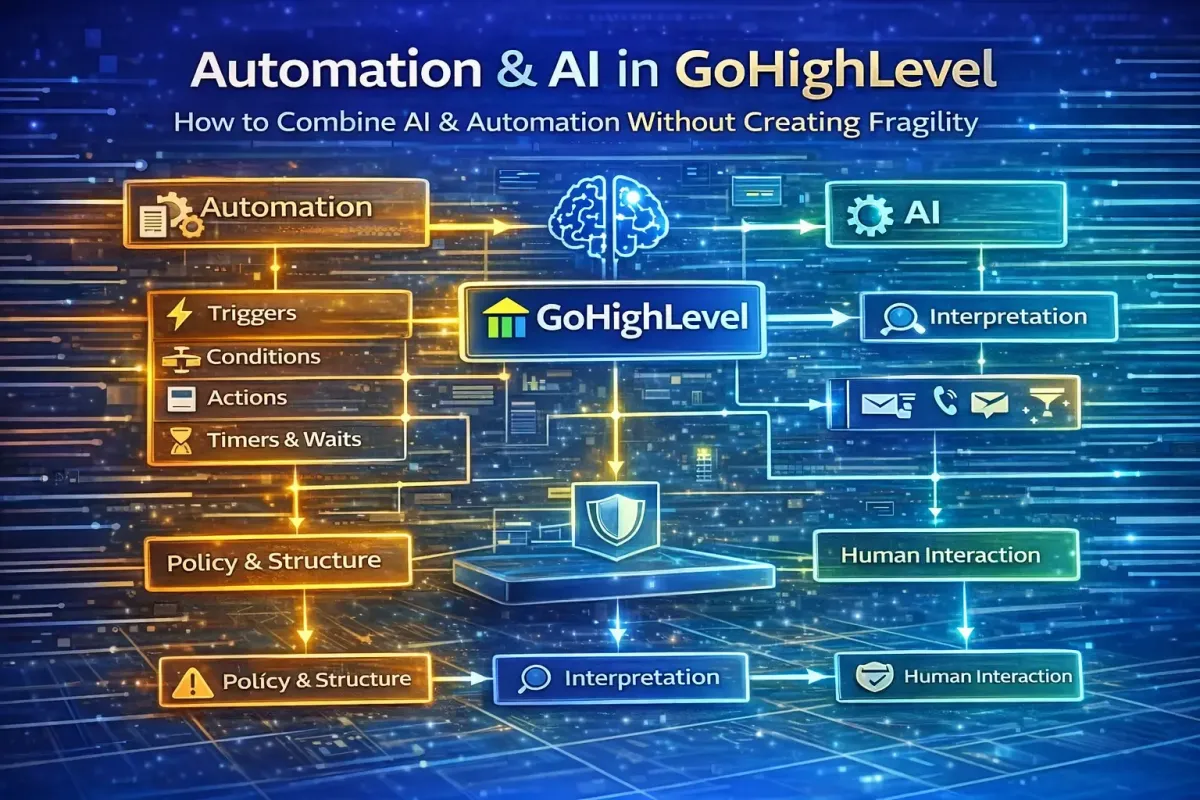
Automation Versus AI inside HighLevel
Go High Level (GHL) provides two distinct but complementary capabilities that are often misunderstood, misapplied, or incorrectly blended:
Automation: deterministic, rule-based execution of predefined business logic
AI: probabilistic, language-driven interpretation and generation
Most underperforming GHL accounts do not fail because they lack AI. They fail because their automation foundations are weak, inconsistent, or unmanaged. Conversely, many technically sophisticated accounts collapse under their own complexity because they attempt to use automation to replicate judgment—something it was never designed to do.
The highest-performing GHL implementations use a clear separation of responsibilities:
Automation for structure, compliance, and scale
AI for interpretation, adaptation, and human-like interaction
This guide explains the difference precisely, shows where most accounts go wrong, and outlines a future-proof architectural model for using automation and AI together—without fragility.
1. Automation vs AI: Two Fundamentally Different Systems
Before discussing features, pricing, or use cases, it is critical to understand that automation and AI solve different classes of problems.
Automation and AI are not competing technologies inside Go High Level. They are different layers of the same operating system.
Automation answers the question:
“What should happen when X occurs?”
AI answers a different question:
“What does this mean, and how should it be responded to?”
Confusing these roles is the root cause of most broken GHL accounts.

2. What “Automation” Means Inside Go High Level
Definition (GHL Context)
Automation in Go High Level refers to explicit, rule-based workflows that execute predefined actions when specific conditions are met.
Automation does not reason.
Automation does not interpret.
Automation executes.
If the same inputs are provided, the outcome is identical every time.
Core Automation Components in GHL
Automation inside GHL is constructed using a small number of deterministic building blocks:
Triggers initiate workflows when events occur, such as form submissions, tag additions, stage changes, or inbound messages
Conditions evaluate Boolean logic using if/else rules, filters, and comparisons
Actions perform predictable outcomes such as sending messages, moving pipeline stages, applying tags, or creating tasks
Timers and waits control sequencing, delays, and business-hour constraints
Branching logic routes contacts down predefined paths
These components form the infrastructure layer of the platform.
Examples of Pure Automation
Pure automation scenarios include:
When a form is submitted, move the contact to a defined pipeline stage
If no reply occurs within three days, send a reminder SMS
When a tag indicating high intent is applied, assign an owner
If an appointment is missed, enter a no-show recovery sequence
In each case, the behaviour is predictable, auditable, and repeatable.
Strengths of Automation
Automation excels at:
Predictability and consistency
Auditability and traceability
GDPR-safe execution and explainability
Scaling across tens of thousands of contacts
Enforcing compliance, timing rules, and ownership
Straightforward testing and debugging
Automation is infrastructure. Infrastructure must be reliable.
Limitations of Automation
Automation fails when asked to:
Interpret free-text responses
Handle ambiguity or nuance
Adapt to novel phrasing or emotional context
Scale decision trees beyond simple logic
Handle edge cases without exponential branching
Automation becomes brittle when over-extended. It is not intelligence—it is execution.

3. What “AI” Means Inside Go High Level
Definition (GHL Context)
AI in Go High Level refers primarily to large language model (LLM)-powered systems that interpret natural language, infer intent, and generate contextually appropriate responses.
AI does not reliably execute business logic.
AI interprets and responds probabilistically.
The same input can yield slightly different outputs depending on context.
Core AI Capabilities in GHL
AI features in GHL are designed to sit at the interaction layer, not the infrastructure layer. They include:
Conversational messaging across SMS, chat, and social platforms
Voice-based interaction and call handling
Natural language lead qualification
Content generation for emails, reviews, funnels, and summaries
Workflow assistance and automation guidance
AI excels where inputs are messy, human, or ambiguous.
Examples of Effective AI Usage
AI is well-suited to:
Interpreting why a lead is hesitant rather than simply that they are hesitant
Responding differently to pricing objections versus timing objections
Summarising long chat or call histories
Understanding unstructured enquiries
Handling conversational booking and rescheduling
AI absorbs variability that would otherwise explode automation complexity.
Strengths of AI
AI provides:
Flexibility in handling real-world language
Reduced manual conversation handling
Improved tone, empathy, and engagement
Graceful handling of edge cases
Faster response times at scale
AI is adaptive—but not deterministic.
Limitations of AI
AI introduces risk if misapplied:
Outputs are non-deterministic
Responses require strong prompt governance
Behaviour is harder to audit and explain
Errors compound if AI is allowed to execute logic directly
Compliance risk increases without constraints
AI must be guided. Unconstrained AI amplifies risk.

4. The Core Insight: Automation Enforces Policy, AI Handles Exceptions
This distinction is the most important principle in this guide.
Automation is best used to enforce what must happen.
AI is best used to interpret what is happening.
Trying to reverse these roles creates fragile systems.
5. Where Most Go High-Level Accounts Go Wrong
Failure Pattern One: AI Layered on Broken Automation
Common symptoms include:
Undefined or inconsistent pipelines
Inconsistent tagging
Multiple triggers are firing unpredictably
No clear ownership model
AI does not fix chaos. AI amplifies it.
Without a clean structure, AI outputs become noisy and unreliable.
Failure Pattern Two: Automation Attempting to Replace Judgment
This typically manifests as:
Twenty-branch workflows to handle objections
Over-engineered decision trees
Hundreds of tags and conditional paths
Workflow sprawl that no one can maintain
This creates technical debt and brittleness.
Automation cannot reason—it can only route.
Failure Pattern Three: AI Given Too Much Authority
High-risk patterns include:
AI is moving pipeline stages autonomously
AI sending pricing or contractual terms
AI closing loops without validation
This introduces compliance, reputational, and commercial risk.

6. The Correct Architectural Model
Principle: Automation Owns State, AI Owns Interpretation
The most resilient GHL architectures follow a layered model.
Layer One: Data and Structure (Automation)
This layer defines truth and state:
Pipelines and stages
Tags and classifications
Ownership rules
Timing constraints
SLA enforcement
This layer must be deterministic and stable.
Layer Two: Interpretation (AI)
This layer interprets human input:
Message intent classification
Objection detection
Urgency assessment
Context summarisation
AI informs the system—it does not control it.
Layer Three: Execution (Automation)
Automation resumes control:
Routing leads
Triggering sequences
Assigning tasks
Escalating to humans
AI classifies.
Automation executes.
7. Practical Use Cases Done Correctly
Lead Reply Handling
First, automation captures the inbound message and metadata.
Next, AI interprets intent—such as pricing enquiry, objection, readiness to book, or general question.
Finally, automation routes the lead into the correct workflow, calendar flow, or human escalation.
The system remains auditable, scalable, and compliant.
No-Show Management
Automation detects the no-show event.
AI generates an empathetic, brand-aligned follow-up message.
Automation enforces timing, retries, and escalation logic.
Tone is flexible.
Logic remains fixed.
Reputation Management
Automation monitors for new reviews.
AI drafts a context-appropriate response.
Automation posts the reply and logs it in the CRM.
Consistency is maintained without manual effort.
8. Governance, Risk, and Compliance
Automation Governance
Strong automation governance includes:
Versioned workflows
Documented triggers and outcomes
Minimal branching
Clear ownership and responsibility
Automation should be boring. Boring is good.
AI Governance
AI governance requires:
Prompt version control
Defined scope of authority
Human override paths
Logging and review
A useful rule of thumb:
AI can speak. Automation decides.
9. Measurement and Optimisation
Automation Performance Metrics
Automation should be evaluated using:
Lead response time
Stage progression rates
Drop-off points
SLA adherence
These are operational metrics.
AI Performance Metrics
AI should be evaluated on:
Conversation resolution rate
Human handoff frequency
Booking completion post-interaction
Sentiment and response quality
AI must always be measured in the context of automation outcomes.
10. Forward-Looking View: 2026 and Beyond
As Go High Level continues expanding its native AI capabilities:
Automation discipline becomes more important, not less
Clean data architecture becomes a competitive advantage
AI increasingly recommends rather than decides
Agencies with governance outperform AI-heavy but structurally weak competitors
AI accelerates systems. It does not replace systems.
Final Takeaway
Automation and AI are not competitors inside Go High Level.
They are different layers of the same operating model.
Automation provides reliability, compliance, and scale
AI provides interpretation, adaptability, and human-like interaction
When combined intentionally:
Automation prevents chaos
AI absorbs complexity
The system scales without becoming fragile
The future of high-performing GHL accounts is not more AI.
It is better automation, augmented by AI in precisely the right places.