
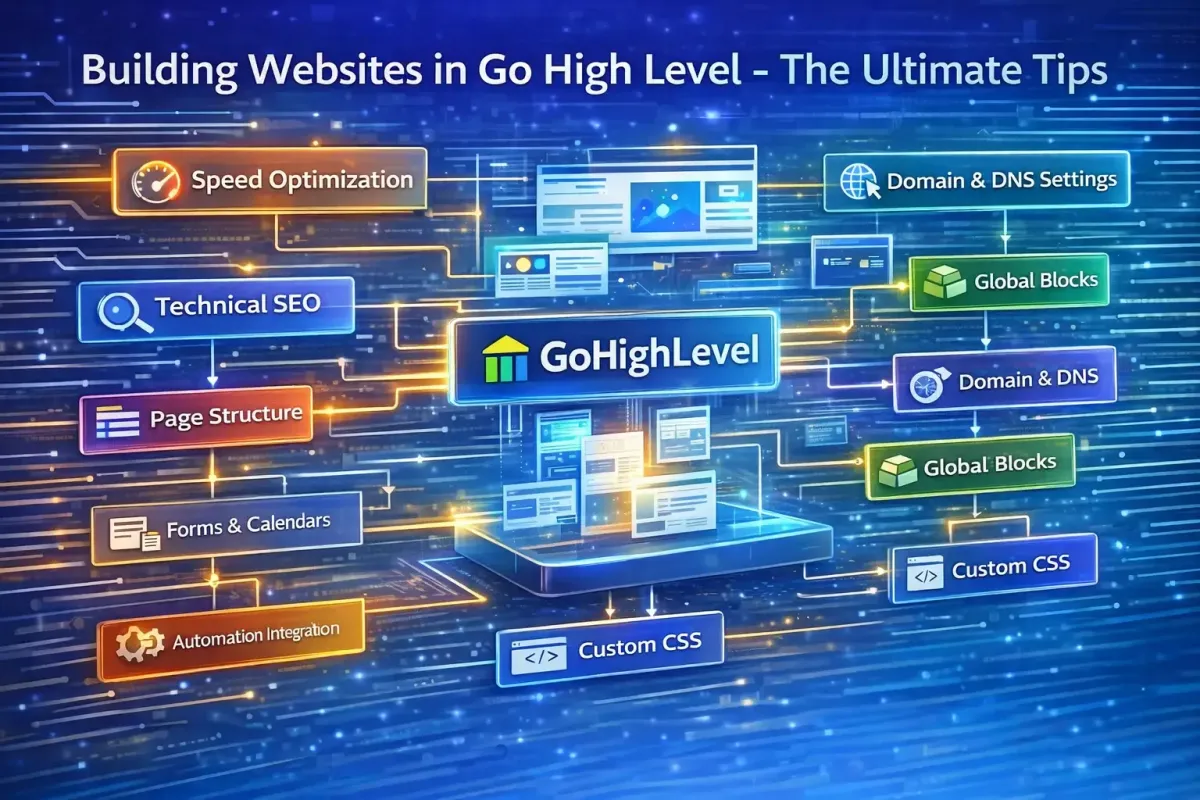
Building Websites in HighLevel - The Ultimate Tips
Building a website in Go HighLevel (GHL) is fundamentally different from building one in WordPress, Webflow, or Squarespace.
Not because GHL is weaker—but because it is designed for conversion, automation, and revenue operations, not traditional content management.
This distinction is where most GHL websites succeed or fail.
WordPress actively nudges users toward best practices through plugins, themes, and guardrails. GHL does not. It gives you power, flexibility, and speed—but very little protection from architectural mistakes. Poor decisions compound quickly. Good decisions scale quietly.
This guide is written for agencies, operators, and growth-focused businesses that want to build GHL websites that are:
Fast and technically sound
Conversion-driven by design
Automation-safe at scale
Governed, not improvised
Future-proofed for multi-location, SaaS mode, and AI-driven workflows
This is not a beginner tutorial. It is a systems-level blueprint.
1. Start With Architecture, Not Pages
The single most common failure pattern in GHL websites is design-first thinking.
Before you touch a section, template, or funnel, you must define the operating model the website supports.
Clarify the website’s role
Every GHL website should clearly fall into one of the following categories:
Marketing-led: Lead capture, education, authority
Sales-led: Appointment booking, qualification, pipelines
Service-led: Support, onboarding, client access
Multi-role: Marketing + sales + service (most agency sites)
If you cannot state the primary role in one sentence, the site will drift.
Map pages to systems, not aesthetics
A scalable GHL website maps to:
Pipelines
Lifecycle stages
Workflows
Data models
Not just navigation menus.
For example:
A “Contact” page is meaningless without knowing which pipeline, stage, and automation logic it feeds.
A “Book a Call” page must be designed around calendar logic, not visual layout.
Forward-thinking rule: treat the website as an interface layer to your revenue operating system, not as a marketing brochure.

2. Domains, Subdomains, and DNS Discipline
Poor domain strategy creates SEO issues, attribution errors, and automation blind spots.
Best-practice domain structure
For most businesses and agencies:
www.domain.com→ Core website (SEO, authority)go.domain.comorfunnels.domain.com→ Funnels & paid trafficapp.domain.com→ Client access / portals (if applicable)
Avoid using funnel domains as your primary website domain. Funnels and websites have different objectives and lifecycle expectations.
DNS hygiene matters
Ensure SSL is fully propagated before publishing pages
Document DNS ownership (critical in agency environments)
Avoid mixing legacy platforms (HubSpot, WordPress) DNS records unless unavoidable
Do not reuse the same domain for experiments, tests, and live assets
DNS mistakes are silent, expensive, and difficult to unwind later.
3. Page Structure: Discipline Beats Creativity
GHL’s flexibility encourages over-building. Resist it.
One objective per page
Not per site—per page.
Every page should answer:
Who is this for?
What problem does it address?
What is the next action?
If a page tries to do three things, it will do none well.
Proven structural hierarchy
High-converting GHL pages consistently follow:
Hero: Clear value + CTA (5-second rule)
Problem articulation
Solution positioning
Proof (social, authority, data)
Call to action (repeated, consistent)
Avoid “section sprawl”—stacking blocks because they look good rather than because they advance the narrative.
4. Global Styles and Reusability Are Non-Negotiable
Rebuilding the same components repeatedly is operational debt.
Configure global styles first
Before creating pages:
Fonts (max two families)
Heading hierarchy
Button styles
Brand colours + neutrals
Inline styling should be the exception, not the norm.
Use global sections aggressively
Headers, footers, CTAs, and trust blocks should be:
Global
Reusable
Centrally governed
Scalability rule: if a section cannot be reused, it should not be custom-built.
5. Speed and Performance Optimisation (Often Ignored)
GHL sites can become bloated quickly if performance is not treated as a first-class concern.
Image discipline
Never upload raw images
Compress before upload (WebP preferred)
Aim for <200KB per image where possible
GHL does not aggressively compress assets for you.
Platform toggles you must enable
In Funnels / Websites settings:
Image optimisation: ON
JavaScript optimisation: ON
Avoid performance killers
Video backgrounds above the fold
Excessive animations
Heavy third-party scripts
Multiple font libraries
Design elegance is meaningless if the page does not load quickly on mobile.
6. Mobile-First Is Mandatory, Not Optional
Most GHL traffic—and most conversions—are mobile. (Except business-to-business traffic).
Design for thumbs, not cursors
Large tap targets
Minimal form fields
Clear spacing
Predictable CTA placement
Never rely on hover states or desktop-only interactions.
Do not “hide” your way to mobile optimisation
Hiding large desktop sections on mobile often creates:
Content gaps
Broken narratives
SEO inconsistencies
Instead, restructure sections specifically for mobile consumption.

7. Forms, Calendars, and Conversion Logic
This is where GHL outperforms traditional website builders—if implemented correctly.
Always use native GHL forms
Native forms:
Load faster
Trigger workflows natively
Maintain clean data structures
Third-party embeds undermine GHL’s biggest advantage.
Every form must map to a system
Each form submission should explicitly connect to:
A pipeline
A lifecycle stage
One or more workflows
Hidden fields should capture:
Source
Campaign
Page or funnel name
Calendar embeds reduce friction
Do not send users elsewhere to book.
Embed calendars directly
Confirm bookings with automation
Handle no-shows programmatically
8. Automation-Safe Website Design
Pages should never assume automation works perfectly.
Design defensively.
Account for real-world behaviour
Duplicate submissions
Partial form completions
Returning visitors
Cross-device sessions
Trigger workflows based on events, not page visits alone.
Separate concerns
Never tightly couple:
Visual design
Automation logic
Data processing
Loose coupling = resilience.
9. Technical SEO: Manual by Default
GHL does not prompt you to do SEO correctly. You must be deliberate.
Mandatory per-page settings
For every indexable page:
Title tag (≤70 characters)
Meta description (≤155 characters, with CTA)
Open Graph image (1200×630)
Clean, stable URL slug
Canonical control matters
If similar pages exist:
Use canonical links
Avoid duplicate content penalties
Indexation discipline
Do not index:
Funnels
Thank-you pages
Internal tools
Utility pages
GHL is powerful, but it is not a WordPress SEO replacement for large content operations.
10. Funnels vs Websites: A Critical Distinction
Many underperforming GHL accounts blur this line.
Websites are for:
Discovery
Trust
Authority
Education
Funnels are for:
Conversion
Velocity
Controlled journeys
Do not build websites like funnels. Do not build funnels like websites. Each has a role in a scalable revenue system.
11. Governance, Versioning, and Change Management
As sites scale, governance becomes more important than creativity.
Essential governance practices
Version pages before major changes
Document:
Page purpose
Connected workflows
Conversion logic
Restrict editor access
Maintain a page-to-automation dependency map
Uncontrolled edits are one of the fastest ways to break high-performing systems.
12. Analytics, Tracking, and Attribution
Tracking should be infrastructure, not an afterthought.
Best practices
Install tracking scripts globally
Use consistent event naming
Prefer conversion events over page views
Ensure form data flows cleanly into reporting fields
A website without reliable attribution is a guessing machine.
13. Multi-Location and SaaS Mode Considerations
If you plan to clone or scale:
Never hardcode names, addresses, or phone numbers
Use custom values everywhere
Avoid location-specific logic in global assets
Test snapshots in clean sub-accounts before rollout
Design once. Deploy many times.
14. Common Failure Patterns to Avoid
Across hundreds of GHL builds, the same issues recur:
Designing before defining workflows
Over-engineering early pages
Mixing website and funnel responsibilities
Ignoring data hygiene
Treating GHL as “just a page builder”
Scaling pages faster than governance
Each mistake compounds quietly until the system becomes fragile.
15. Strategic Mindset: What Separates Elite GHL Builds
The best Go High Level websites share common traits:
Operationally aware
Automation-compatible
Designed for change
Governed, not improvised
Built to compound value
A well-architected GHL website becomes a revenue asset. A poorly structured one becomes technical debt with a logo.
Final Thoughts
Building websites in HighLevel is not about replicating WordPress or Squarespace—it is about designing a conversion-focused interface for an automation-driven operating system. When implemented with intent, a GHL website becomes more than a collection of pages; it becomes the front door to your marketing, sales, and service infrastructure.
The difference between high-performing GHL sites and those that quietly underperform is rarely visual design alone. It is an architectural discipline. Speed optimisation, structured SEO, mobile-first UX, and native conversion tools are table stakes. What truly compounds value over time is governance: clear ownership, reusable global components, disciplined automation design, and a mindset that treats the site as part of a wider system rather than a standalone asset.
HighLevel gives agencies and operators extraordinary leverage—but it does not enforce best practices for you. That responsibility sits squarely with the builder. Teams that prioritise performance, structure, and automation alignment from day one create sites that scale cleanly, convert consistently, and remain easy to maintain. Those that do not inevitably face rework, technical debt, and declining results.
In 2026 and beyond, the most effective GHL websites will not be the most visually complex. They will be the most intentional—fast, focused, automation-aware, and designed to support growth rather than fight it.