
Expanding HighLevel for B2B Operations
HighLevel (GoHighLevel or GHL) originally gained popularity as a platform designed primarily for Business to-consumer (B2C) environments, particularly among local businesses and service providers served by marketing agencies. Over time, however, the platform has expanded significantly, introducing features such as company records, custom objects, enhanced workflow automation, and deeper CRM capabilities that make it increasingly viable for B2B organisations.
These newer capabilities, combined with HighLevel’s highly customisable CRM architecture, now make the platform a strong option for B2B small and medium-sized businesses (SMBs).
B2B businesses operate very differently from typical B2C or local lead-generation models. The commercial dynamics are more complex, and the sales process usually involves a broader range of stakeholders and decision stages. In many B2B environments:
Sales cycles often last weeks or months rather than days.
Multiple stakeholders participate in the purchasing decision.
Deal values are significantly higher but occur less frequently.
Outbound prospecting plays a major role alongside inbound marketing.
Revenue attribution and forecasting become critical for leadership teams.
This guide explains how to build a robust B2B CRM architecture inside HighLevel, including:
Account-based marketing structures
Company-centric CRM design
Multi-stakeholder sales tracking
Lead scoring models
Revenue attribution
Sales pipelines
reporting frameworks
automation architecture
The goal is not simply to generate leads, but to build a CRM operating system capable of supporting long-cycle B2B sales.
Why B2B Requires More Than a Standard CRM
B2B revenue models differ fundamentally from B2C and local lead generation:
Longer sales cycles (weeks to months)
Multiple contacts per deal
Outbound-led acquisition alongside inbound
Higher deal values with lower volumes
Greater emphasis on attribution and intent signals
Account-level, not contact-level, decision making
While GHL handles pipelines, automation, and communications extremely well, it lacks native tooling for:
Cold prospecting at scale
LinkedIn automation
Account-based engagement tracking
Long-horizon attribution
Data enrichment
This is where targeted integrations become strategically valuable.

Understanding B2B CRM Requirements
B2B organisations differ fundamentally from B2C or local lead-generation businesses.
Instead of selling to individuals, B2B companies sell to organisations. Each organisation typically involves multiple stakeholders who influence purchasing decisions.
A typical B2B deal might involve:
a technical evaluator
a department manager
a procurement officer
a financial decision-maker
an executive sponsor
The CRM, therefore, needs to track relationships at two levels simultaneously:
The company account
The individual contacts within that company
Without this structure, sales teams lose visibility into how accounts evolve.
B2B CRM systems must also support:
long sales cycles (months or years)
complex qualification processes
opportunity tracking
marketing attribution
multi-threaded communication
account-level engagement insights
HighLevel can support all of these requirements when designed correctly.
The Key Difference Lies in Architectural Philosophy
Many traditional B2B CRM systems provide predefined structures built specifically for enterprise sales teams. These platforms often impose rigid frameworks for pipelines, objects, and data relationships. HighLevel approaches the problem differently. Rather than enforcing a fixed structure, it provides a highly customisable automation platform that allows organisations to design their own operational framework.
This flexibility enables businesses to model their CRM around their specific sales processes. Workflows, custom fields, object relationships, and integrations can be combined to build a system tailored to how the organisation actually sells.
HighLevel itself has also evolved rapidly. It is now one of the most widely adopted all-in-one platforms for CRM, marketing automation, sales funnels, messaging, and workflow automation.
This B2B CRM implementation explanation is designed for organisations operating within the B2B sector, focusing on client acquisition, lead nurturing, and sales delivery. The approach is modular, allowing it to be adapted to a wide range of B2B industries and commercial models.
CRM for B2B requires custom fields and data structures for B2B key functions:
Outbound Business Development
HighLevel supports company records and integrates with B2B enrichment tools via Zapier or Make. Tools like Leadfeeder and Expandi (for LinkedIn Sales Navigator integration) can be leveraged for data enrichment and tracking.Inbound Marketing Qualification
Inbound leads captured via forms, surveys, or website activity will be routed through automated qualification workflows. Lifecycle stages like Prospect, MQL, SQL, and Client will be stored as structured custom fields to ensure accurate funnel analytics.Client Acquisition & Attribution
Leads must be tracked by their origin, using fields like "Source" and "Attribution Reports." This ensures that the CRM can identify the marketing channels (SEO, Social, Ads) generating the highest-value opportunities.Commercial Agreement Management
HighLevel offers proposals, contract management, e-signatures, and payment integrations, allowing the CRM to store and track agreements, contracts, and payments.
Moving from Contact-Centric to Account-Centric CRM
Many HighLevel implementations begin with a simple structure where every lead is just a contact. This works well for simple marketing funnels, but it becomes limiting in B2B environments.
A better architecture places companies at the centre of the CRM model. The structure should resemble the following hierarchy.
Company
→ Contacts
→ Opportunities
→ Activities
Each company represents an account. Each account can have multiple contacts. Opportunities track potential deals associated with that account.
This structure allows sales teams to track engagement across an entire organisation rather than focusing on individual contacts. HighLevel’s Company object now makes this architecture significantly easier to implement.

Designing the Core B2B Data Model
A strong CRM begins with a clear data structure. A typical B2B HighLevel architecture includes several core objects.
Contacts
Companies
Opportunities
Custom objects (optional)
Contacts represent individuals. Companies represent organisations. Opportunities represent revenue-generating deals. Custom objects allow additional operational data to be stored when required. Example custom objects might include:
Projects
Contracts
Subscriptions
Partner relationships
Service engagements
The exact structure depends on the business model. However, the central principle remains consistent: Contacts belong to companies, and opportunities belong to companies. This ensures that sales teams can analyse engagement at the account level rather than simply the contact level.
Implementing Account-Based Marketing in HighLevel
Account-Based Marketing (ABM) is one of the most effective strategies for B2B growth.
Rather than targeting thousands of individual leads, ABM focuses on a defined list of high-value companies. Each company becomes a strategic account that receives targeted outreach. HighLevel can support ABM strategies using companies, custom fields, and workflows.
Key elements of an ABM system include:
Target account identification
Buying committee mapping
Account engagement scoring
Multi-channel outreach sequences
Companies can be segmented using fields such as:
ICP tier
Industry
Company size
Revenue band
Strategic priority
For example, a company record might include an ICP Tier field.
Tier A
Tier B
Tier C
Tier A accounts represent the highest strategic value. Workflows can then prioritise outreach for these accounts.
Mapping the Buying Committee
In B2B sales, decisions rarely involve a single individual. Multiple stakeholders often participate in the purchasing process. HighLevel allows organisations to map these relationships through contact fields.
A useful field to create is Buying Role.
Example values include:
Decision Maker
Influencer
Technical Evaluator
Champion
Procurement
End User
When contacts are associated with a company, this field allows sales teams to visualise the buying committee.
A single account might contain:
CEO – Decision Maker
Head of Marketing – Champion
Marketing Manager – End User
Finance Director – Budget Authority
This structure allows teams to pursue multi-threaded sales conversations rather than relying on one individual contact.
Building a B2B Lead Scoring System
Lead scoring helps sales teams prioritise the most promising opportunities. In B2B environments, scoring should measure two separate dimensions: Engagement & Qualification.
Engagement scoring tracks behavioural activity such as:
email opens
link clicks
form submissions
website visits
call interactions
Qualification scoring measures how closely a lead matches the ideal customer profile.
Examples include:
industry fit
company size
budget potential
authority level
Separating these two scores is critical.
A highly engaged lead might still be a poor fit for the business. Conversely, a perfect target account might initially show little engagement. HighLevel workflows can implement scoring systems using numeric custom fields.
Workflows then add or subtract points based on behaviour. Example scoring logic:
Email open +2
Link click +5
Reply +15
Call connected +10
Once a threshold is reached, automation can trigger the next stage in the sales process.
Creating Account-Level Engagement Scores
Contact-level scoring is useful, but B2B decisions happen at the account level. An organisation may have multiple contacts interacting with marketing content.
Aggregating these interactions provides a clearer picture of account interest. HighLevel can implement this using roll-up workflows.
Example process:
Contact engagement score updates
Workflow triggers
Update the company engagement score
If three contacts within the same company interact with content, the account score increases accordingly. This approach allows sales teams to identify “warm” accounts even when individual contacts appear inactive.
Designing a B2B Sales Pipeline
Sales pipelines represent the structured stages a deal passes through before closing. In B2B environments, these pipelines typically contain more steps than consumer sales processes because qualification, stakeholder alignment, and proposal development take longer and involve more decision-makers.
When designing pipelines in HighLevel, it is also important to consider how pipeline activity updates company records automatically. In B2B CRM architecture, the company record represents the account, while contacts represent individuals within that organisation. For this reason, key commercial data should be synchronised to the company level using workflows.
For example, workflows can update company-level fields such as:
Revenue band
Number of opportunities
Account tier
Engagement score
Lifecycle stage
Client status
This ensures the company record reflects the overall commercial relationship rather than just the activity of individual contacts.
Marketing & Sales Pipeline
Pipeline Name: Client Acquisition Pipeline. A typical B2B pipeline might include several stages that reflect the progression from initial account research to a signed agreement.
Stage Definitions
Target Account Identified
A company record is created and enriched with basic account data. Fields such as Ideal Customer Profile (ICP) tier, industry, and estimated company size can be populated.
Automation can also update company-level segmentation fields, such as:
Account Tier
Strategic Priority
Target Industry
This stage ensures the organisation exists in the CRM before prospecting begins.
Prospect Mapped
Contacts are added to the company and associated with the account record. Contacts may be linked automatically using domain matching or manually through research.
Buying roles can also be assigned at this stage, for example:
Decision Maker
Influencer
Technical Evaluator
Procurement
Workflows can update company-level metrics such as:
Number of known stakeholders.
Buying committee completeness
This helps account executives understand how well the account has been mapped.
Initial Outreach Sent
The first outbound outreach activity is logged. This may include email, LinkedIn messaging, or a phone call.
Automation sequences can begin based on the contact persona or lead source. At the same time, workflows can update company-level activity indicators such as:
Last Outreach Date
Outreach Status
Outbound Campaign Source
This provides visibility into account engagement across the organisation.
Active Sequence
Automated follow-up sequences continue until engagement is detected. Messaging may occur across multiple channels, including email, LinkedIn, and call tasks.
At this stage, workflows may track engagement signals such as:
Email replies
Link clicks
Call connections
These interactions can contribute to both contact engagement scores and company engagement scores.
Engaged Conversation
A positive reply or conversation indicates that the account is beginning to engage with outreach efforts.
AI intent detection or reply classification can automatically tag contacts as engaged. When this occurs, workflows may update company-level fields such as:
Account Engagement Status
Engaged Contact Count
Engagement Score
This allows sales teams to identify warm accounts even when engagement occurs across multiple contacts.
Qualified for Discovery
Qualification criteria are confirmed, typically including:
Need
Authority
Budget
Timeline
Geography
Reverse workflows can enforce mandatory field completion before the deal can progress further. If qualification conditions are met, lifecycle stages can also be updated automatically.
For example:
Contact Lifecycle Stage → Sales Qualified Lead
Company Lifecycle Stage → Sales Qualified Lead
This ensures that the qualification status of the account is reflected across both contacts and the company record.
Discovery & Second Discovery
Discovery calls are conducted to understand the prospect’s business challenges, evaluate solution fit, and identify potential implementation considerations.
At this stage, additional company-level data can be captured, including:
Estimated contract value
Expected implementation scope
Strategic priority level
Workflows can update account scoring or opportunity probability based on discovery outcomes.
Proposal Sent
A formal proposal is generated and delivered through HighLevel using built-in document generation, e-signature tools, and payment integrations.
When a proposal is sent, workflows can automatically update fields such as:
Proposal Status
Proposal Date
Pipeline Probability
These fields can also be synchronised to the company record to support reporting at the account level.
Negotiation
Final commercial terms are discussed, including pricing, scope, and contractual conditions.
At this stage, company-level fields such as expected revenue or contract value range may be updated automatically based on the opportunity value.
Closed/Won
The deal is finalised and the organisation becomes an active client.
When an opportunity reaches this stage, automation can update the company record with fields such as:
Client Status = Active
Lifecycle Stage = Client
First Deal Value
Client Start Date
Additional workflows can also move the account into a post-sale pipeline for onboarding and service delivery.

Managing Opportunities and Revenue Forecasting
Opportunities represent potential revenue and are associated with companies. Each opportunity typically includes fields such as:
Deal value
Stage
Probability
Expected close date
HighLevel pipelines allow probability percentages to be assigned to each stage. For example:
Discovery – 20%
Proposal – 50%
Negotiation – 80%
Forecast revenue can then be calculated automatically. For example:
£20,000 opportunity at 50% probability = £10,000 forecast value.
This provides leadership teams with visibility into expected revenue and pipeline health.
Pipeline & Opportunity Management
Pipeline Name: Sales Delivery Pipeline
Once a deal has been won, the organisation transitions from acquisition to service delivery. A second pipeline can be used to manage the post-sale relationship.
Stages
Initial Qualification
Proposal Review
Contract Negotiation
Final Agreement
Onboarding/Implementation
Client Active
Stage Definitions
Initial Qualification
The client’s requirements are reviewed and confirmed internally to ensure the proposed solution aligns with the agreed scope.
Company records can be updated with implementation data such as:
Client Segment
Service Package
Delivery Owner
Proposal Review
The client reviews the proposal and provides feedback on the proposed engagement. Automation may track approval status or update project readiness indicators.
Contract Negotiation
Final contractual details are discussed and agreed upon. This stage often involves procurement teams or legal review.
Company records can store contract metadata such as:
Contract Term
Contract Value
Renewal Date
Final Agreement
The agreement is signed, and all commercial terms are confirmed.
At this point, workflows may trigger operational processes such as onboarding tasks, project creation, or billing setup.
Onboarding/Implementation
The client is onboarded into the service environment. This may include account setup, data migration, system configuration, or training.
Company-level fields such as:
Implementation Status
Onboarding Completion
Client Success Owner
can be automatically updated as onboarding progresses.
Client Active
The organisation is now an active client with ongoing relationship management. At this stage, company records typically represent the primary account record within the CRM. Opportunities, support requests, and renewals can all be associated with this central company object, allowing the business to maintain a complete history of the client relationship.
Implementing Lifecycle Stages in HighLevel
Traditional B2B CRM platforms typically include a Lifecycle Stage property applied to both contacts and companies. This field tracks how a prospect or organisation progresses through the commercial journey, from early marketing engagement to becoming a paying client.
Lifecycle stages provide a structured model for understanding where leads sit within the revenue funnel. They also allow marketing, sales, and leadership teams to analyse conversion performance at each stage of the customer journey.
A typical lifecycle structure used in many B2B environments may include:
Prospect
Subscriber
Lead
Marketing Qualified Lead (MQL)
Sales Qualified Lead (SQL)
Opportunity
Client
Evangelist
These stages create a consistent framework for measuring funnel progression and aligning marketing activity with sales outcomes.
HighLevel does not currently include a predefined lifecycle stage framework. However, the same structure can be implemented effectively using custom fields, automation workflows, and pipeline triggers.
Creating a Lifecycle Stage Field
The first step is to create a custom dropdown field named:
Lifecycle Stage. This field should normally be created on both:
Contact records
Company records
Maintaining the field across both objects allows lifecycle progression to be tracked at both the individual contact level and the organisation level, which is essential in B2B environments.
While these stages are widely used across many B2B organisations, the exact structure should be adapted to reflect the company’s specific sales model.
The key objective is to maintain a clear and consistent funnel hierarchy that supports reliable reporting and automation.
Contact-Level Lifecycle Tracking
Lifecycle progression typically begins at the contact level, as individual contacts are usually the first entities captured by marketing activity.
Contacts may enter the CRM through various channels, including:
Website forms
Inbound enquiries
Webinar registrations
Advertising campaigns
Outbound prospecting lists
Manual imports from enrichment platforms
Once a contact enters the CRM, workflows can automatically update the lifecycle stage based on behavioural or qualification signals.
Example automation logic might include:
Form submission → Lifecycle Stage = Lead
Engagement score threshold reached → Lifecycle Stage = MQL
Discovery meeting booked → Lifecycle Stage = SQL
Opportunity created → Lifecycle Stage = Opportunity
Deal closed → Lifecycle Stage = Client
This automation ensures lifecycle stages evolve naturally as prospects interact with marketing and sales activities. It also removes the need for manual updates from sales teams, which reduces data inconsistency.
Company-Level Lifecycle Synchronisation
In B2B environments, the commercial relationship typically exists with the organisation rather than the individual contact. For this reason, lifecycle stages should also exist at the company level. HighLevel workflows can synchronise lifecycle stage changes from contacts to companies.
Example logic:
If any contact associated with a company reaches SQL → update Company Lifecycle Stage to SQL.
If an opportunity linked to a company is closed as won → update Company Lifecycle Stage to Client.
This approach ensures that the organisation's records accurately reflect the true commercial status of the account.
Even when multiple contacts are interacting with marketing campaigns or sales outreach, the company-level lifecycle stage provides a consolidated view of the relationship.
Preventing Lifecycle Regression
One important principle in CRM design is ensuring lifecycle stages do not move backwards unintentionally.
For example, once a contact becomes a Sales Qualified Lead, it should not automatically revert to a lower stage because of a later marketing interaction.
This can be controlled through workflow conditions such as:
Only update the lifecycle stage if the new stage represents a higher stage in the funnel.
Implementing this rule preserves data integrity and ensures lifecycle reporting remains reliable over time.
Lifecycle Stages vs Pipeline Stages
Lifecycle stages and pipeline stages serve different operational purposes and should not be confused. Lifecycle stages represent overall funnel progression across the CRM, from early prospecting through to becoming a client.
Pipeline stages represent the specific milestones within an individual deal.
For example:
Lifecycle Stage → Sales Qualified Lead
Pipeline Stage → Discovery Meeting
The lifecycle stage indicates the overall qualification level of the contact or company, while the pipeline stage reflects the current step in the sales process.
Maintaining both structures provides deeper operational insight, allowing organisations to measure:
Marketing funnel performance
Sales pipeline efficiency
Revenue progression through the lifecycle
Lifecycle Reporting
Once lifecycle stages are implemented, they become a powerful foundation for CRM reporting and revenue analytics.
HighLevel dashboards and custom reports can analyse lifecycle progression across the organisation.
Common lifecycle metrics include:
Lead to MQL conversion rate
MQL to SQL conversion rate
SQL to Client conversion rate
Average time between lifecycle stages
Revenue generated by the lifecycle stage
These metrics help marketing and sales teams identify where prospects drop out of the funnel and where conversion optimisation efforts should be focused.
When lifecycle stages are implemented correctly, they become a core operational layer within the CRM, enabling organisations to track how prospects move through the entire revenue journey and measure the effectiveness of both marketing and sales activities.
Implementing Marketing Attribution
Understanding where revenue originates is essential for B2B marketing. HighLevel provides basic attribution tracking through source fields.
Common attribution fields include:
Lead Source
Campaign
Medium
Channel
These can capture whether a lead originated from:
Google Ads
LinkedIn outreach
Organic search
Email marketing
Referrals
More advanced attribution can be implemented through custom fields. Example approach:
Capture the first touch source when the contact enters CRM
Update the last touch source whenever a new engagement occurs
Reporting dashboards can then analyse revenue by source.
Automating Outbound Prospecting Workflows
Outbound sales remain a major driver of B2B growth. HighLevel workflows allow structured outreach sequences to be deployed across multiple channels.
Example sequence:
Day 1 – Email introduction
Day 3 – LinkedIn connection request
Day 6 – Follow-up email
Day 10 – Phone call task
Each step can trigger automatically until a response is detected. If a prospect replies, automation can remove them from the sequence and notify the account owner.
Reporting & Analytics
A B2B CRM should provide clear visibility into pipeline performance. Useful reports include:
Pipeline conversion rates
Revenue forecast
Lead source performance
Sales velocity
Account engagement levels
HighLevel’s custom reporting tools allow dashboards to combine fields from contacts, companies, and opportunities. Example metrics:
Target account to discovery conversion rate
Discovery to proposal conversion rate
Average deal size
Average sales cycle length
These insights help sales leaders identify bottlenecks and optimise processes.
Sales Pipeline Metrics: Use custom reports to track stage-to-stage conversion rates, opportunity age, and win/loss ratio. Measure the overall pipeline health and efficiency.
Lead Source Attribution: Track how leads entered the system (e.g., LinkedIn, Ads, Organic) and tie revenue back to specific channels.
Client Performance Reports: Measure the revenue generated per client and track repeat business metrics.
Enforcing Data Integrity
One challenge in flexible CRM systems is maintaining data quality. HighLevel currently does not enforce mandatory fields by default. However, workflows can enforce process compliance.
Example method:
If required fields are missing
Automatically move the opportunity back to the previous stage
Notify record owner
This approach ensures that deals cannot progress without the necessary information.
AUTOMATION AND RULE ENFORCEMENT
Reverse Workflows: Enforce mandatory data completion at critical stages, ensuring no opportunity progresses until all necessary fields are populated.
Task Reminders: Automated task creation and follow-up reminders ensure nothing slips through the cracks.
SYSTEM RULES AND INTEGRITY
No Opportunity without Client Info: Ensure every opportunity is tied to a client record.
No Proposal without Signed Contract: All deals must progress through contract signing before proposals are sent.
End-to-End B2B CRM Flow
A typical B2B lifecycle inside HighLevel may look like this.
Target account identified
Contacts mapped to the company
Initial outreach launched
Prospect engagement detected
Discovery meeting scheduled
Opportunity created
Proposal delivered
Negotiation
Deal closed
Client onboarding
Each stage can trigger automated workflows, tasks, and notifications. This ensures that sales processes remain consistent across the organisation.
Integrating External B2B Data Sources
Many B2B sales teams rely on external tools for data enrichment and prospect identification. HighLevel integrates with many of these tools through Zapier, Make, and webhooks.
Examples include:
LinkedIn automation platforms
Website visitor identification tools
Data enrichment services
Intent data platforms
These integrations can automatically create company and contact records in the CRM.
B2B Prospecting & Data Enrichment
GHL excels at capturing inbound leads, but B2B growth is rarely inbound-only. Outbound prospecting remains a core driver of pipeline, particularly for high-value services and enterprise-adjacent offers.
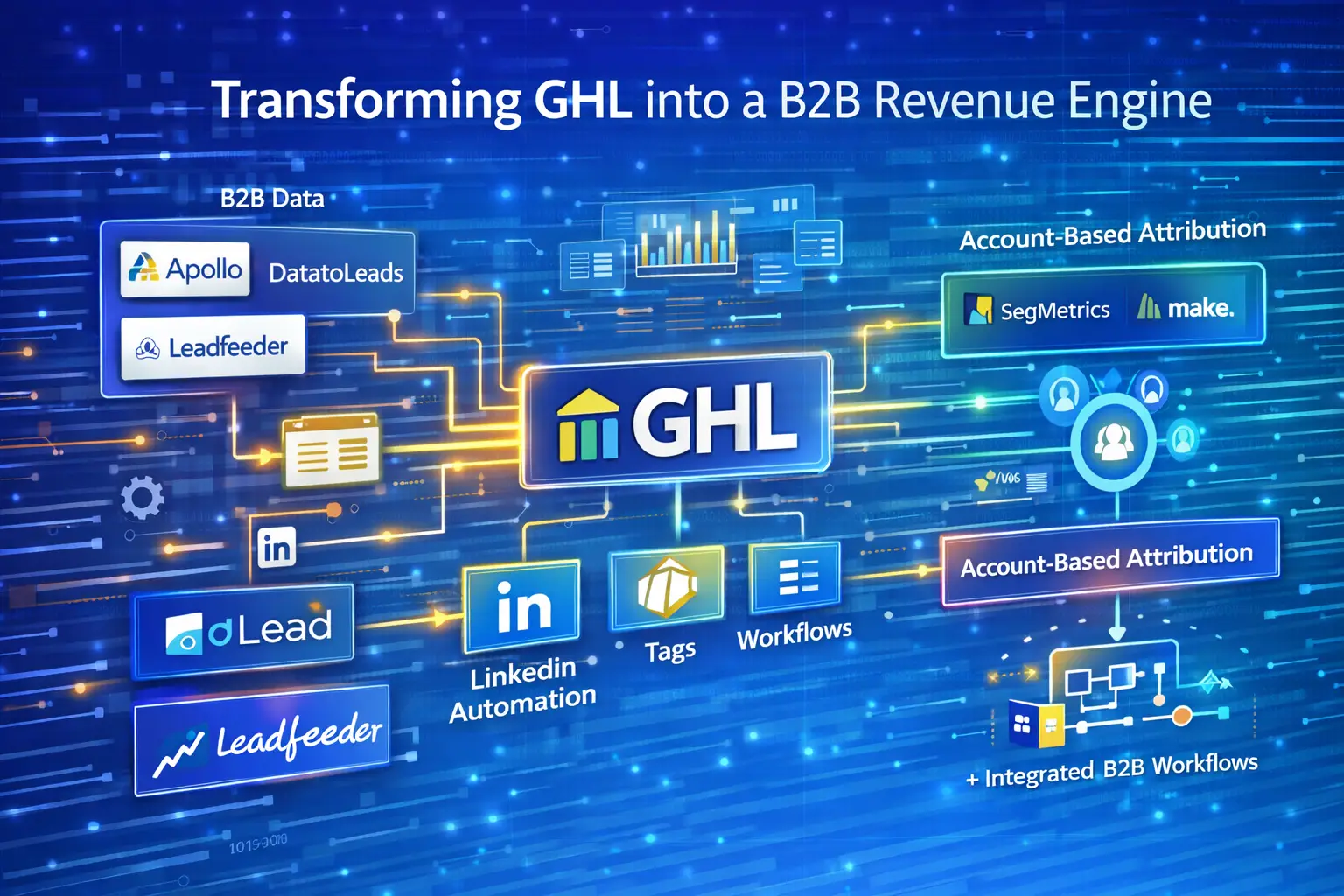
Key Tools to Extend GHL
Apollo-io / Lusha: These platforms provide access to verified B2B contact data, including:
Business email addresses
Direct-dial phone numbers
Company metadata (industry, size, role)
Lists can be exported and imported into GHL with structured tags (e.g. Cold Prospect, Outbound Q3), automatically triggering cold outreach workflows via email, SMS, or task assignment.
DatatoLeads: DatatoLeads is a GHL-native ecosystem solution that offers:
Skip tracing
Business lead lists
Data enrichment is directly aligned to GHL fields
This reduces friction by eliminating manual imports and ensuring data consistency inside GHL pipelines.
Leadfeeder: Leadfeeder identifies anonymous B2B website visitors at the company level, even when no form is submitted.
For B2B teams, this enables:
Identification of high-intent accounts
Automatic task creation in GHL for sales outreach
Triggering account-specific follow-ups based on page behaviour
This shifts GHL from a passive CRM into an intent-aware sales platform.
Multi-Channel Outreach (LinkedIn-Centric)
In B2B, LinkedIn is not optional. It is the primary channel for prospecting, relationship building, and deal acceleration. GHL does not natively automate LinkedIn, so a bridging platform is required.
LinkedIn Automation Solutions
HeyReach / Closely
These tools automate:
LinkedIn connection requests
Follow-up messages
Reply detection
When a prospect replies, platforms like Make-com or Zapier can:
Create or update a contact in GHL
Move the deal to a Hot Lead stage
Assign a sales rep task automatically
Expandi: Expandi supports advanced “Smart Sequences” that blend:
LinkedIn touchpoints
Email outreach
Conditional logic based on engagement
This allows LinkedIn activity to function as a first-class signal within your GHL pipelines.
Turning GHL into a True B2B Engine
HighLevel does not need to compete directly with enterprise CRMs to win in B2B. Its strength lies in automation speed, flexibility, and cost efficiency.
By layering:
B2B data enrichment
LinkedIn automation
Intent detection
Account-level attribution
Advanced workflow logic
GHL can support serious B2B revenue operations without the overhead of legacy platforms.
The result is a modular B2B stack:
GHL is the operational core
Specialist tools handling high-value B2B functions
Automation ties everything together
Company & Contact Objects
Company Object:
Fields: Company Name, ICP Tier, Industry, Revenue Band, Key Contact Info, AE Ownership, Active Client Status
Company Engagement:
Automatically track interaction with each company using associated contacts.
The company record will be tied to key metrics such as engagement score, opportunities, and touchpoints.
Contact Object:
Fields: Persona Type (Decision Maker, Influencer), Seniority, Buying Authority, Email, Phone
Engagement Tracking: Contacts will be linked to companies and scored based on engagement (email opens, calls, replies, etc.). Their buyer role and persona will influence the outreach.
Client Engagement & Nurturing
Engagement Scoring:
Behavioural Scoring: Track interactions (email opens, clicks, call connections) and calculate an engagement score for each contact and company. This score will trigger specific workflows, moving leads through stages.
Qualification Scoring: Calculate a qualification score based on critical business needs (budget, authority, timeline, pain). Once the score hits a threshold, the lead moves to the "Qualified for Discovery" stage.
Workflows:
Lead Nurturing: Triggered by engagement activities, a series of follow-up emails, calls, or LinkedIn outreach can be automatically scheduled.
Engagement-Based Stage Movement: Once a contact reaches a specific engagement score, they will automatically progress through pipeline stages.
Conclusion
This B2B implementation plan for HighLevel CRM is structured to accommodate a wide range of industries, leveraging the flexibility of custom fields, workflows, and object relationships to align with business-specific sales and marketing processes.
While HighLevel provides an excellent foundation for many service and lead-generation businesses, B2B sales models demand additional complexity in terms of outreach, multi-channel engagement, attribution, and account-level decision-making. By incorporating specialised tools for prospecting, LinkedIn automation, and account-based marketing (ABM), GHL can evolve into a comprehensive B2B platform capable of supporting sophisticated sales workflows. With the right integrations, GHL becomes a flexible, cost-effective solution that can manage the entire B2B sales process—from lead generation to closed deals—while maintaining the automation, ease-of-use, and scalability that makes GHL a preferred choice for businesses of all sizes. HighLevel is often associated with marketing automation and funnel building.
However, when configured correctly, it can operate as a powerful B2B CRM platform. The key is architectural design, allowing organisations to build a highly capable B2B sales system.
By leveraging:
companies
contacts
opportunities
custom objects
company, contact and opportunity lead scoring
automation workflows
reporting dashboards
Rather than relying on rigid CRM structures, HighLevel provides a flexible framework that can adapt to many B2B business models.
For companies willing to invest in thoughtful architecture and automation logic, it becomes possible to create a fully customised revenue engine capable of supporting long-term B2B growth.