
The Best Tips for Using HighLevel
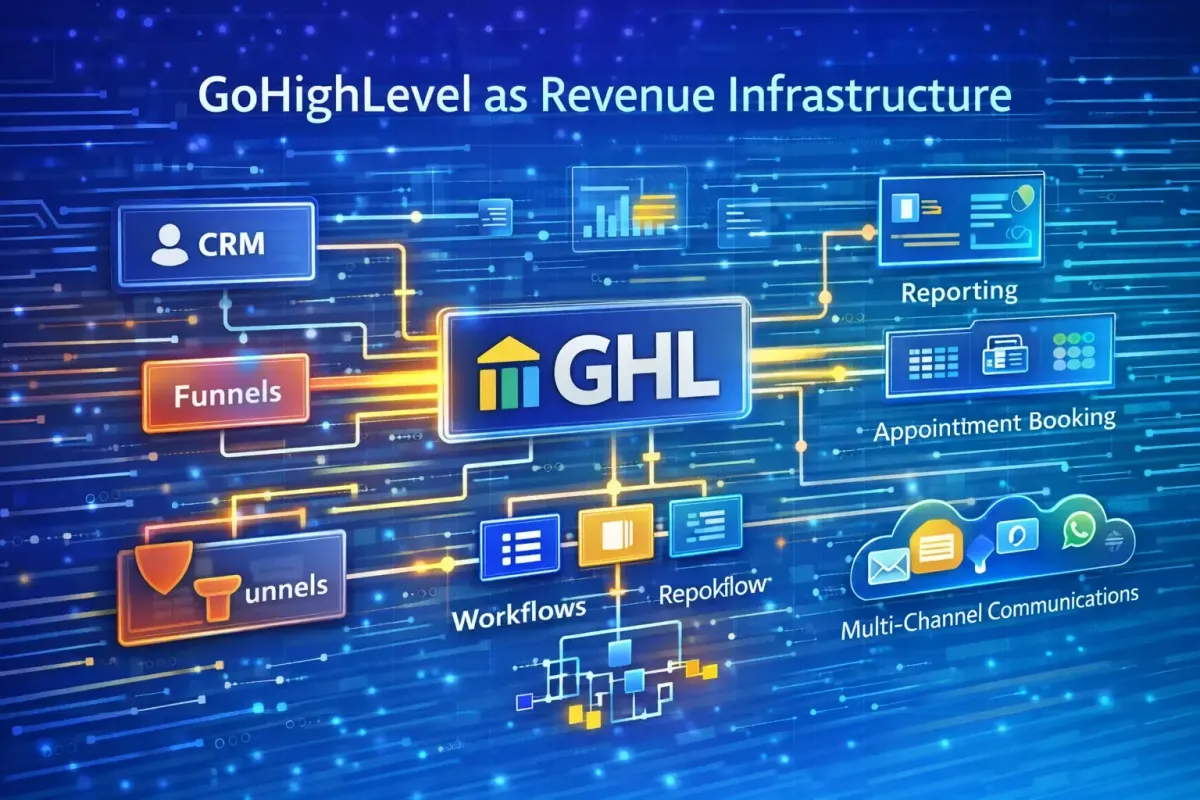
Go High Level has quickly evolved from a popular “all-in-one” platform into a serious contender for powering modern revenue operations. At face value, its proposition is compelling: CRM, marketing automation, funnels, appointment booking, multi-channel communications, and reporting—consolidated into a single, extensible environment at a fraction of the cost of traditional enterprise stacks.
But consolidation alone does not create scale.
The reality is that most Go High Level accounts underperform not because the platform is limited, but because it is implemented without architectural intent. As accounts grow, common failure patterns emerge: unclear ownership between teams, shallow data models, uncontrolled workflow growth, fragile automation logic, and a complete absence of governance. Over time, what should function as a revenue engine quietly becomes operational drag.
This article is written for agencies, operators, and RevOps leaders who are building beyond basic lead generation. It is not a feature walkthrough or a beginner’s tutorial. Instead, it outlines the structural principles, operating decisions, and governance models required to transform Go High Level into a scalable revenue operating system—one that compounds value over time rather than accumulating technical debt.

1. Start With Operating Model Clarity (Before Touching the CRM)
Before building funnels, workflows, or pipelines, you must define who owns what across marketing, sales, service, and operations.
This includes:
Who qualifies leads
Who advances deals
Who owns customers post-sale
Who is responsible for retention, renewals, or upsells
Document the end-to-end lifecycle:
Lead → Qualified Opportunity → Customer → Retained / Expanded / Churned
You must also decide what role GHL plays within your wider stack:
A system of engagement (front-end automation and communications)
A system of record (core CRM and source of truth)
Or a control layer within a composable RevOps stack
Most GHL issues stem from unclear lifecycle ownership—not technical constraints.
2. Design Your Data Model Intentionally
GHL is often deployed with “contact-only thinking.” This works for simple lead gen. It breaks down quickly in B2B or multi-stage sales environments.
Introduce structure early:
Deals / Opportunities
Tickets or Service Requests
Subscriptions, Retainers, or Ongoing Contracts
Standardise:
Field naming conventions
Required vs optional fields
Status logic (avoid free-text fields entirely)
Rule:
If it will be automated, reported on, or used in decision-making, it must be structured.
3. Control Your Pipeline Architecture
Pipelines are business logic, not visual tools.
Best practice includes:
Multiple pipelines where logic differs (e.g. inbound vs outbound)
Locked entry criteria per stage
Defined automation triggers per stage
Explicit exit conditions (Closed Won / Lost)
Avoid allowing automation to move deals backwards unless absolutely required. Backward movement creates loops, corrupts velocity reporting, and confuses operators.

4. Build Workflows Like Systems, Not Campaigns
Most GHL users build workflows like email campaigns. At scale, workflows should be treated as business logic engines.
Adopt a consistent structure:
Trigger → Filters → Decision Logic → Actions → Exit Rules
Apply filters as early as possible to:
Reduce execution cost
Prevent unintended automation
Improve reliability
Name workflows by function, not channel.
Example: Lead Qualification – Inbound (not Email Follow-Up 1).
5. Be Ruthless With Workflow Governance
Workflow sprawl is the single biggest long-term risk in mature GHL accounts.
Enforce governance standards:
One owner per workflow
Versioning (date + purpose)
Clear notes documenting logic
Quarterly audits should remove:
Redundant actions
Deprecated tags
Broken integrations
Overlapping workflows touching the same fields
A CRM without governance becomes automation chaos.
6. Use Tags Sparingly and Strategically
Tags are contextual signals, not core data.
Use tags for:
Short-term states
Campaign attribution
Behavioural indicators
Do not use tags for:
Lifecycle stages
Lead status
Qualification outcomes
If something requires reporting, filtering, or automation branching, it should be a field, not a tag.
7. Separate Automation Logic From Messaging
Embedding copy directly inside complex workflows creates friction and risk.
Instead, centralise:
Custom values
Snippets
Shared templates
This allows:
Faster copy changes
Safer experimentation
Cleaner handover between teams
Logic should control when messages fire—not what they say.
8. Implement Stop Conditions Aggressively
Every workflow must have explicit stop logic.
Define stop conditions:
On reply
On appointment booking
On deal stage movement
Use “Stop on Response” and conditional exits properly.
Never rely on time delays alone to end automation.
This protects user experience, reduces spam complaints, and preserves deliverability.
9. Treat Email, SMS, and WhatsApp as Distinct Channels
Each channel has different expectations:
Pacing
Tone
Compliance requirements
Avoid copying logic across channels blindly.
Segment automation by intent, not channel.
What works for SMS follow-up will often damage email reputation if reused.
10. Protect Deliverability From Day One
Deliverability is not optional—it is infrastructure.
Best practice includes:
Full domain authentication (SPF, DKIM, DMARC)
Gradual warm-up
Segmentation of cold vs warm contacts
Avoid:
Overlapping campaigns
Excessive frequency
Multiple sending domains per location without a purpose
Automation velocity must never exceed reputation capacity.
11. Use Snapshots as Products, Not Templates
Snapshots should be treated like software releases.
This means:
Versioning
Documentation
Testing
Maintain:
A clean “gold master” snapshot
Client-specific overlays
Never patch live client systems to fix master logic. That path leads to fragmentation and unmaintainable systems.
12. Integrate GHL Into a Wider Stack When Needed
GHL excels at orchestration—not deep specialisation.
Extend it when required using:
Automation platforms (advanced logic and transformations)
Analytics tools (multi-touch attribution, cohort analysis)
Finance systems (billing, reconciliation, revenue reporting)
Position GHL as the control plane, not the bottleneck.
13. Track Outcomes, Not Activity
Vanity metrics create false confidence.
Shift reporting focus to:
Lead-to-appointment rate
Appointment-to-deal rate
Deal velocity
Revenue attribution
Dashboards should support decision-making—not marketing optics.
14. Design for Human Override
Automation should assist humans, not trap them.
Ensure operators can:
Pause workflows
Override stages
Add contextual notes
Train teams on why automation exists—not just how to click buttons.
15. Revisit Your System Quarterly
Every 90 days, review:
Pipelines
Workflows
Data quality
Integrations
Remove anything that no longer supports revenue, retention, or scale.
A static CRM becomes technical debt rapidly.
16. Architecture and Setup Foundations
Before launching funnels, establish a structure:
Master Snapshots per niche or use-case
Consistent naming conventions (e.g. [INTERNAL], [ADS], [OPS])
Extensive use of custom values for reusable data
This ensures scalability across hundreds of assets without chaos.
17. Advanced Automation Capabilities
Most teams use a fraction of GHL’s workflow power.
Leverage:
If/Else branching instead of duplicate workflows
Missed call text-back automations for immediate ROI
Smart Lists instead of static lists
Workflow AI for summarisation, intent detection, and routing
This reduces manual effort while improving response speed.
18. CRM and Lead Management as a Proactive System
Treat the CRM as an active system, not a database.
Automate:
Contract sending on stage movement
Task creation for sales teams
Lead scoring based on behaviour
Use the Conversations inbox as a unified engagement hub to eliminate channel fragmentation.
19. Funnels and Websites at Scale
Key principles:
Use Global Sections for shared components
Deploy Trigger Links to move leads without forms
Run continuous A/B tests on primary conversion points
Funnels should evolve through data—not opinion.
20. For Agency Owners: SaaS Mode Strategy
Retention equals system dependency.
Best practice includes:
Full white-labelling
Custom app domains
Controlled user permissions
Monitoring the Labs section for early feature adoption
Clients should see your platform, not a resold tool.
Final Thought: Treat GHL as Infrastructure, Not Software
High Level is not a tool to be “set up once and left alone.” It is infrastructure.
When treated as a collection of funnels, workflows, and campaigns, GHL will eventually collapse under its own complexity. Automation overlaps, reporting degrades, operators lose trust in the system, and scale becomes harder, not easier. This outcome is not accidental; it is the natural result of building without an operating model.
By contrast, when Go High Level is designed deliberately—around clear ownership, structured data, governed automation, and measurable outcomes—it becomes far more than a CRM. It becomes a control plane for revenue, aligning marketing, sales, service, and operations into a single execution layer.
The difference between success and failure is never the platform itself.
It is whether the system is treated as software to use or infrastructure to design.
Teams that revisit their architecture regularly, enforce governance, and design for both automation and human intervention will find that Go High Level scales remarkably well. Those that do not will eventually be forced to rebuild—often at the exact moment they can least afford disruption.
In RevOps, the question is not whether your system is powerful enough.
It is whether it is intentional enough to scale.