
Using HighLevel for Sales - Increase Revenue and Scale
HighLevel is frequently positioned as a marketing platform. Funnels, campaigns, automations, reviews. All true—but incomplete.
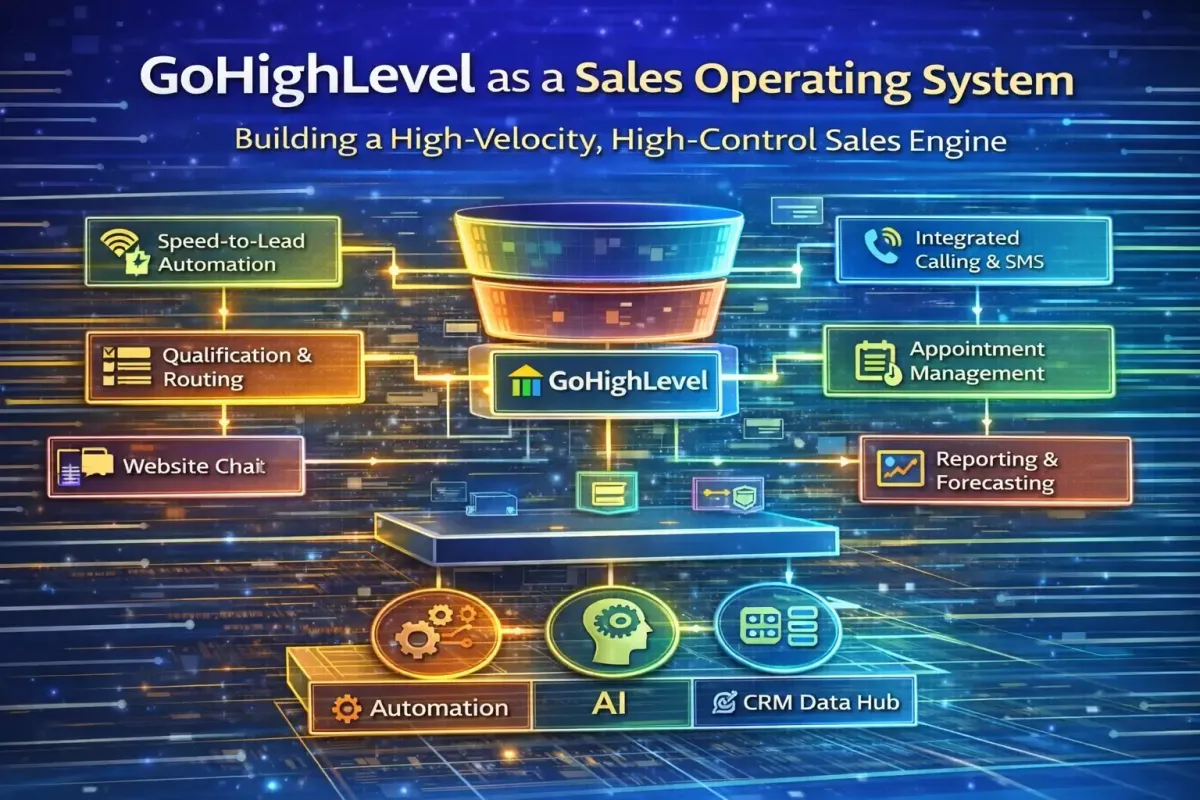
When deployed through a sales-first lens, HighLevel functions far less like a campaign tool and far more like a Sales Operating System: a system designed to maximise selling capacity per rep, reduce response latency, enforce process discipline, and provide leadership with real-time commercial visibility.
Most sales teams do not underperform due to poor closing skills. They underperform because of manual drag: fragmented data, slow response times, inconsistent follow-up, weak qualification, and pipelines that look healthy on paper but rot in reality.
HighLevel’s real strength is not that it “does more things. It is that it collapses complexity, removing friction between data, conversations, decisions, and action. When implemented correctly, it allows a sales organisation to generate more qualified conversations, faster, with the same or fewer resources.
What follows is a sales-first, systems-level breakdown of how to use HighLevel as a high-performance selling platform rather than a generic CRM.
1. The Single Source of Truth: CRM, Conversations, and Context
Why sales teams leak revenue
Sales teams lose deals when context is fragmented. A prospect fills in a form, replies to an SMS, asks a question via email, then ghosts—only to reappear weeks later. The rep opens three tools, scans old notes, and responds with uncertainty.
That moment of hesitation is commercial debt.
How HighLevel fixes this structurally
HighLevel enforces a single customer record with a chronological activity timeline. Every inbound and outbound interaction—form submissions, page views, SMS, emails, calls, voicemails, chats, social messages—attaches to one contact.
There is no “where did this come from?” moment.
Unified conversation stream
Sales reps see:
All messages across channels in one thread
Call logs, recordings, and dispositions
Automation actions and timestamps
Attribution data (source, campaign, medium)
This allows any rep—or manager—to step into a conversation with full situational awareness.
Selling-specific data architecture
Instead of generic CRM fields, high-performing teams create qualification-driven custom fields, such as:
Budget authority (Yes / No / Unknown)
Pain severity (Low / Medium / High)
Current provider or tech stack
Buying timeframe
Decision criteria
These fields are not passive storage. They provide routing, prioritisation, automation, and reporting.
Smart Lists as a daily action engine
HighLevel Smart Lists replace static lead lists with live, rules-based queues, such as:
Leads not contacted in the last 48 hours
Hot leads without a booked meeting
Deals stuck in the proposal stage
No-shows requiring recovery
When a rep logs in, the system tells them exactly who to contact and why.
Sales impact: Less cognitive load, faster context acquisition, and higher conversation quality per call.

2. Pipeline Design That Reflects Reality (Not Hope)
The problem with most pipelines
Many CRMs treat pipelines as passive storage. Deals enter, sit, and decay. Forecasts are optimistic guesses rather than controlled systems.
How HighLevel pipelines enforce selling discipline
HighLevel pipelines are operational objects, not just visual boards.
Custom stage architecture
You define stages that reflect how your team actually sells, for example:
New Inbound Lead
Discovery Completed
Capability Demo Delivered
Proposal Sent
Commercial Review
Closed Won / Closed Lost
Multiple pipelines can coexist for different sales motions (inbound vs outbound, SMB vs enterprise).
Opportunity value and probability Weighting
Each stage can carry:
Monetary value
Close probability
This produces weighted pipeline forecasts, allowing leadership to see:
Total pipeline value
Expected revenue this period
Revenue at risk
This is materially different from “total deal value”.
Stagnation detection and escalation
HighLevel allows time-based logic such as:
If deal remains in “Proposal Sent” for 3 days → notify rep
If still inactive after 5 days → notify manager
If no response after 7 days → trigger re-engagement sequence
Pipelines become self-policing systems.
Sales impact: Cleaner forecasting, reduced pipeline rot, earlier intervention.

3. Advanced Sales Automation: The “Silent SDR” Layer
Where sales capacity is really lost
Reps spend disproportionate time on:
Chasing responses
Sending reminders
Logging notes
Booking meetings
Following up on lost deals
None of this directly closes revenue.
How HighLevel automates non-selling work
HighLevel’s workflow engine acts as a silent SDR, executing predictable tasks instantly and consistently.
Speed-to-Lead automation
Response time is one of the strongest predictors of conversion.
A common high-performance pattern:
Lead submits form or starts chat
Immediate SMS/email confirmation
Forced call logic:
System calls rep
Whisper message plays (“New inbound lead, press 1 to connect”)
System dials prospect instantly
This reduces response time from hours to seconds.
AI-driven qualification and booking
AI conversation agents can:
Ask qualification questions via SMS or chat
Capture structured responses into fields
Book qualified prospects directly into calendars
Human reps only engage once intent and fit are established.
Automated recycling and reactivation
When deals are marked as:
Lost – No budget
Lost – Timing
Lost – Internal priority
They can automatically enter long-term nurture sequences that re-engage quarterly, without rep involvement.
Sales impact: More selling conversations per rep, lower cost per booked meeting.
4. Integrated Communication: One Inbox, Zero Friction
The cost of channel fragmentation
Switching between phone systems, email clients, SMS tools, and calendars destroys momentum.
How HighLevel consolidates selling activity
HighLevel provides native communication tools embedded directly into the CRM.
Built-in calling and power dialling
Reps can:
Click-to-call from contact or pipeline views
Dial through Smart Lists sequentially
Drop voicemails automatically
Log call outcomes instantly
Call recording and AI coaching
Every call can be:
Recorded and stored on the contact
Summarised using AI
Analysed for sentiment or intent
Managers gain real data for coaching rather than anecdotal feedback.
Two-way SMS as a primary sales channel
SMS consistently outperforms email for:
Appointment confirmations
Micro-commitments (“Still good for 2pm?”)
Objection handling
Reducing no-show rates alone often justifies the platform cost.
Sales impact: Higher throughput per rep, faster deal progression, improved show rates.
5. Workflow-Driven Sales Sequences That Replicate Top Performers
The inconsistency problem. Most follow-up failures are not neglect—it is inconsistency.
How the HighLevel systemises follow-up
Sales sequences in HighLevel are built using event-driven workflows, not linear drip campaigns.
Common high-ROI sequences include:
Inbound lead (0–48 hours)
No-show recovery
Proposal follow-up
Dormant lead reactivation
Post-demo decision sequence
Branching logic
Sequences adapt dynamically:
If prospect replies → notify rep, stop automation
If link clicked → escalate
If silent → change channel or cadence
The system mirrors your best rep’s behaviour—perfectly, every time.
Sales impact: Higher conversion with fewer leads, reduced dependency on individual habits.

6. Appointment Control, Show Rates, and Selling Time Protection
Why booked meetings ≠ selling time: A booked calendar full of no-shows is operational noise.
How HighLevel optimises attendance
HighLevel calendars integrate tightly with workflows.
Key controls include:
Qualification gates before booking
Round-robin or weighted rep assignment
Buffer rules and capacity limits
Automated reminders at optimal intervals
One-click rescheduling
For some industries, optional deposits or pre-call commitments dramatically increase attendance.
Sales impact: More attended meetings per booked slot, higher effective utilisation of rep time.
7. Reporting, Forecasting, and Sales Management Control
Moving from anecdote to evidence. Sales leadership requires leading indicators, not just closed-won reports.
What HighLevel reports well
HighLevel provides visibility into:
Conversion rates by rep and stage
Lead source ROI
Response time and activity volume
Appointment show and cancellation rates
Pipeline velocity and bottlenecks
Dashboards can be filtered by:
Date range
Rep
Pipeline
Lead source
This enables targeted coaching and early intervention.
Sales impact: More predictable revenue, faster correction of underperformance.
8. AI in Sales: Acceleration, Not Autonomy
Where AI genuinely adds value
In HighLevel, AI performs best when used to:
Summarise conversations and calls
Draft follow-ups for human review
Extract buying signals into fields
Reduce admin overhead
Where governance is essential
AI should not:
Commit pricing
Promise delivery terms
Negotiate contracts autonomously
High-performing teams deploy AI with guardrails, using it to assist—not replace—human judgment.
9. The Sales Capacity Model: Where GHL Delivers Measurable Lift
Across most service and B2B sales environments, the biggest gains typically come from:
Faster speed-to-lead
Reduced follow-up leakage
Improved show rates
Shorter sales cycles
Higher rep throughput
None of these requires more leads. They require better systems.
10. Sales-First Implementation Blueprint
For maximum ROI, a sales deployment should follow this order:
Data model (fields, tags, pipelines)
Inbound capture and instant response
Routing, ownership, and SLAs
Core sales sequences
Reporting and dashboards
Governed AI assistance
This avoids automation sprawl and preserves data integrity.
Final Perspective: HighLevel as a Revenue Engine
When viewed purely as a marketing platform, HighLevel appears powerful.
When deployed as a Sales Operating System, it becomes transformative.
Its real advantage is not feature breadth—it is the ability to:
Collapse selling tools into one environment
Enforce process without micromanagement
Scale conversations without scaling headcount
Turn sales activity into a measurable, optimisable system
For teams focused on speed, accountability, and predictable revenue, HighLevel is less a CRM and more a commercial control plane.