
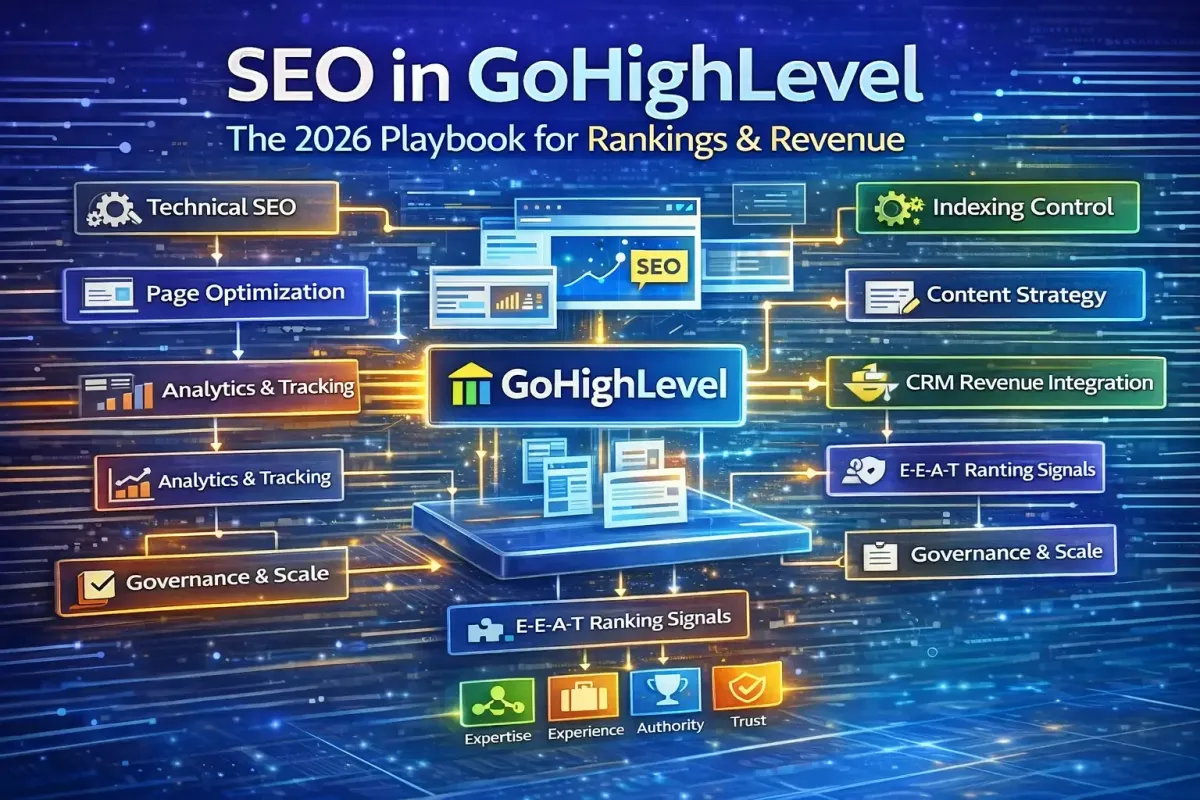
SEO Tips for HighLevel - Ranking Websites
GoHighLevel (GHL) has evolved dramatically by 2026. What began as a funnel-centric CRM has matured into a platform capable of supporting serious websites with scalable SEO performance—if it is implemented with discipline. This evolution has created a sharp divide in outcomes.
On one side are GHL websites that fail to rank, suffer from index bloat, duplicate content, weak internal linking, and poor crawl efficiency. On the other hand, GHL implementations that compete directly with WordPress sites—ranking for commercial keywords, dominating local maps, and feeding high-intent organic leads directly into CRM-driven automation.
The difference is not in the algorithms. It is governance.
Unlike WordPress, HighLevel does not rely on auto-optimising SEO plugins such as Yoast or RankMath. There is no “green light” system correcting poor structure, duplicated titles, or broken hierarchies. Everything is manual by design.
That reality makes GHL both dangerous and powerful.
This guide is written from an agency, RevOps, and systems-design perspective. It does not focus on surface-level checklists. Instead, it lays out a complete SEO operating model for HighLevel, covering:
Technical SEO foundations
On-page and content architecture
Local SEO as a native GHL advantage
Performance and Core Web Vitals
Measurement, governance, and scale
Strategic alignment between SEO and CRM revenue systems
If you treat HighLevel as a serious CMS rather than a funnel toy, it can rank exceptionally well. If you do not, SEO debt compounds quickly.
1. Understanding GHL’s SEO Reality (Critical Context)
Before touching page settings or keywords, one principle must be understood:
HighLevel does not protect you from SEO mistakes.
There is:
No automated canonical enforcement
No duplicate meta detection
No structural warnings
No crawl waste management
Poor decisions at the page level replicate instantly across cloned funnels, global sections, and multi-location sites.
As a result:
Weak structure compounds faster than WordPress
SEO errors scale invisibly
Agencies without standards lose control quickly
GHL should be treated as a conversion-first CMS that must be SEO-disciplined, not a blogging platform with guardrails.
2. Page Indexing Control Is Not Optional
Never assume a page is indexable.
In GoHighLevel, page-level indexing toggles must be reviewed explicitly for every page. Many SEO failures stem from accidental indexation of pages that should never appear in search results.
Pages that must be excluded:
Thank-you pages
Booking confirmation steps
Funnel duplicates
Test pages
Preview URLs
Indexing bloat dilutes crawl budget and weakens authority signals across the domain.
3. Robots.txt Governance at the Domain Level
GHL now allows direct robots.txt editing at the domain level—this is a critical control point.
Use robots.txt intentionally to:
Block duplicated funnel paths (e.g. /funnels/)
Prevent crawling of parameters and preview URLs
Exclude internal system paths such as /account/reset-password
GoHighLevel does not dynamically manage crawl waste. If you do not define boundaries, search engines will crawl everything they can find.
4. Canonical URLs Are Manual by Design
Canonical logic is frequently overlooked in GHL, yet it is one of the most damaging omissions.
Best practice:
One URL = one search intent
No funnel + website duplication of the same content
No service-location permutations pointing to multiple URLs
Every high-value page should have its full canonical URL manually defined in SEO metadata. Failure to do so leads to authority fragmentation.
5. URL Structure Discipline
URLs should be treated as permanent revenue assets.
Correct characteristics:
Short
Lowercase
Hyphenated
Keyword-led
Avoid:
Auto-generated suffixes
Numeric strings
Deep nesting
Example
✅ /go-high-level-consultant
❌ /services/marketing/ghl/solutions/page-1
Once published, URLs should only change via controlled 301 redirects—not casual edits.

6. Meta Titles Are Non-Negotiable
Every page must have:
A unique meta title
≤ 60–65 characters
A keyword-first structure
Brand names should follow commercial intent—not lead it.
Poor titles are one of the most common reasons GHL pages fail to gain impressions.
7. Meta Descriptions as a CTR Lever
Meta descriptions do not directly affect rankings—but they strongly influence click-through rate.
Effective descriptions:
Communicate outcomes
Address buyer intent
Differentiate from competitors
Duplicate descriptions across pages are a silent performance killer.
8. The Single H1 Rule
HighLevel’s drag-and-drop editor makes it dangerously easy to misuse headings.
Rules:
One H1 per page
No logos, menus, or banners as H1
H1 must express search intent—not branding
Multiple H1s confuse search engines and weaken topical clarity.
9. Hierarchical Heading Structure
Headings are not design tools—they are semantic signals.
Correct hierarchy:
H1 → H2 → H3
Never skip levels
Use headings to reinforce topical depth
Well-structured headings improve indexation, featured snippet eligibility, and content comprehension.
10. Intent Mapping Comes Before Writing
Before creating content, define:
Informational vs commercial vs navigational intent
Funnel stage alignment
Internal linking purpose
Content without intent alignment rarely ranks—and even when it does, it rarely converts.
11. Funnel Copy ≠ SEO Copy
A critical mistake is using short funnel-style copy on SEO pages.
SEO content must:
Answer real questions
Provide depth and context
Demonstrate authority
Thin, sales-only copy does not rank sustainably in 2026.
12. Topical Authority Through Content Clusters
Google rewards depth, not volume.
Using HighLevel as an example, Effective GHL content clusters might include:
GHL CRM
GHL Automation
GHL Websites
GHL AI
GHL Integrations
Each cluster should:
Contain multiple interlinked pages
Reinforce a central pillar
Share internal authority deliberately
13. Internal Linking as a System
Every page should:
Receive links
Pass links
Use descriptive anchor text
Avoid:
“Click here”
Orphaned pages
Random footer stuffing
Global Sections in GHL allow internal links to be updated centrally—this is a powerful, underused SEO lever.
14. Image Optimisation Is Critical in GHL
GHL hosting is fast—but image abuse kills performance.
Best practice:
Compress images before upload
Prefer WebP
Keep images ≤ 200KB
Never rely on post-upload optimisation to fix poor media hygiene.
15. Avoid Video Background Abuse
Video backgrounds:
Destroy LCP scores
Hurt mobile SEO
Increase bounce rates
For SEO pages, static hero images consistently outperform videos.
16. Mobile-First Is Not Optional
Google indexes mobile versions first.
In GHL:
Design mobile before desktop
Test font sizes and tap spacing
Eliminate layout shifts (CLS)
A desktop-only mindset guarantees underperformance.
Schema & SERP Enhancement Opportunities
17. Structured Data Is a Manual Advantage
HighLevel does not auto-generate schema—this is an opportunity, not a limitation.
Consider:
Organisation schema
Service schema
FAQ schema (JSON-LD via custom code)
Schema improves:
Rich results
CTR
SERP real estate dominance
18. FAQ Sections That Actually Rank
FAQs should:
Address real objections
Reflect buyer questions
Appear on service and location pages
Do not use generic filler questions—Google has learned to ignore them.
19. Location Page Discipline
One page per location—no exceptions.
Each page must contain:
Unique local context
Local proof and examples
Distinct copy
Token swaps and copy-paste templates are easily detected and devalued.
20. NAP Consistency Across Systems
Name, Address, and Phone must match exactly across:
Website
Google Business Profile
Citations
Even minor discrepancies reduce trust signals.
21. Automated Review Generation
Reviews remain a top-three local ranking factor.
GHL’s CRM makes it uniquely powerful here:
Trigger review requests automatically when deals close
Use SMS and email workflows
Monitor sentiment inside the CRM
This is where SEO and operations intersect.
22. Google Search Console Is Mandatory
Monitor:
Indexing errors
Crawl anomalies
Page experience
Query performance
GHL will not alert you—Search Console must.
23. SEO Without Conversion Data Is Blind
Traffic alone is not success.
Tie organic entry points to:
Forms
Calls
Chats
Pipeline stages
This transforms SEO from traffic acquisition into revenue attribution.
24. Page Naming Conventions
Standardise:
URL formats
Meta title logic
Description structure
This is essential for agencies managing multiple GHL sites.
25. Environment Separation
Never build SEO pages in:
Draft funnels
Temporary subdomains
Test environments
Production URLs must be intentional and permanent.
26. Version Control via Process
HighLevel lacks revision-level SEO tooling.
Mitigate with:
SOPs
Change logs
QA checklists before publishing
Process replaces missing platform controls.
27. E-E-A-T Signals Matter More Than Ever
Demonstrate:
Expertise
Experience
Authority
Trust
Add:
Author bios
Case studies
Credentials
This is increasingly decisive for competitive keywords.
28. Avoid Thin AI Content
Mass-generated AI blogs are easy to detect.
AI content must be:
Edited
Structured
Experience-driven
GHL sites flooded with unedited AI content are increasingly penalised.
29. Link Acquisition Still Matters
Content alone is not enough.
Build:
Digital PR links
Partner citations
Authority mentions
Quality blog content attracts organic links
SEO remains an ecosystem, not an isolated tactic.
30. SEO Pages Are Revenue Assets, Not Blog Posts
High-performing GHL SEO pages:
Capture demand
Qualify leads
Feed automation
Trigger CRM logic
They do not exist in isolation.
The most successful GHL implementations treat SEO as part of a revenue operating system, not a marketing checkbox.
Conclusion: SEO in HighLevel Is an Operating Discipline, Not a Feature
HighLevel has reached a level of technical maturity where strong SEO performance is entirely achievable—but only for teams willing to apply structure, governance, and intent at every layer of the platform. The absence of automated SEO “safety nets” is not a weakness; it is a signal that GHL is designed for operators who want control rather than convenience.
In 2026, successful HighLevel SEO is defined by disciplined architecture, deliberate content strategy, and tight integration between pages, data, and CRM-driven workflows. Rankings are not won through shortcuts, mass AI output, or cloned funnels. They are earned through clean URL structures, intentional indexing, strong topical authority, performance optimisation, and measurable alignment between organic traffic and revenue outcomes.
Organisations and agencies that treat SEO pages as revenue assets—connected to automation, pipelines, and conversion logic—consistently outperform those treating SEO as a standalone marketing tactic. HighLevel rewards this systems-led approach. When SEO is embedded into your operating model rather than bolted on, GHL becomes not just a funnel builder, but a scalable growth platform capable of compounding organic demand over time.