
SUCCESS STORIES
camperbuyer.com
Our client success is at the core of what we do. We align with client goals to provide objective based services.
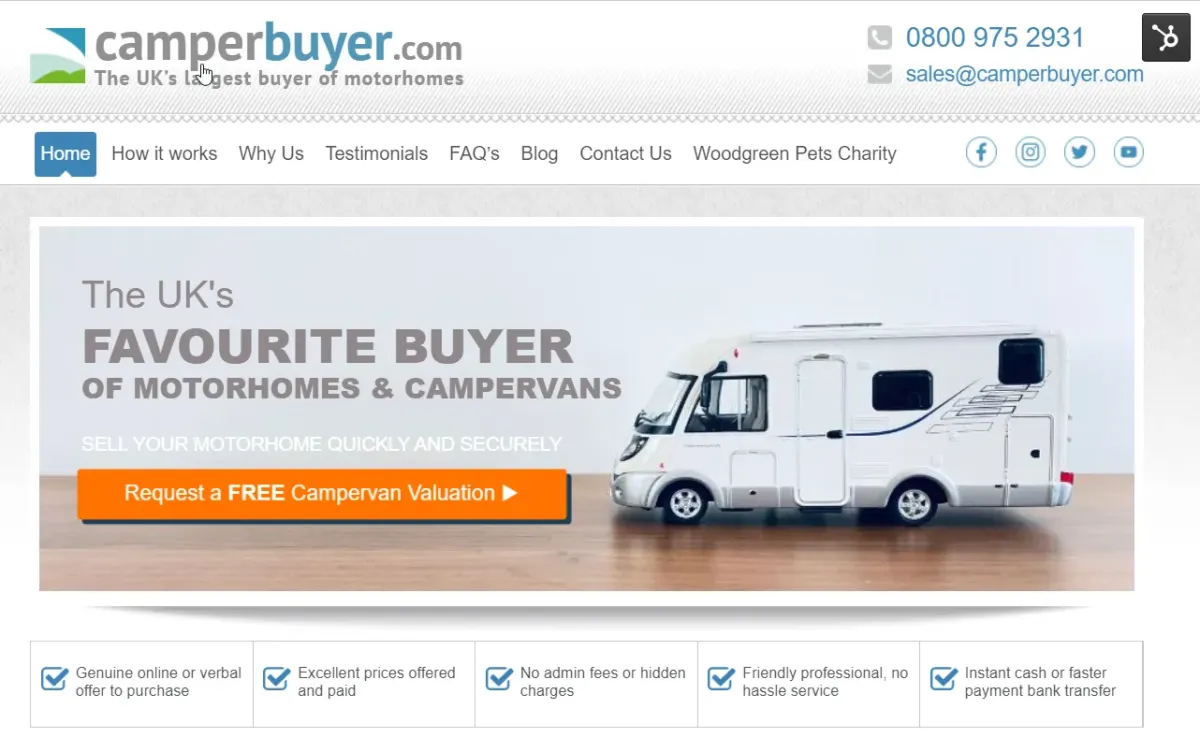
Helping a vehicle-buying business attract sellers, manage enquiries and build a more connected sales process.
CamperBuyer helps owners sell their motorhomes and campervans through a process covering vehicle details, valuation, offer acceptance, collection and payment.
Our work brought together paid advertising, landing-page development, CRM integration and lead-management improvements. The objective was to support the complete acquisition journey: attracting relevant vehicle sellers and helping the team progress those enquiries towards completed vehicle purchases.
Situation
For CamperBuyer, generating an enquiry is only the beginning of the commercial process. The team needs to assess the vehicle, contact the seller, establish a suitable valuation, agree an offer and arrange the remaining steps.
This makes lead quality particularly important. An inexpensive enquiry has limited value if the vehicle falls outside the buying criteria, the seller cannot be contacted or the opportunity does not progress.
The business also operated across related vehicle-buying brands, requiring advertising and enquiry capture to reflect different vehicle categories and seller motivations. A motorhome campaign and a classic-car campaign may share parts of the same marketing infrastructure, but they need different messaging and qualification criteria.
The challenge was to coordinate three connected areas:
Advertising: Generate relevant enquiries across search and social channels.
CRM and lead management: Capture accurate information and make it available for follow-up.
Measurement: Understand which enquiries progress towards worthwhile vehicle purchases.
Solution
The engagement combined ongoing advertising management with improvements to the systems supporting lead capture and sales follow-up. Work covered Google Ads, Facebook Ads, Microsoft Ads, landing pages and a CRM environment involving HubSpot, HighLevel and Zapier at different stages.
1. Google Ads to Reach Owners Actively Looking to Sell
Google Ads formed an established part of CamperBuyer’s lead-generation activity, reaching people actively searching for a way to sell their vehicle.
The campaign work included search targeting, competitor targeting, ad-copy testing and landing-page testing. The objective was to connect the seller’s search with a relevant proposition and a clear route to submitting vehicle details.
Regional budget management also formed part of the work. For example, the Scotland campaign’s daily budget was increased following the client’s request, with the understanding that available search demand would influence actual spend.
This approach allowed investment to respond to business priorities while recognising that higher budgets alone do not guarantee additional suitable enquiries.
2. Facebook Advertising Across Vehicle-Buying Brands
Facebook advertising complemented search by reaching vehicle owners who might be considering a sale but were not actively searching at that moment.
The wider account work included audience prospecting, remarketing, engagement campaigns and creative development across CamperBuyer and associated vehicle-buying brands.
CamperBuyer messaging highlighted practical reasons to enquire, including outright purchase, secure payment and nationwide collection. Image and video assets supported testing different ways to communicate the offer.
The related classic-vehicle campaigns also demonstrated why lead volume must be assessed alongside suitability. Low-cost enquiries could still create unnecessary work when the vehicles submitted did not match the intended buying criteria.
That feedback informed recommendations to strengthen form qualification and collect clearer vehicle information before the enquiry reached the team.
3. Microsoft Ads as an Additional Search Channel
The wider advertising programme included replicating relevant search activity into Microsoft Ads.
This extended coverage beyond Google and provided another source of seller enquiries. Campaign relevance, landing-page alignment and lead quality remained the important considerations when evaluating the channel.
4. Landing Pages and Vehicle Enquiry Forms
Landing-page and content work supported the transition from advertisement to valuation enquiry. The customer journey needed to explain what happens after submission and make it straightforward for owners to provide their vehicle details. The forms discussed included a three-step process, a thank-you page and an image-upload option.
These elements serve different purposes:
Clear service messaging helps sellers understand the buying proposition.
Structured vehicle questions give the team information needed to assess an enquiry.
Image uploads provide additional context about the vehicle.
Submission confirmation reassures the seller that their enquiry has been received.
The aim was to balance ease of completion with the information required for a useful sales conversation.
5. CRM Integration and Lead Routing
CRM work focused on connecting incoming enquiries with the systems used to manage follow-up.
The project history included HubSpot website forms, HighLevel account setup and Zapier-based lead routing. These arrangements evolved as the business reviewed how best to connect its websites, Facebook lead forms and CRM.
HighLevel work included connecting Facebook lead capture and confirmation-email activity. Native integration options were also considered where they could simplify the process and reduce reliance on intermediary automation.
The underlying objective was consistent: make customer and vehicle information available to the team promptly, with a clear basis for the next action.
6. Improving Lead-Import Reliability
A specific operational issue involved delayed batches of duplicate leads entering the CRM.
The lead-import configuration was changed to “new leads only” to address this behaviour. Vehicle-year information was also being captured, supporting assessment of the enquiry.
This work addressed a practical problem in the handover between advertising and sales. Duplicate imports can make older enquiries appear new, create unnecessary follow-up and complicate interpretation of lead volume.
Reliable imports are therefore part of effective lead generation: the team needs to trust both the information received and when it entered the system.
7. Strengthening Qualification and Follow-Up
The CRM and form work also supported a more structured approach to qualification.
Across the related vehicle-buying campaigns, vehicle age emerged as an important criterion. The discussions identified cases where classic-car advertising generated enquiries for vehicles that were too modern for the intended campaign.
Recommendations included clearer year-selection fields and conditional qualification. These were intended to help distinguish relevant opportunities earlier and reduce avoidable assessment work.
Follow-up planning centred on acknowledging enquiries, gathering missing details and helping the team maintain contact as opportunities progressed. The appropriate next action depends on whether the seller is awaiting contact, supplying additional information, considering an offer or moving towards an agreed purchase.
8. Moving Towards CRM-Based Advertising Measurement
A further recommendation was to send meaningful CRM sales outcomes back to the advertising platforms.
Initial lead tracking shows which campaigns generate submissions. CRM outcome tracking can provide additional insight into which enquiries become qualified opportunities or completed vehicle purchases.
For CamperBuyer, the proposed next phase involved connecting sales-stage information with Google Ads and exploring reporting around won opportunities and commercial value.
This remained a recommended development in the retrieved project history. Its purpose was to bring campaign assessment closer to the outcomes that matter to the business, rather than relying solely on cost per enquiry.
Impact
The engagement connected advertising activity with the practical work of capturing, assessing and progressing seller enquiries.
The documented contribution spans ongoing campaign management, landing-page and form development, CRM lead routing and a specific correction to duplicate lead imports. Together, these addressed both acquisition and the operational processes supporting it.
Advertising Aligned With the Buying Process
Search and social campaigns supported different stages of seller intent. Google and Microsoft search activity reached people actively exploring a sale, while Facebook provided an additional way to introduce the proposition and generate interest.
Campaign and creative work reflected the vehicle category and the reasons an owner might choose a direct buyer.
Better Attention to Enquiry Quality
Feedback from the sales process highlighted the importance of collecting the right vehicle information.
The classic-vehicle campaigns provided a clear example: a low lead cost did not necessarily indicate strong commercial performance when the submitted vehicles were unsuitable. Qualification recommendations addressed this gap between advertising volume and buying relevance.
More Reliable CRM Inputs
The change to import new leads only addressed the duplicate-batch issue and supported clearer handling of incoming enquiries.
Accurate vehicle details and dependable lead routing provide a stronger basis for timely, relevant follow-up.
A Clearer Measurement Roadmap
The recommended CRM-to-advertising feedback loop established a direction for future measurement: assess campaigns by the quality and progression of their enquiries, alongside initial acquisition cost.
For a vehicle-buying business, that means understanding the journey from seller enquiry to suitable vehicle, agreed offer and completed purchase.
A Connected Approach to Advertising and CRM
CamperBuyer’s engagement illustrates why advertising and CRM should be considered together.
Campaigns create opportunities, landing pages capture the required information, and CRM processes help the team act on it. Feedback from the buying team then informs improvements to targeting, messaging and qualification.
Our work across these areas supported a more coordinated approach to generating and managing vehicle-seller enquiries, with a roadmap for connecting advertising performance more closely to completed business.
What Our Customer Says
“I have used Liam's services for a number of years and his expertise as made a significant difference to my business. His knowledge is second to none. Whenever I have an issue or question he responds straight away. I would not hesitate in recommending Liam and his company to anyone.”
Aaron Mercer
Managing Director
TESTIMONIALS
What our customers say
LIMITED TIME OFFER
FREE CONSULTATION
Are you wondering if your business processes can be improved further through automation? Take the opportunity now for a complimentary, no-obligation consultation.
Business Transformation
We are a tried and trusted automation partner offering a personalised service to align with your company's immediate and future strategic goals.
We can help you:
Get the most out of your current tech stack and achieve your business goals
Streamline and automate processes to transform your business
Automate actions within a single app, as well as across all of your businesss apps
Improve revenue operations and align your organisation
Get ahead of the competition

Newquay Orchard
Trevenson Road
United Kingdom
TR7 3BW


© 2026 AIOP.UK. All Rights Reserved.