
HighLevel AI Data Extraction vs Forms: The Future of Collecting Customer Information
For decades, online forms have been the undisputed gatekeepers of customer information. Whether a visitor is requesting a quotation, booking a service, or downloading a lead magnet, we have all become conditioned to complete a series of predefined fields before we are allowed to proceed.
And for good reason: forms work. They remain an essential part of every CRM and marketing stack.
But Artificial Intelligence is fundamentally changing how businesses think about data collection.
Rather than forcing customers to type their thoughts into dozens of tiny boxes, modern CRM platforms—like HighLevel—can now use AI to understand natural conversation and automatically extract structured information.
The question is no longer whether forms or AI are "better." The real competitive advantage lies in understanding where each approach provides the greatest value, and how to combine them seamlessly.
Why Forms Have Worked So Well
Forms were designed to solve a straightforward problem: businesses needed structured data to scale.
Rather than receiving a free-text message like this:
> "Hi, I'd like someone to clean my carpets next week."
A quotation form could seamlessly capture:
* Name
* Email address
* Telephone number
* Property type
* Number of rooms
* Preferred appointment date
* Postcode
From a database perspective, forms are beautifully organised. Every customer provides information in exactly the same format, making it incredibly easy to automate follow-up emails, build pipelines, generate reports, and trigger workflows.
The Friction Problem: The Limitations of Forms
The fatal flaw of forms is that customers do not think in structured fields.
In an era of instant gratification, long forms create friction. Every additional field you ask a prospect to fill out increases the chance of form abandonment. Many people simply want to explain what they need in their own words and get an immediate answer.
Imagine someone looking for a carpet cleaning quotation. Instead of completing eight different boxes, they naturally write:
> "Hi, we've just moved into a four-bedroom detached house in Maidstone. We'd like the lounge, stairs, and three bedrooms cleaned sometime next week."
To a human, that message contains everything needed to provide a quote. But to a traditional CRM, it is just one large, useless block of text. Without AI, a human team member would have to read that message, interpret it, and manually update the customer record.
That costs time, money, and slows down your response rate.
Enter AI Data Extraction
This is where AI Data Extraction flips the script.
Rather than demanding that customers organise their thoughts into separate fields, AI analyses natural conversation and identifies useful pieces of information automatically.
Using the previous example, an AI powered by HighLevel could read that single message and instantly extract:
* Property type: Detached house
* Number of bedrooms: 4
* Rooms requiring cleaning: Lounge, stairs, 3 bedrooms
* Preferred appointment timeframe: Next week
* Town: Maidstone
Each value is then seamlessly written into the appropriate custom field in your CRM—without a single keystroke from your team. The customer simply communicates naturally; the CRM quietly structures the data behind the scenes.
A Real-World HighLevel Workflow in Action
To see the power of this, let’s look at a fictional example using a HighLevel workflow.
Imagine a carpet cleaning company called FreshStep Carpet Care. To maximise conversions, they ditched their 8-field website form and replaced it with a 3-field "micro-form" asking only for:
1. Name
2. Email address
3. Telephone number
The AI Handoff:
The moment the form is submitted, a HighLevel Workflow triggers an automated SMS to the customer:
"Hi [Name], thanks for reaching out! Could you tell us a little about the carpets you'd like cleaned?"
The Customer Replies:
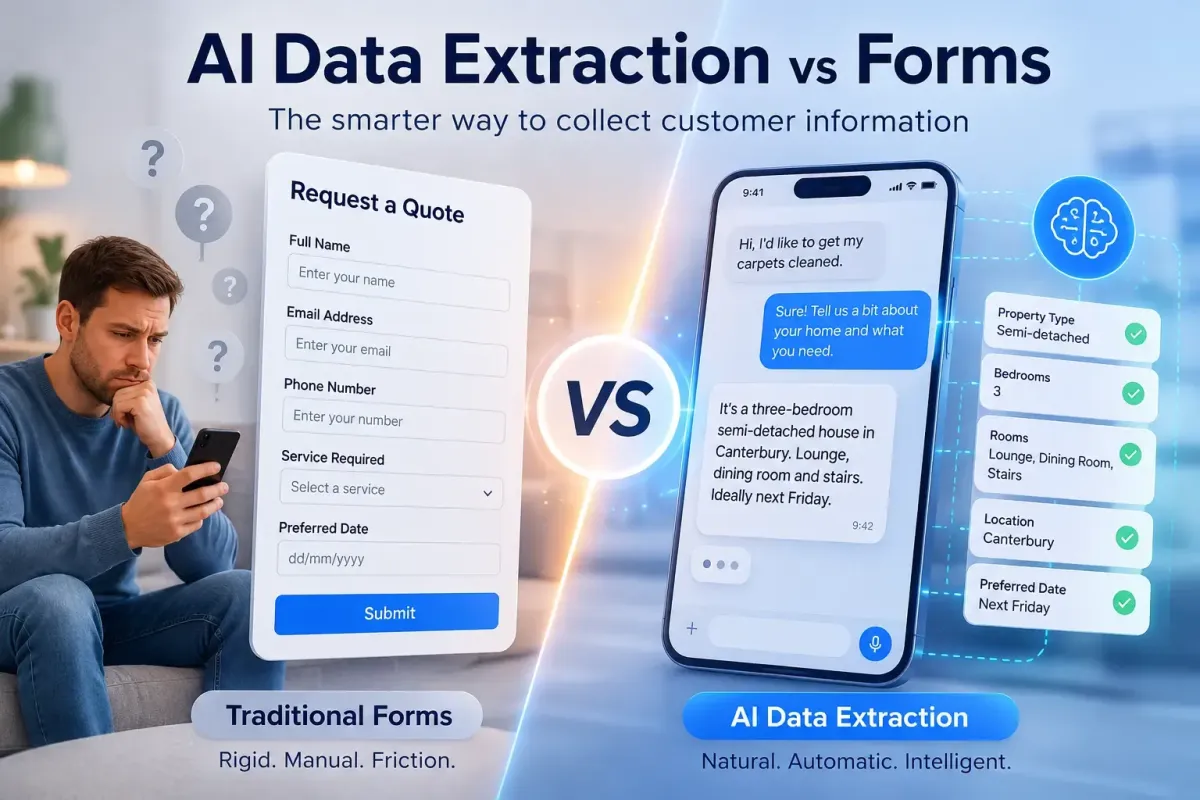
"It's a three-bedroom semi-detached house. We need the lounge, dining room, and upstairs landing cleaned. We're based in Canterbury and ideally need it done before next Friday."
The AI Extraction:
Instead of storing that response as a stagnant "note" on the contact profile, HighLevel’s AI Data Extraction steps in:
* "Three-bedroom" ➡️ Updates Custom Field: Bedrooms = 3
* "Semi-detached" ➡️ Updates Custom Field: Property Type = Semi-Detached
* "Lounge, dining room..." ➡️ Updates Custom Field: Rooms = Lounge, Dining Room, Landing
* "Canterbury" ➡️ Updates Custom Field: City = Canterbury
* "Before next Friday" ➡️ Updates Custom Field: Urgency = High
Within seconds, the CRM has transformed an ordinary text conversation into highly structured, actionable business data. The customer never filled out a secondary form, yet your CRM now contains significantly richer information than it would have otherwise.
The Golden Rule: Structured Data Still Matters
Although AI makes conversations far more useful, structured data remains the absolute foundation of every CRM.
* Workflows still depend on fields.
* Reporting still depends on fields.
* Dashboards still depend on fields.
* Automations still depend on fields.
AI does not replace structured data. It creates structured data from unstructured conversations. That distinction is incredibly important. You still get the clean, organised database you need to run your business—you just stopped forcing the customer to do the data entry for you.
When to Stick to Traditional Forms
Despite rapid advances in AI, forms remain the quickest and most reliable way to collect essential, standardised information. You shouldn't ditch forms entirely for:
* Newsletter subscriptions (Just need an email)
* Payment processing (Requires specific billing formats)
* Event registrations (Needs strict ticket counts and waivers)
* Standard lead generation (Where a name and email are sufficient to start an email nurture sequence)
Forms allow businesses to validate required fields (like ensuring an email contains an "@" symbol) before submission. When every customer needs to provide the exact same basic details, forms are still highly efficient.
Where AI Data Extraction Really Excels
AI becomes most valuable after the initial contact has been made.
As customers move through your sales pipeline, they naturally ask questions, provide additional context, change appointment dates, explain special requirements, or update their addresses.
Historically, if a customer texted you to change their appointment, you had to find their record, open it, and manually update the date field. Now, AI can simply "listen" to the incoming SMS, WhatsApp, or email, and update the CRM automatically.
This creates a frictionless customer experience while keeping your database impeccably accurate.
The Hybrid Approach: Building a "Living" CRM
The most effective CRM systems do not replace forms with AI—they combine them.
1. The Hook: A short, low-friction form collects the bare minimum information needed to create the customer record and capture permission to text them.
2. The Conversation: An automated, conversational workflow (via SMS or WhatsApp) asks qualifying questions.
3. The Extraction: AI captures the complex answers and populates your custom fields.
4. The Evolution: Every future interaction—from support tickets to casual texts—becomes another opportunity for AI to enrich that record.
The Future of CRM Architecture
Perhaps the biggest change brought about by AI isn't the technology itself, but the philosophy behind it.
Traditional CRM systems expected the customer to adapt to the database. Modern AI allows the database to adapt to the customer. Information no longer has to arrive through carefully designed web forms. It can come from:
* Email replies
* Two-way SMS conversations
* WhatsApp messages
* Facebook/Instagram DMs
* Live chat transcripts
* Voice call transcriptions
As this technology matures within platforms like HighLevel, forms will remain an important starting point—but they will no longer be responsible for carrying the heavy lifting of data collection.
Instead, your CRM will become a living, breathing system that continuously learns throughout the entire customer journey, automatically transforming everyday conversations into structured, actionable revenue.