
The Best Industries for HighLevel?
HighLevel was initially adopted most widely by marketing agencies serving the small and medium-sized business market. In its early growth phase, the platform became closely associated with agencies because many firms used it to deliver CRM, lead management, and marketing automation services on behalf of their clients.
That early agency connection shaped market perception, but it never fully reflected what the platform was designed to do. From the outset, HighLevel was built as a unified business operations, automation, and AI platform that brings together customer relationship management, lead capture, messaging automation, pipeline tracking, appointment scheduling, and sales enablement within a single system.
A conventional CRM often acts as a database first and an automation layer second. HighLevel was built more as an operational system for revenue activity. It is not simply there to store contact records after something has happened. It is intended to help businesses capture demand, respond to that demand immediately, move prospects through structured stages, automate communication, and convert interest into booked appointments, sales, reviews, and repeat business.
The Main Industries for HighLevel
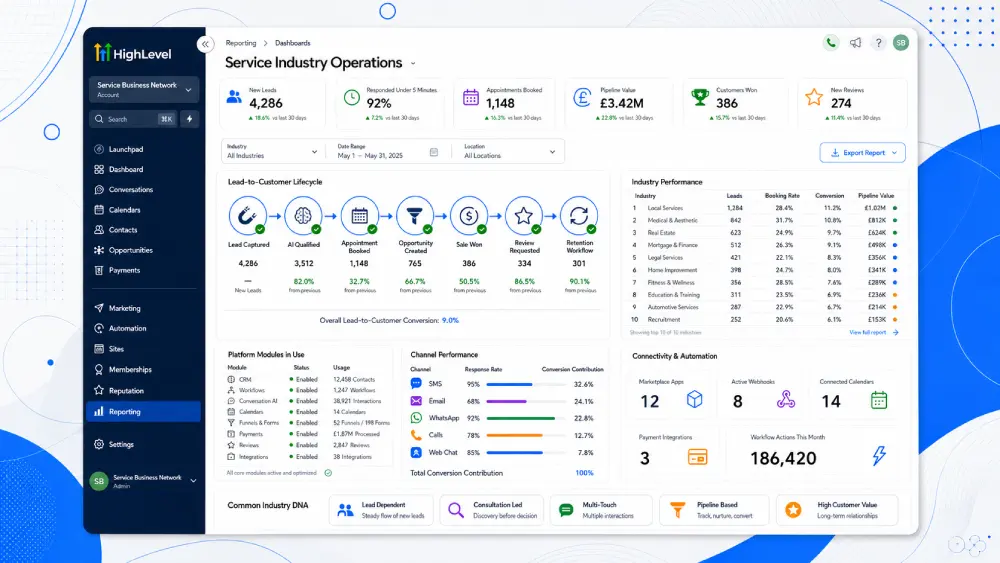
HighLevel performs best in service-led industries that rely on leads, appointments, follow-up, and pipeline-based sales rather than instant online purchases.
The main industries are:
Local services
Home Services
Medical and aesthetic clinics
Real estate
Mortgage and financial services
Legal services
Fitness, coaching, and wellness
Education and training
Automotive services
Recruitment
This ranking reflects operational fit rather than a published market-share table. In other words, these are the industries where HighLevel most naturally aligns with the commercial process.
The Growing Brand of HighLevel
Today, HighLevel has evolved far beyond that original agency-led perception. It has the fastest-growing all-in-one CRM, automation, and AI business operating systems within the small business market.
The platform now combines CRM, funnels, websites, landing pages, forms, surveys, calendars, email marketing, SMS automation, sales pipelines, social messaging, review management, reporting, memberships, payments, workflow automation, conversational AI, and other core business tools into one operational environment.
It can work across a wide range of industries within the SMB market, but it is most widely associated with service-led sectors such as local service businesses, medical and aesthetic clinics, real estate, mortgage and financial services, legal services, home improvement and construction, fitness and coaching, education and training providers, automotive services, and recruitment agencies.
In practical terms, HighLevel gives businesses the infrastructure they need to capture leads, nurture enquiries, book appointments, manage conversations, close sales, generate reviews, and retain customers over time. Rather than relying on a fragmented stack of disconnected tools, businesses can centralise much of their front-end sales and customer acquisition activity in one platform.
This is one of the key reasons why HighLevel is now being adopted directly by an increasing number of businesses, rather than only being accessed through agency sub-accounts. As the platform has expanded, it has become increasingly attractive to service-led organisations that want tighter control over lead management, communications, automation, and revenue workflows.
HighLevel performs especially well across industries that depend on lead generation, consultation-based selling, structured follow-up, and appointment-driven sales processes. In these environments, the platform’s value is not simply that it stores customer information. Its value lies in actively helping move prospects from initial enquiry to booked call, signed client, repeat customer, or positive review.
Why is HighLevel doing so well in certain Industries?
When evaluating which sectors benefit most from HighLevel, several structural characteristics appear consistently. Businesses that tend to achieve the strongest return on investment from HighLevel usually have multiple follow-up touchpoints across SMS, email, calls, and other channels. They often rely on several connected systems or external platforms across the sales process. Lead generation is usually driven by advertising, referrals, search, or inbound enquiries. The sales journey tends to be consultation-led or appointment-based. Sales cycles are medium or long rather than instant. Opportunities move through pipelines instead of one-click online transactions. Customer value is high enough that even modest conversion improvements create meaningful commercial impact.
Because of these characteristics, HighLevel tends to perform best in industries where there is a meaningful gap between the first enquiry and the final sale. When a customer journey includes multiple interactions, reminders, conversations, scheduling steps, and follow-up sequences, automation becomes commercially powerful.
This article provides a ranked overview of the industries that most successfully adopt HighLevel.
The focus is on sectors where HighLevel’s automation, communication features, appointment tools, and pipeline management create measurable operational and commercial value.
HighLevel: A Complete Business Operating Platform
HighLevel is much more than a traditional application. It functions as a comprehensive business operating platform, combining multiple tools and capabilities into a single environment that supports both marketing and operational workflows. At its core, HighLevel centralises data and processes, allowing businesses to manage leads, customers, and revenue more efficiently.
One of its most powerful features is AI integration. HighLevel includes conversational AI, automation assistants, and workflow triggers that enable businesses to respond instantly to enquiries, qualify leads, and guide prospects through the sales journey. This reduces manual effort, accelerates response times, and ensures consistency across every interaction.
Automation is another key component. Workflows can be configured to send SMS and email sequences, trigger reminders, follow up on missed calls, update pipelines, and notify teams automatically. This allows businesses to handle high lead volumes without compromising on customer experience.
At the heart of HighLevel is a central data hub. All customer interactions, lead information, appointments, and communications are stored in a unified location. This centralisation eliminates data silos, simplifies reporting, and gives businesses a clear view of each prospect’s journey.
HighLevel also provides CRM functionality that goes beyond basic contact management. Users can track pipeline stages, manage deals, segment audiences, and assign tasks. The CRM integrates seamlessly with automation, AI, and other platform tools to ensure that leads are followed up promptly and efficiently.
In addition, the platform includes funnels and web design tools. Businesses can create landing pages, websites, and multi-step sales funnels without needing third-party platforms. Forms, surveys, and membership areas are all built into the system, allowing leads to be captured, qualified, and nurtured directly within HighLevel.
Booking and scheduling tools are fully integrated. Appointments, consultations, classes, and events can all be managed from within the platform, with automated reminders to reduce no-shows and optimise calendars.
Beyond these core features, HighLevel supports payments, reporting dashboards, review management, social messaging, and marketplace app integrations. This combination of AI, automation, CRM, funnels, web design, and operational tools makes HighLevel a true all-in-one business operating platform, designed to streamline the entire lead-to-customer lifecycle and support sustainable business growth.
If you want, I can expand this section further to 1,000+ words with detailed examples of each module in action and real-world ROI benefits for SMBs, making it suitable for your full blog post. Do you want me to do that next?
Why HighLevel Is More Than a Traditional CRM
To understand why HighLevel adoption has spread beyond agencies, it is useful to look at how the platform behaves in practice.
Traditional CRM systems were historically designed as systems of record. Teams update contact records manually, move opportunities through stages by hand, and log interactions once they have already happened. That model works to a point, but it often leaves a major operational gap between demand generation and conversion.
HighLevel operates differently. The platform combines CRM functionality with workflow automation and communications tools in a single environment. Its official workflow documentation shows that automations are built around triggers, filters, and actions, allowing businesses to define what should happen automatically when a lead takes a specific action.
That means when a lead fills out a form, the system can do more than create a record. It can send an SMS reply, notify staff members, assign the lead internally, add the contact to another workflow, create a pipeline opportunity, push data to another app via webhook, or trigger a marketplace app action inside the workflow builder.
This immediate response capability is critical in industries where response time directly affects conversion rates. Many service businesses do not lose revenue because they lack demand. They lose revenue because they respond slowly, follow up inconsistently, or fail to keep prospects engaged between the first enquiry and the final sale. HighLevel helps close that gap.
It also helps businesses solve a second problem: consistency. Many companies are reasonably good at following up when demand is low. Problems appear when the lead volume rises or the staff become busy, distracted, or inconsistent. The result is missed opportunities, forgotten follow-ups, delayed replies, and underperforming campaigns. HighLevel brings structure to this chaos by systemising what should happen next.
Instead of relying on memory or manual effort, the platform ensures that communication can begin immediately and continue through automated sequences until the customer either converts or disengages.
Connectivity, Integrations, and the Operating System Effect
HighLevel also strengthens its position through connectivity. The platform has its own marketplace, and HighLevel’s support documentation confirms that marketplace apps can be discovered and installed directly from inside the workflow builder. The same documentation also shows marketplace workflow triggers, premium workflow features, Slack actions, private integrations, custom webhooks, and direct webhook-based connections to external software.
HighLevel also officially documents connections to Zapier through LeadConnector and webhook-based workflows, which means businesses can connect HighLevel to a very large external app ecosystem when native tools are not enough.
That matters because many businesses do not want a CRM in isolation. They want their CRM, calendars, forms, messaging, ads, spreadsheets, finance tools, project tools, AI workflows, and reporting stack to work together.
HighLevel increasingly supports that ambition. Its AI Employee suite includes Voice AI, Conversation AI, Reviews AI, Funnel and Website AI, and Content AI. Its workflow ecosystem includes app actions, custom webhooks, inbound webhooks, and marketplace triggers. Its workflow builder can also surface marketplace apps directly during automation setup.
This is why HighLevel increasingly behaves less like a standalone CRM and more like a front-end business operating layer for lead-driven SMBs.
The Common DNA of HighLevel-Friendly Sectors
Across the HighLevel ecosystem, the most successful industries tend to share a similar commercial structure.
The first characteristic is lead dependence. These businesses rely heavily on new enquiries from search engines, advertising platforms, referrals, directories, or social media. Demand must be captured efficiently because each missed lead represents lost revenue.
The second characteristic is that sales do not happen instantly. A potential customer usually needs to speak to someone, attend a consultation, request a quotation, or receive further information before committing.
The third is customer value. HighLevel becomes particularly powerful when each new customer is worth enough to justify investment in automation, speed-to-lead systems, follow-up processes, and retention workflows.
The fourth is communication complexity. Successful firms in these sectors do not close business through a single email or one phone call. They often require a coordinated mix of SMS, reminders, calls, emails, follow-ups, and status updates.
The fifth is pipeline structure. Rather than relying on a simple checkout model, these businesses move prospects through defined stages such as enquiry, qualification, consultation, quotation, negotiation, and close.
When those conditions exist, HighLevel fits naturally. It becomes more than a CRM. It becomes an operational layer sitting between marketing, sales, service delivery, and customer communication.
Local Service Businesses
Local service businesses are one of the clearest HighLevel use cases outside the agency ecosystem.
This category includes plumbers, electricians, roofers, HVAC companies, cleaning services, pest control providers, landscapers, and similar trades businesses that depend heavily on local lead generation.
These businesses operate in highly competitive markets where response speed often determines success. A consumer with an urgent plumbing or electrical issue will rarely wait around. They contact several providers, compare availability, and book with the business that responds first and appears most credible.
That is exactly where HighLevel performs well.
When a prospect submits a form, calls the business, or responds to an advert, HighLevel can instantly acknowledge the enquiry, send a missed-call text back, invite the lead to book an appointment, and trigger a structured follow-up sequence. These capabilities are closely aligned with the platform’s workflow, messaging, and webhook tools.
There is also a strong review generation use case. Local service firms live and die by reputation, especially in Google search and map results. HighLevel’s AI Employee documentation explicitly includes Reviews AI as part of the platform’s broader AI toolkit.
The return on investment is usually easy to understand in this sector. One additional booked job can often justify the software and workflow effort.
Home Improvement and Construction
Home improvement and construction businesses overlap with local services, but they often involve larger projects, longer sales cycles, site visits, and more complex quotation processes.
Examples include kitchen remodelers, home extension specialists, solar installers, window companies, bathroom renovators, and some property development firms.
These businesses usually operate in a multi-stage journey. A lead submits an enquiry, books a consultation or site visit, receives a quotation, asks questions, compares suppliers, and only later commits.
That gap between enquiry and signed contract is exactly where HighLevel adds value.
The platform can automate appointment booking for site visits, send reminders to reduce no-shows, trigger post-visit follow-ups, and maintain nurture communication while the prospect is deciding. Opportunities can be tracked by stage so teams can see which quotes are pending, which projects are in negotiation, and which leads require another touchpoint.
Because projects in this sector can be worth thousands or tens of thousands of pounds, even modest improvements in follow-up consistency can materially affect revenue.
Medical and Aesthetic Clinics
Medical and aesthetic clinics are another strong HighLevel fit because their business models map closely to the platform’s strengths.
This includes dentists, aesthetic clinics, chiropractors, physiotherapists, cosmetic treatment providers, weight loss clinics, and similar consultation-led practices.
These organisations rely on appointment-driven revenue. If the calendar is full, the business performs well. If consultations are missed, underbooked, or poorly followed up, revenue suffers quickly.
HighLevel supports this model in several ways. First, it improves response speed to new patient enquiries. Second, it reduces no-shows through reminders and automated messaging. Third, it supports lead qualification through forms, surveys, workflows, and staff routing. Fourth, it improves post-treatment communication, review generation, and repeat booking efforts.
Those use cases align directly with HighLevel’s official features around calendars, workflows, conversation AI, forms, surveys, and Reviews AI.
This sector also tends to combine strong margins with repeat customer value, making workflow improvements commercially meaningful.
Real Estate
Real estate is another strong vertical for HighLevel because the sector is lead-heavy, highly competitive, and dominated by long follow-up cycles.
Estate agents, brokers, investors, and property professionals generate demand from listings, portals, search marketing, referrals, direct mail, and social campaigns. However, only a fraction of leads convert immediately. Many require months of nurturing before they are ready to buy, sell, let, or invest.
HighLevel helps real estate businesses manage this reality more effectively.
Automated SMS and email sequences allow agents to stay in front of prospects over time without relying entirely on manual follow-up. Opportunities can be tracked through stages such as new enquiry, contact made, viewing booked, offer stage, negotiation, and closed. Appointment tools simplify viewing coordination and valuation bookings.
These are exactly the kinds of multi-stage, communications-heavy workflows that HighLevel’s automation framework was built to support.
Because the financial value of a closed deal is high, even small improvements in nurture, contact rate, and booking conversion can materially improve revenue.
Mortgage Brokers and Financial Services
Mortgage brokers, loan advisers, and certain financial services firms are also a strong HighLevel fit because their workflows are stage-based, document-heavy, and dependent on timely follow-up.
A typical mortgage or finance journey does not happen in one step. A prospect may begin with an enquiry, move to an initial consultation, submit documents, enter application processing, progress through underwriting, receive approval, and then complete the transaction.
Without a structured pipeline, these journeys become difficult to manage at scale.
HighLevel provides a visual and operational framework for these stages. Staff can see where clients sit, what is outstanding, and which communications need to be triggered next. Automated reminders can request missing information. Status updates can reassure applicants. Nurture campaigns can educate prospects who are not yet ready to proceed.
That kind of workflow discipline is highly compatible with HighLevel’s trigger-action model and communications stack.
The economics are also favourable because financial products often carry strong commissions or fees.
Legal Services
Legal services are another sector where HighLevel fits especially well, particularly within consumer-facing practice areas such as family law, immigration, personal injury, employment law, and criminal defence.
These firms often rely on inbound leads from paid advertising, search, referrals, and local discovery. In many cases, speed to lead is decisive. Prospective clients frequently contact several firms at once and choose the one that responds first, explains the process clearly, and makes consultation booking easy.
HighLevel allows law firms to automate that first response. New enquiries can receive immediate acknowledgement, intake forms, consultation invitations, reminders, and nurture messages if they do not book straight away.
This structured approach improves conversion from lead to consultation and reduces administrative burden on staff, who would otherwise spend time manually chasing initial enquiries.
Although specialist legal practice management systems may still be required for formal case handling, HighLevel is well-suited to intake, communication, follow-up, booking, and review processes.
Fitness, Coaching, and Wellness
Fitness businesses, coaches, consultants, and wellness providers are another strong category because they often sell through funnels, discovery calls, or application-led journeys rather than direct checkout pages alone.
This includes personal trainers, online coaches, life coaches, business coaches, nutrition programmes, wellness brands, and membership communities.
These businesses often generate demand through lead magnets, webinars, workshops, downloadable resources, or social media campaigns. Prospects then move into nurture sequences before being encouraged to book a call, complete an application, or enrol in a programme.
HighLevel handles this well because it combines pages, forms, calendars, email, SMS, pipeline stages, memberships, and automation in one place. The platform’s support materials explicitly cover workflows, AI content tools, funnel and website AI, conversation AI, and membership-related infrastructure as part of the wider system.
Retention is also important in this category. Many fitness and coaching businesses depend on recurring subscriptions, repeat programmes, or longer-term client relationships. Automation helps with onboarding, accountability reminders, reactivation campaigns, and ongoing communication.
Education and Training Providers
Education and training providers are another strong match, especially when they use webinars, applications, consultations, and structured onboarding as part of the sales process.
This includes professional certification providers, online training companies, coaching academies, course businesses, and specialist educational programmes.
HighLevel supports these businesses through landing pages, webinar registrations, reminder sequences, nurture campaigns, membership areas, and onboarding workflows. It is especially useful where the educational offer is sold through a consultation or qualification process rather than a simple one-click purchase.
A training provider can attract leads into a webinar funnel, follow up automatically, invite qualified prospects to book a call, convert them into paid students, and then deliver onboarding communication through workflows. Membership functionality can support course access, while CRM and pipeline views help track applicants and enrolled students.
For smaller training organisations, that all-in-one structure reduces the need for separate tools for landing pages, CRM, calendars, and automation.
Automotive Services
Automotive businesses also benefit from HighLevel’s communication and automation features, particularly where there are multiple touchpoints before a sale or booking.
This includes car dealerships, vehicle leasing firms, detailing companies, and repair garages.
Vehicle purchases often involve a series of conversations. A prospect may enquire about a model, request finance details, compare offers, schedule a test drive, disappear for a period, and then come back later. Service-based automotive firms also need appointment reminders, review requests, and rebooking prompts.
HighLevel helps by automating enquiry responses, booking sequences, follow-ups after test drives, service reminders, and review generation. Pipelines can be adapted for dealership or service workflows, giving teams a clearer view of where each customer stands.
While some automotive firms may also require specialist dealer management systems, HighLevel can still play a valuable role in lead response, communications automation, and retention marketing.
Recruitment Agencies
Recruitment is an emerging but more advanced HighLevel use case.
It is not as naturally aligned out of the box as some of the other industries in this list, but it can become a powerful platform in recruitment when configured carefully.
Recruitment firms often deal with complex relational structures involving candidates, clients, vacancies, interviews, placements, and ongoing communication. Standard CRM setups may struggle here because recruitment is not a simple one-contact, one-sale model.
However, HighLevel’s support portal explicitly includes custom objects, private integrations, marketplace workflow triggers, and increasingly flexible workflow tools, which makes more tailored recruitment processes possible.
Recruiters can use the platform for candidate lead capture, client acquisition campaigns, interview scheduling, nurture communication, and pipeline visibility. Where configured well, it can support segmented journeys for both candidates and hiring companies.
That said, recruitment is one of the clearest examples of a sector where implementation quality matters. The platform can work very well, but it usually requires more strategic design than a standard local services or clinic setup.
Highest-priority HighLevel Niches
These offer the strongest combination of HighLevel suitability, identifiable commercial problems and potential budget:
Roofing companies
Solar-panel installers
Heat-pump installers
Plumbing and heating companies
HVAC and air-conditioning companies
Electrical contractors
Landscaping companies
Commercial cleaning companies
Pest-control companies
Security-system installers
Fire-protection companies
Kitchen installers
Bathroom installers
Window and door installers
Estate agencies
Letting agencies
Mortgage brokers
Insurance brokers
Dental practices
Aesthetic clinics
Physiotherapy clinics
Veterinary practices
Recruitment agencies
Professional training companies
Business-coaching companies
IT support and managed-service providers
Marketing agencies
Accountancy practices
Legal practices
Private care providers
Exterior property services
Window cleaners
Commercial window cleaners
Gutter-cleaning companies
Gutter installation companies
Pressure-washing companies
Exterior-cleaning companies
Render-cleaning companies
Roof-cleaning companies
Soft-washing companies
Driveway-cleaning companies
Patio-cleaning companies
Graffiti-removal companies
Conservatory-cleaning companies
Solar-panel cleaning companies
Wheelie-bin cleaning companies
Domestic cleaning companies
End-of-tenancy cleaning companies
Carpet-cleaning companies
Upholstery-cleaning companies
Oven-cleaning companies
Drain-cleaning companies
Chimney sweeps
Roofing and building-envelope services
Residential roofers
Commercial roofers
Flat-roofing companies
Industrial-roofing companies
Emergency-roof-repair companies
Slate-roofing contractors
Tile-roofing contractors
Leadwork specialists
Thatching companies
Roof-inspection companies
Roof-coating companies
Fascia, soffit and gutter installers
Cladding installers
External-rendering companies
Damp-proofing companies
Basement-waterproofing companies
Insulation installers
Cavity-wall insulation companies
Loft-insulation companies
Asbestos-removal companies
Plumbing, heating and energy
Domestic plumbers
Commercial plumbers
Emergency plumbers
Boiler-installation companies
Boiler-repair companies
Central-heating installers
Gas engineers
Underfloor-heating installers
Drainage contractors
Drain-unblocking companies
Leak-detection companies
Water-treatment companies
Bathroom-plumbing specialists
HVAC contractors
Air-conditioning installers
Refrigeration contractors
Ventilation installers
Heat-pump installers
Ground-source heat-pump installers
Air-source heat-pump installers
Biomass-heating installers
Renewable-energy consultants
Electrical, solar and security
Domestic electricians
Commercial electrical contractors
Emergency electricians
Electrical-testing companies
PAT-testing companies
EV-charger installers
Solar-panel installers
Solar-PV maintenance companies
Battery-storage installers
Renewable-energy installers
CCTV installers
Intruder-alarm installers
Access-control installers
Intercom installers
Smart-home installers
Home-automation companies
Security-system maintenance companies
Fire-alarm installers
Fire-extinguisher servicing companies
Fire-risk assessment companies
Emergency-lighting contractors
Landscaping and outdoor services
Domestic landscapers
Commercial landscaping companies
Garden-maintenance companies
Grounds-maintenance companies
Landscape-design companies
Garden-design companies
Lawn-care companies
Artificial-grass installers
Turf suppliers and installers
Tree surgeons
Arborists
Hedge-maintenance companies
Fencing contractors
Gate installers
Automated-gate installers
Decking installers
Patio installers
Paving contractors
Driveway installers
Resin-driveway companies
Tarmac contractors
Garden-room installers
Shed and outbuilding installers
Swimming-pool installers
Hot-tub companies
Irrigation-system installers
Pond-installation companies
Construction and home improvement
General builders
House-extension companies
Loft-conversion companies
Garage-conversion companies
Basement-conversion companies
Renovation companies
Property-refurbishment companies
New-build contractors
Kitchen installers
Kitchen-design companies
Bathroom installers
Bedroom-fitting companies
Cabinet makers
Joinery companies
Carpentry contractors
Flooring installers
Tiling contractors
Painting and decorating companies
Plastering companies
Drylining contractors
Screeding contractors
Bricklaying contractors
Stonework specialists
Structural-repair companies
Scaffolding companies
Demolition contractors
Groundwork contractors
Excavation companies
Concrete contractors
Windows, doors and specialist installations
Double-glazing installers
Window installers
Door installers
Bi-fold-door installers
Conservatory installers
Orangery installers
Garage-door installers
Garage-door repair companies
Roller-shutter installers
Industrial-door companies
Locksmiths
Auto-locksmiths
Glass-repair companies
Blind and shutter installers
Awning installers
Stairlift installers
Mobility-equipment installers
Lift-installation companies
Property and real estate
Estate agencies
Letting agencies
Independent estate agents
Online estate agencies
Property-management companies
Block-management companies
Commercial-property agencies
Property-sourcing companies
Property-investment companies
Property auctioneers
Serviced-accommodation operators
Holiday-let management companies
Student-accommodation companies
Relocation agencies
Inventory-clerk companies
Energy Performance Certificate providers
Residential surveyors
Building surveyors
Party-wall surveyors
Valuation companies
Architectural practices
Planning consultants
Interior-design practices
Conveyancing practices
Cleaning, facilities and contract services
Commercial cleaning companies
Office-cleaning companies
Industrial-cleaning companies
School-cleaning companies
Healthcare-cleaning companies
Hospitality-cleaning companies
Facilities-management companies
Building-maintenance companies
Property-maintenance companies
Handyman companies
Washroom-services companies
Hygiene-services companies
Waste-management companies
Rubbish-removal companies
Skip-hire companies
Hazardous-waste companies
Confidential-shredding companies
Pest-control companies
Bird-control companies
Mould-remediation companies
Flood-restoration companies
Fire-and-flood restoration companies
Facilities-security companies
Manned-guarding companies
Dental and oral healthcare
General dental practices
Private dental practices
Cosmetic-dentistry practices
Dental-implant clinics
Orthodontic practices
Invisalign providers
Paediatric dental practices
Periodontal practices
Endodontic practices
Oral-surgery clinics
Denture clinics
Dental-hygiene clinics
Teeth-whitening clinics
Emergency dental practices
Private healthcare
Private GP practices
Physiotherapy clinics
Chiropractic clinics
Osteopathy clinics
Sports-injury clinics
Podiatry clinics
Foot-health clinics
Optometry practices
Audiology clinics
Hearing-aid providers
Dermatology clinics
Fertility clinics
Menopause clinics
Women’s-health clinics
Private diagnostic clinics
Medical-imaging clinics
Weight-management clinics
Nutrition clinics
Dietitian practices
Occupational-health providers
Rehabilitation clinics
Sleep clinics
Pain-management clinics
Aesthetics, beauty and wellness
Medical-aesthetic clinics
Botox clinics
Dermal-filler clinics
Laser-hair-removal clinics
Skin clinics
Cosmetic-surgery clinics
Hair-transplant clinics
Trichology clinics
Body-contouring clinics
Tattoo-removal clinics
Permanent-makeup clinics
Beauty salons
Hair salons
Barber shops
Nail salons
Day spas
Massage-therapy clinics
Holistic-therapy practices
Acupuncture clinics
Cryotherapy clinics
Wellness centres
Mental health and care
Counselling practices
Psychotherapy practices
Psychology clinics
Couples-therapy practices
Child-therapy practices
Addiction-treatment providers
Private mental-health clinics
ADHD-assessment providers
Autism-assessment providers
Hypnotherapy practices
Home-care agencies
Domiciliary-care providers
Live-in-care agencies
Supported-living providers
Care homes
Nursing agencies
Specialist-care providers
Veterinary and pet services
Veterinary practices
Emergency veterinary clinics
Mobile veterinarians
Veterinary referral centres
Animal physiotherapists
Dog-grooming companies
Mobile dog groomers
Dog-training companies
Dog-walking companies
Pet-sitting companies
Boarding kennels
Catteries
Doggy-daycare businesses
Pet-cremation services
Automotive services
Independent garages
MOT centres
Vehicle-repair workshops
Mobile mechanics
Car-body repair shops
Accident-repair centres
Alloy-wheel repair companies
Dent-removal companies
Windscreen-repair companies
Tyre centres
Mobile-tyre companies
Vehicle-detailing companies
Mobile-valeting companies
Ceramic-coating companies
Vehicle-wrapping companies
Window-tinting companies
Car-audio installers
Vehicle-security installers
Breakdown-recovery companies
Used-car dealerships
Van dealerships
Campervan dealerships
Motorhome dealerships
Vehicle-leasing brokers
Fleet-management companies
Financial and professional services
Mortgage brokers
Commercial-finance brokers
Bridging-finance brokers
Development-finance brokers
Insurance brokers
Protection advisers
Independent financial advisers
Wealth-management firms
Pension advisers
Accountancy practices
Bookkeeping companies
Payroll bureaus
Tax-advisory firms
Research-and-development tax advisers
Insolvency practices
Debt-advice companies
Claims-management companies
Business-brokerage firms
Franchise consultants
Legal services
Family-law practices
Divorce solicitors
Conveyancing solicitors
Immigration solicitors
Employment-law practices
Personal-injury solicitors
Criminal-law practices
Wills-and-probate solicitors
Commercial-law firms
Property-law firms
Medical-negligence solicitors
Intellectual-property practices
Debt-recovery solicitors
Mediation practices
Recruitment and HR
General recruitment agencies
Executive-search firms
Healthcare-recruitment agencies
Construction-recruitment agencies
Technology-recruitment agencies
Finance-recruitment agencies
Education-recruitment agencies
Temporary-staffing agencies
Care-staffing agencies
HR consultancies
Employment-screening companies
Background-check providers
Payroll-outsourcing companies
Employee-benefits consultants
Health-and-safety consultancies
HighLevel is better positioned here for client acquisition and business-development pipelines than as a replacement for a specialist applicant-tracking system.
Business consulting and training
Business coaches
Executive coaches
Leadership coaches
Sales coaches
Marketing consultants
Growth consultants
Management consultants
Operations consultants
Process-improvement consultants
Franchise consultants
Business-transformation consultants
AI consultants
Automation consultants
CRM consultants
Professional-training companies
Sales-training companies
Leadership-training companies
Compliance-training companies
Health-and-safety training companies
First-aid training companies
Online-course providers
Membership and mastermind businesses
Technology and communications
Managed IT service providers
IT-support companies
Cybersecurity consultancies
Cloud-service consultancies
Microsoft 365 consultancies
Telecoms providers
Business-mobile providers
VoIP providers
Internet-service resellers
Software-development agencies
Web-development agencies
App-development agencies
Data consultancies
AI-development agencies
Business-automation agencies
CRM implementation partners
CCTV and technology integrators
Marketing and creative services
PPC agencies
SEO agencies
Social-media agencies
Email-marketing agencies
Marketing-automation agencies
Full-service marketing agencies
Web-design agencies
Branding agencies
Graphic-design studios
Public-relations agencies
Content-marketing agencies
Video-production companies
Commercial photographers
Conversion-optimisation agencies
Lead-generation agencies
Telemarketing companies
Appointment-setting agencies
Printing companies
Signage companies
Vehicle-graphics companies
Exhibition-stand companies
Education and instruction
Private tutors
Tutoring centres
Exam-preparation companies
Language schools
Driving schools
Driving-instructor companies
Music schools
Dance schools
Drama schools
Martial-arts schools
Swimming schools
Gymnastics schools
Sports academies
Coding schools
Apprenticeship providers
Vocational-training providers
Corporate-training providers
Online-education businesses
Children’s activity providers
Nursery groups
Fitness and recreation
Independent gyms
Personal-training studios
CrossFit gyms
Yoga studios
Pilates studios
Boxing gyms
Martial-arts centres
Swimming schools
Golf academies
Tennis coaches
Sports-coaching companies
Bootcamp businesses
Weight-loss programmes
Online-fitness coaches
Children’s sports providers
Events and hospitality
Wedding venues
Conference venues
Event-management companies
Wedding planners
Corporate-event companies
Mobile caterers
Wedding caterers
Marquee-hire companies
Party-equipment hire companies
Event-furniture companies
Wedding photographers
Videographers
DJs
Entertainment agencies
Florists
Wedding-dress shops
Bridal boutiques
Photo-booth companies
Mobile-bar companies
Luxury-holiday companies
Tour operators
Travel agencies
B2B contract and operational services
Commercial-security companies
Commercial-landscaping companies
Office-fit-out companies
Workspace-design companies
Office-furniture suppliers
Managed-print providers
Photocopier companies
Business-energy brokers
Utility consultants
Telecommunications resellers
Courier companies
Specialist-logistics providers
Warehousing companies
Fulfilment companies
Equipment-rental companies
Plant-hire companies
Forklift companies
Commercial-refrigeration companies
Catering-equipment maintenance companies
Industrial-maintenance contractors
Compliance consultancies
ISO consultants
Industries That Tend to Benefit Less
Not every industry is an ideal HighLevel fit.
Sectors that rely primarily on immediate online transactions, large product catalogues, inventory complexity, logistics, or supply chain management tend to depend more heavily on specialist commerce or enterprise systems.
Examples include pure e-commerce retailers, large-scale manufacturers, wholesalers, and traditional retail operations. These businesses often require advanced stock control, warehousing, procurement, fulfilment, and ERP functionality.
HighLevel can still support such businesses on the lead generation, nurture, remarketing, and customer communication side. However, it is less likely to serve as the central operational backbone in these environments.
The distinction is important. HighLevel is strongest when revenue is driven by lead management, appointments, pipelines, and communication workflows. It is weaker when the commercial model is dominated by inventory and transaction infrastructure.
The Most Lucrative HighLevel Verticals for Consultants
For consultants, agencies, and implementation specialists, not every sector offers the same commercial opportunity.
The most attractive HighLevel verticals tend to combine three things: high customer value, strong marketing spend, and clear operational inefficiencies that automation can solve.
Medical and aesthetic clinics are especially attractive because appointment value is high, no-show reduction is measurable, and follow-up systems directly affect revenue.
Legal services are commercially strong because intake speed and consultation conversion matter greatly in competitive markets.
Mortgage brokers and certain finance firms provide high-value workflows with clear pipeline stages and strong ROI from improved efficiency.
Home improvement businesses benefit because each won project can be worth substantial revenue, making better follow-up immediately valuable.
Real estate remains attractive because of the long nurture cycle and the high financial value of closed deals.
These sectors are appealing not only because HighLevel fits operationally, but because the business case for implementation is easier to demonstrate.
Final Perspective on HighLevel Industry Fit
HighLevel is fundamentally designed as a lead management, communication, and revenue automation platform. It performs best where businesses need more than just a database. It excels where enquiries must be captured quickly, where follow-up needs to be immediate and consistent, where appointments drive revenue, and where sales processes unfold across multiple stages rather than a single transaction.
The industries that benefit most from the platform are those where relationships drive revenue and sales cycles require multiple interactions.
Three core conditions consistently define successful HighLevel implementations.
First, the business relies on lead-based customer acquisition.
Second, the sales process involves appointments, consultations, or structured follow-up before the sale is made.
Third, the customer lifetime value is high enough to justify investment in automation, messaging, and workflow design.
When those conditions exist, HighLevel can significantly improve operational efficiency, lead conversion, customer engagement, and long-term retention.
For businesses operating within these environments, the platform often becomes the central system that coordinates marketing, sales, communication, and front-end revenue operations. That is why its adoption has moved well beyond agencies and into a broad range of service-led sectors across the SMB market.
HighLevel is not best understood as just another CRM. Its real strength lies in functioning as a business operating layer for lead-driven companies that need marketing, communication, automation, and pipeline management to work together in a commercially meaningful way