
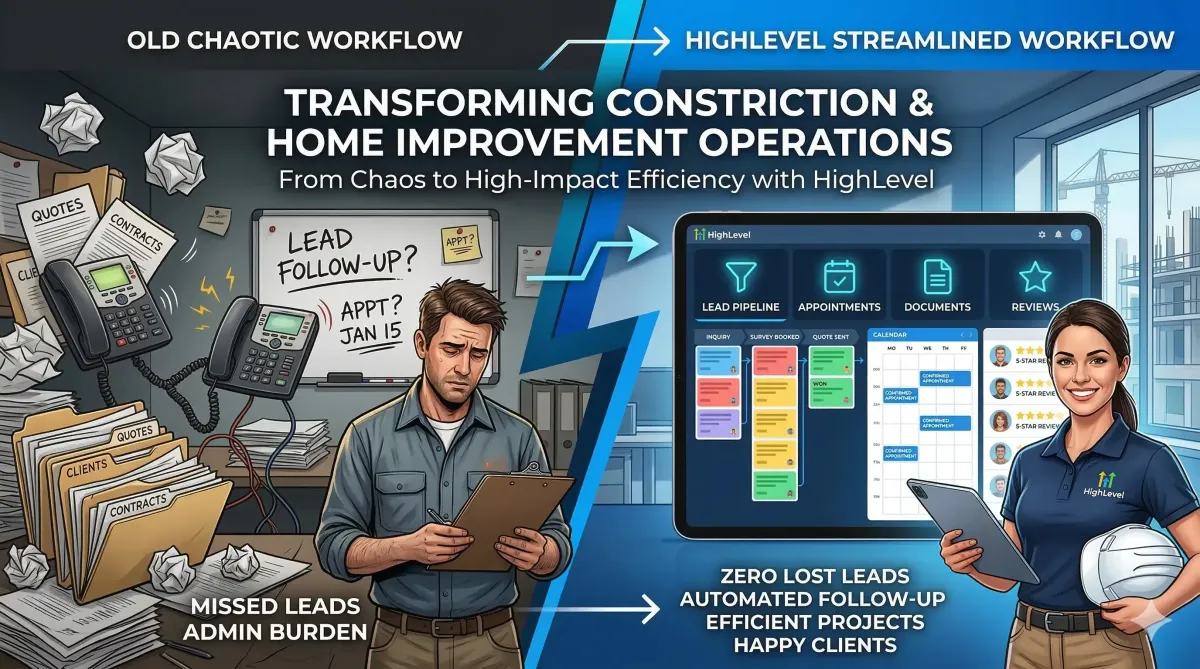
HighLevel for Home Improvement and Construction
Home improvement and construction businesses operate in a uniquely demanding environment. Unlike retail transactions where customers purchase immediately, projects in this sector typically involve multiple stages over extended periods. A homeowner may submit an enquiry, book a consultation or site visit, receive a detailed quotation, ask questions, compare suppliers, and only later commit to proceeding. That gap between enquiry and signed contract is exactly where operational systems make the difference between thriving and merely surviving.
HighLevel provides a complete operating platform that transforms how home improvement and construction businesses manage their operations. Unlike conventional CRM systems that primarily store contact information, HighLevel actively manages the entire customer journey from first click through to completed project and beyond. It combines lead capture, automated follow-up, appointment scheduling, pipeline management, communication tools, document collection, and review generation within a single environment.
Why Home Improvement and Construction Businesses Achieve Strong Results with HighLevel
Several structural characteristics make home improvement and construction particularly well-suited to HighLevel's capabilities. Understanding these characteristics explains why the platform delivers measurable commercial impact in this sector.
Lead-Heavy Business Models with High Stakes
Home improvement businesses depend entirely on incoming enquiries. Kitchen remodelers, extension specialists, solar installers, window companies, bathroom renovators, and property development firms generate demand through search advertising, social media, referrals, and local presence. Each enquiry represents potential project revenue, but only if handled promptly and professionally.
Research consistently shows that leads contacted within the first five minutes are over four times more likely to convert, while delayed follow-ups cause significant opportunity loss. In home improvement and construction, where projects can be worth thousands or tens of thousands of pounds, the cost of slow response is substantial.
Consultation-Led Sales Processes
Unlike e-commerce transactions, home improvement projects require consultation before any commitment. A homeowner considering a kitchen refurbishment needs to discuss options, understand materials, see examples, and build trust with the contractor. A property developer requires detailed feasibility analysis before proceeding.
These consultations are critical conversion points. HighLevel supports the entire journey from initial enquiry through consultation booking, pre-consultation information gathering, post-consultation follow-up, and contract signing. Each stage can be automated to ensure no potential client falls through the cracks.
Long Sales Cycles and Extended Nurturing
Home improvement decisions are rarely made quickly. Homeowners may take weeks or months to decide between contractors, compare quotes, arrange finance, and commit to proceeding. During this period, consistent nurturing is essential to maintain engagement and prevent competitors from winning the work.
HighLevel automates this nurturing through structured sequences that maintain contact, provide valuable information, and keep the contractor top of mind throughout the decision process. For high-end builders facing cautious buyers and longer decision cycles, a disciplined lead handoff system becomes essential to protect margin while rates and market conditions fluctuate.
High Individual Project Value
Each project in home improvement and construction represents significant revenue. Even modest improvements in conversion rates, response times, or follow-up effectiveness translate directly into bottom-line impact. A single additional signed contract can justify the entire investment in systems and automation.
Multi-Stage Project Journeys
Construction projects follow predictable but complex journeys. A typical project might progress through: enquiry, consultation, site survey, quotation, negotiation, contract signed, deposit paid, planning, material ordering, construction, inspections, completion, and final payment. Each stage requires different communications, documents, and coordination.
HighLevel's pipeline functionality mirrors these real-world processes. Opportunities move through custom stages that reflect exactly how each business operates. Automation ensures that movement between stages triggers appropriate actions, such as sending a reminder when a quotation remains unsigned, notifying the team when a deposit is received, or prompting a satisfaction check after project completion.
Multi-Channel Communication Requirements
Home improvement professionals must communicate across multiple channels to meet client preferences. SMS works well for appointment reminders and quick updates. Email suits detailed information, quotations, and status updates. Phone calls build relationships and handle sensitive discussions about budgets and timelines.
HighLevel unifies these channels within a single platform, ensuring consistent communication regardless of how clients choose to interact. The platform's workflow automation can coordinate multi-channel sequences that keep clients informed throughout the entire project lifecycle.

Core HighLevel Features That Support Home Improvement and Construction Operations
The platform brings together multiple tools that address every stage of the project journey, from first contact through to completed work and beyond.
Lead Capture and Qualification
Forms, landing pages, and surveys capture enquiries from multiple sources and feed them directly into the system. Whether a lead comes from a Google search, a social media advert, a website enquiry, or a referral, HighLevel creates a contact record and begins tracking the interaction.
Qualification can be automated through intelligent forms that gather relevant information before the first conversation. A kitchen renovation enquiry form might ask about property type, budget range, project timeline, and specific requirements. A solar installation enquiry could collect details about property size, current energy usage, and roof orientation. This information flows directly into the contact record, allowing surveyors and sales staff to prepare appropriately and reducing the need for repetitive questions during initial conversations.
Digital intake forms with conditional logic help streamline the process by tailoring questions based on each client's responses. Instead of showing a long, generic form, logic-based triggers ensure that only relevant fields appear. If a client selects "Extension," the form can automatically populate questions about property type, planning permission status, and desired timeline. This speeds up completion and ensures the team receives precise, actionable information from the start.
Automated Lead Response and Follow-Up
The speed of response directly affects conversion in home improvement. With automated immediate responses, every enquiry receives instant acknowledgement regardless of when it arrives or whether sales staff are available. This speed advantage translates directly into more consultations and signed contracts.
A documented case study of a home remodelling business shows the transformative impact of automated lead response. Before implementing an automated lead-to-appointment conversion system, leads were coming from advertising but often contacted too late, with no centralised tracking of response times, no automation for confirmations and reminders, and sales teams missing appointments. After implementation, the business achieved zero lost leads, dramatically faster response times, and the lead-to-appointment conversion rate improved by 23%.
HighLevel's missed call text-back feature ensures that when a hot lead calls outside business hours or while staff are with other clients, an automated text is sent immediately, capturing the enquiry and preventing loss to competitors.
Beyond the initial response, automated nurture sequences maintain engagement over time. For leads that aren't ready to proceed immediately, follow-up sequences via SMS and email can share project galleries, client testimonials, case studies, and answers to frequently asked questions, keeping the firm present in the prospect's mind until they are ready to act.
Appointment Scheduling Optimisation
Integrated calendars and booking pages allow potential clients to schedule consultations and site visits at their convenience. The system synchronises with the surveyor and sales team availability, prevents double-bookings, and sends automated confirmations immediately after booking.
Different consultation types can be offered through dedicated booking links: "Initial Design Consultation," "Site Survey Booking," or "Showroom Appointment." This clarity helps qualify leads before the conversation begins.
Automated reminders significantly reduce no-shows, which cost firms wasted time and lost opportunities. A typical reminder sequence might include confirmation immediately upon booking, a reminder two days before, and a final confirmation on the day, with any preparation instructions such as property details to have ready or questions to consider.
In documented case studies, automated appointment systems have reduced no-shows by over 40%. For a busy home improvement business, this represents hours of recovered staff time each week.
Pipeline Management for Every Project
Custom pipelines give visibility into every lead and project status. Rather than relying on spreadsheets, sticky notes, or memory, teams can see exactly where each opportunity sits and what needs to happen next.
A typical home improvement pipeline might include these stages:
New enquiry receives automated acknowledgement and assignment to the appropriate team member. Consultation booked sends calendar invites and reminders to both client and staff. Site survey completed logs findings, and triggers quotation preparation. Quote sent tracks whether the proposal has been opened and viewed. Negotiation in progress flags for follow-up and handles questions. Contract signed celebrates milestone and begins project setup. Deposit received triggers material ordering and scheduling. Planning and approvals track any permissions required. Construction in progress manages ongoing work and client updates. Completion celebrates project finish and begins post-project follow-up.
Each stage can have its own automation, ensuring consistent handling regardless of project volume. Teams can see at a glance which opportunities need attention, which are progressing well, and which have stalled and require intervention.
In the roofing sector specifically, common pipeline stages include New Lead, Scheduled, Quote Sent, Won, and Lost. More detailed pipelines might extend to Appt Set, Appt Confirmed, Inspected, and Contract Won/Lost.
Document Collection and Contract Management
Construction projects involve significant paperwork: quotations, contracts, plans, specifications, permissions, and countless other documents. Chasing documents and paperwork wastes hours each week for most firms. HighLevel helps manage this complexity through automated document workflows and task reminders.
When a project reaches the contract stage, the system can automatically send engagement letters and contracts through integrated e-signature platforms. Clients can review and sign documents on any device, with automated reminders ensuring they don't forget to complete the process.
For projects requiring multiple approvals or stages, document workflows can be configured to send the right documents at the right time. When one document is signed, the system can automatically trigger the next, guiding both client and contractor through the process seamlessly.
Integration with QuickBooks API for financial tracking allows invoices and payments to sync automatically, ensuring that financial records remain up to date without manual data entry.
Job Scheduling and Crew Management
For construction businesses with multiple projects and teams, coordinating resources efficiently is essential. HighLevel's scheduling tools can manage job assignments, crew notifications, and timeline tracking.
When a project is confirmed and materials ordered, the system can automatically assign crew members, send them project details and schedules, and notify them of any changes. Crew members can receive mobile notifications about their assignments, reducing the need for manual coordination.
For businesses managing multiple locations, receptionists and dispatchers must be able to quickly switch between locations and access relevant project information. HighLevel's multi-location capabilities support this requirement, ensuring that teams have the information they need regardless of which project or location they are supporting.
Automated Status Updates
Clients value transparency throughout the construction process. Yet keeping every client informed of progress manually is time-prohibitive for busy project managers. HighLevel automates status updates triggered by pipeline movements.
When a project moves to planning, the system can send an automated message explaining what happens next and expected timelines. When materials are ordered, a celebratory update maintains momentum. When construction begins, clients receive preparation guidance. When the project completes, a thank-you message creates a positive final impression.
These automated updates reduce client anxiety, decrease status enquiry calls, and demonstrate professionalism without requiring manual effort for each project.
Review Generation and Reputation Management
Online reviews significantly influence whether potential clients choose a particular contractor. Homeowners research thoroughly before committing to significant expenditure, and positive reviews build the trust necessary to proceed.
HighLevel automates review requests timed to arrive when satisfaction is highest, typically shortly after successful project completion. The system can send personalised messages with direct links to Google, Facebook, or specialist trade review platforms.
One contractor's tech stack documented on LinkedIn shows how systematic review automation can build reputation: "My clients average 4.8 stars because we systematically ask satisfied customers. Integrated workflow: Project complete → Wait 3 days → SMS review request → Follow-up if no review".
For firms concerned about negative feedback, dissatisfied clients can be routed to a private feedback form rather than a public review platform, allowing the team to address concerns privately before they become public criticism.
AI-Powered Engagement
HighLevel's AI capabilities extend automation into intelligent conversation and content generation. Conversation AI can engage with prospects instantly, answering common questions about project types, timelines, costs, and processes.
A prospect enquiring at midnight can receive immediate responses to questions such as "How much does a kitchen extension cost?" "How long does a bathroom renovation take?" or "Do you handle planning permission?" The AI can book consultations directly into the calendar when prospects are ready to proceed.
Content AI helps draft client communications, social media posts, and newsletter content that maintain a consistent brand voice across all channels. This saves time while ensuring professional, on-brand messaging.
Sector-Specific Applications Across Home Improvement and Construction
Different types of home improvement and construction businesses have unique requirements, but HighLevel's flexibility allows it to adapt to each speciality's specific workflows.
Kitchen and Bathroom Remodelers
Kitchen and bathroom projects typically involve detailed design work, product selection, and careful coordination of multiple trades. HighLevel supports these complex projects through structured pipelines and document management.
Initial enquiries can be directed to design consultation booking, with pre-consultation questionnaires gathering information about property type, style preferences, budget range, and timeline. Following consultation, automated quotation delivery tracks whether proposals have been viewed and when follow-up is appropriate.
During the project, automated updates keep clients informed of progress: design completion, order placement, trade scheduling, and installation milestones. Post-completion, review requests and maintenance reminders maintain the relationship for future projects.
Extension and Loft Conversion Specialists
Larger structural projects involve planning permission, building regulations, and extended construction periods. HighLevel helps manage these longer timelines through automated check-ins and milestone tracking.
When planning permission is submitted, clients receive automated updates on expected decision dates. When approvals are received, celebratory messages maintain momentum. During construction, regular progress updates reduce the need for clients to chase information.
For projects spanning many months, periodic automated check-ins maintain client confidence and reduce the burden on project managers to provide frequent reassurance.
Solar Installation Companies
Solar installers often handle high volumes of enquiries requiring technical qualifications. Automated forms can capture property details, roof orientation, shading information, and current energy usage to determine suitability before consultation.
Qualified leads proceed to site survey booking, with automated reminders ensuring survey appointments are kept. Following the survey, detailed quotations are delivered through branded portals, with tracking to show when they have been viewed.
Post-installation, automated check-ins can monitor system performance, request reviews, and prompt referrals. For customers with battery storage or ongoing monitoring, periodic performance updates maintain engagement.
Roofing Contractors
Roofing businesses deal with a mix of emergency repairs and planned replacements. HighLevel supports both through intelligent routing and automation.
For emergency enquiries such as leaks, the system can prioritise immediate response, triggering SMS alerts to available crews and providing emergency contact information. For replacement enquiries, automated qualification can capture property details, roof size, and material preferences before scheduling surveys.
Documented requirements for roofing CRM systems include QuickBooks API integration for invoicing and payments, pipeline automation moving leads through stages, document uploads and e-signatures for contracts, job scheduling and crew management, and multi-location management for companies operating across regions.
Window and Door Companies
Window and door replacement projects often involve measurement surveys, product selection, and manufacturing lead times. HighLevel supports these processes through automated workflows and document management.
Following an initial enquiry, survey appointments can be booked online with automated reminders. Survey results feed into quotation preparation, with automated delivery and follow-up. When orders are placed, manufacturing timelines are communicated automatically, with updates when products are ready for installation.
Post-installation, review requests and maintenance reminders, maintain relationships and generate future referrals.
Property Developers and Builders
For developers managing multiple projects simultaneously, visibility across the entire portfolio is essential. HighLevel's pipeline and reporting tools provide this visibility at both project and portfolio levels.
Each development can be tracked through stages: site acquisition, planning, financing, construction, marketing, sales, and completion. Automated tasks ensure that critical steps are not missed: planning application deadlines, financing reviews, and marketing campaign launches.
For sales phases, buyer enquiries are captured and nurtured through dedicated pipelines, with automated updates keeping purchasers informed of construction progress.
Managing the Complete Client Journey
HighLevel's true value for home improvement and construction businesses lies in its ability to manage the entire client journey from first contact through to long-term relationship.
From First Click to First Consultation
When a potential client first encounters a contractor's marketing, their experience shapes their perception of the entire organisation. HighLevel ensures this first interaction is prompt, professional, and helpful.
A prospect who clicks on a Google ad might land on a dedicated landing page with project galleries, service information, and a consultation booking link. Within seconds of submitting an enquiry, they receive confirmation via SMS and email. The system simultaneously notifies the appropriate team member, adds the appointment to the calendar, and creates a contact record that will track all future interactions.
In documented successful implementations, this API-driven infrastructure ensures zero lead loss and near-instant response times. Each enquiry is automatically distributed across CRM systems and internal communication channels, allowing the team to react within minutes while maintaining full data consistency across platforms. This creates real-time visibility and eliminates human delay.
Preparing for Site Visit and Consultation
Between booking and consultation, clients often have questions or need to gather information. They may wonder what the survey will involve, how long the project might take, or what preparation is needed. HighLevel automates this pre-consultation communication, ensuring clients arrive informed and ready.
A pre-survey sequence might include confirmation of date and time, directions and parking information, an explanation of what the survey will cover, and a brief questionnaire to gather preliminary information about property age, construction type, and specific requirements.
This preparation improves survey efficiency and demonstrates professionalism. Surveyors arrive knowing the context, reducing time spent on basic information gathering and allowing focus on technical assessment.
Post-Survey and Quotation Follow-Up
The period immediately after the survey is critical for maintaining momentum. Clients who have received a quotation need a timely follow-up that reinforces key points, provides additional information, and encourages progression to the contract.
HighLevel automates this follow-up based on quotation outcomes. When a quotation is delivered, the system tracks whether it has been opened. If it remains unviewed after several days, automated reminders can prompt the client. If it has been viewed multiple times, this may indicate serious consideration, triggering a personal follow-up call.
For clients who requested time to consider, automated nurture messages can share relevant case studies, client testimonials, or articles about project benefits that maintain engagement during the decision period.
Through Construction and Project Delivery
During active construction, clients appreciate clear communication about progress and next steps. HighLevel keeps clients informed through automated updates at each stage.
When materials are delivered, the system can notify clients and provide guidance on what to expect. When trades are scheduled, automated confirmations ensure clients are prepared. When milestones are reached, celebratory messages maintain enthusiasm.
This ongoing communication reduces anxiety, decreases status enquiry calls, and demonstrates care while reducing administrative burden on project managers.
Post-Completion and Long-Term Engagement
Project completion is not the end of the client relationship. It is an opportunity to build ongoing engagement that generates future business and referrals.
HighLevel automates post-completion communication that maintains the relationship and positions the firm for future opportunities. A thank-you message expresses gratitude and reinforces ongoing support availability. Review requests build online reputation. Maintenance reminders for services such as gutter cleaning, roof inspections, or kitchen servicing prompt conversations about ongoing care.
For clients whose circumstances may change, automated triggers can identify potential opportunities: property extensions, additional renovations, or referrals to friends and family.
Building a Referral Engine That Runs Itself
Referrals are particularly valuable in home improvement, where trust is essential before clients commit to significant expenditure. A satisfied client's recommendation carries more weight than any advertising.
HighLevel automates referral generation through structured programmes that acknowledge and encourage client recommendations. A simple referral offer might provide a thank-you gift or discount on future services for any client referred who proceeds with a project.
Post-completion, automated messages can prompt satisfied clients: "If you know anyone planning a home improvement project, we would be honoured to help – and we'll send you a thank-you gift as our appreciation." When referrals convert, automated follow-up thanks both the referrer and the new client, reinforcing positive behaviour.
Tags track referral sources, allowing firms to identify their most valuable advocates and nurture those relationships, especially.
Operational Efficiency and Business Productivity
Beyond client-facing benefits, HighLevel delivers significant operational improvements that affect business efficiency and scalability.
Reducing Administrative Burden
Home improvement businesses spend substantial time on administrative tasks: sending emails, making reminder calls, updating records, and chasing documents. HighLevel automates much of this work, allowing teams to focus on revenue-generating activities such as surveys, quotations, and project delivery.
A documented case study shows that implementing an automated lead-to-appointment conversion system resulted in a 20% reduction in average case resolution times and a 15% increase in first-contact resolution rates. Teams spend less time on administrative follow-up and more time on productive work.
Improving Lead Conversion Through Speed
Faster response times directly increase conversion rates. With automated immediate responses, every enquiry receives instant acknowledgement regardless of when it arrives or whether staff are available. This speed advantage translates directly into more consultations and signed contracts.
The same case study documented a 35% reduction in lead response time through enhanced tracking and prioritisation, which directly boosted conversion rates.
Maximising Appointment Utilisation
Every unfilled survey or consultation slot represents a missed opportunity. HighLevel helps businesses maximise appointment utilisation through intelligent scheduling, automated reminders that reduce no-shows, and easy rescheduling options.
When a client cancels, the system can automatically offer the slot to other prospects waiting for appointments. This fills cancellations that might otherwise remain empty, recovering opportunities that would have been lost.
Visibility and Performance Tracking
Business owners and managers gain complete visibility into operations through HighLevel's reporting and dashboard tools. They can see exactly how many leads arrived, where they originated, how quickly they were handled, and what proportion converted to consultations and contracts.
This visibility enables data-driven decisions about marketing investment, staffing levels, and process improvements. If certain lead sources consistently underperform, they can be adjusted or replaced. If response times are slowing during certain periods, additional coverage can be scheduled.
For builders and contractors tracking performance, key metrics include lead-to-proposal conversion rate, proposal-to-contract rate, cycle time from enquiry to contract, and average project value by source.
Real-Time Team Accountability
For teams handling high volumes of leads, real-time accountability tools ensure that response standards are maintained. When every new lead is sent into a team communication channel with client details and a timestamp, team members must acknowledge once the call is initiated. This allows measuring exact response time, ensuring leads are contacted within target windows, and identifying bottlenecks instantly.
If response is late, it becomes immediately visible. This single control mechanism can eliminate lost leads entirely.
Integration with Other Business Systems
HighLevel does not operate in isolation. It connects with the other tools that home improvement businesses use, creating a cohesive technology environment.
Accounting and Invoicing Integration
Integration with accounting platforms such as QuickBooks allows project details and payments to flow automatically between systems. When a deposit is received, both systems update simultaneously. When project completion triggers final invoicing, the invoice is generated without manual data entry.
For roofing companies specifically, QuickBooks API integration for financial tracking is a documented requirement, enabling invoices and payments to sync automatically.
Material Supplier Integration
For businesses ordering materials directly, integration with supplier systems can streamline procurement. When projects are confirmed, material orders can be triggered automatically, reducing administrative steps and ensuring timely delivery.
Payment Processing
Built-in payment tools allow clients to pay deposits, stage payments, or final invoices directly through links sent by SMS or email. This reduces friction in the payment process and improves cash flow by making it easy for clients to pay promptly.
Advertising Platform Connections
Connections to advertising platforms allow lead data to flow both ways. When a lead converts to a booked consultation, this information can be fed back to Google or Facebook, improving campaign optimisation and providing clearer return on investment data.
In documented implementations, this integration helps businesses understand exactly which advertising spend generates actual revenue, enabling more effective marketing decisions.
Google Business Profile Integration
For local contractors, a Google Business Profile presence is essential. Integration allows review requests to be automated and performance to be tracked. One documented contractor stack includes Google Business Profile API specifically for review automation, with an integrated workflow: project complete, wait three days, SMS review request, follow-up if no review.
Call Tracking
For businesses relying on phone enquiries, call tracking integration proves return on investment. When contractors ask "Is this working?" documented systems show them: 47 calls from the website this month, 12 became consultations, 5 closed for £87,000 revenue. The math becomes easy when everything is tracked.
Technology Stack Considerations
For home improvement businesses building their operational systems, a documented technology stack that consistently delivers results includes:
GoHighLevel as the CRM and automation hub, providing built-in SMS, email, voicemail, calendar booking without additional fees, and pipeline management that contractors actually understand.
Make for complex automations, offering better value than alternatives at scale. For businesses sending thousands of automation actions monthly, Make costs significantly less than alternatives while providing better logic handling for conditional workflows.
Twilio for SMS infrastructure, ensuring deliverability and local area code numbers that achieve higher response rates, with better spam filtering and SMS tracking.
WPForms Pro for lead capture, connecting directly to GoHighLevel without webhook delays, with conditional logic for qualification, partial submission capture, and GDPR compliance.
Total monthly cost for this stack ranges from £400-600, with documented client ROI of £15,000-50,000 in new projects.
Measuring Return on Investment
For home improvement businesses considering HighLevel, understanding the return on investment is essential. Several factors contribute to a measurable financial impact.
Increased Lead Conversion
Faster response times to initial enquiries directly increase conversion rates. With automated immediate responses ensuring every lead is acknowledged within minutes, businesses capture more consultations and contracts from the same marketing spend.
Documented results show that after implementing an automated lead-to-appointment conversion system, one home remodelling business increased sales by 233%, lead volume by 264%, while advertising spend increased by only 20%. Lead-to-appointment conversion rate improved by 23%, and appointment show-up rate increased by 40%.
Higher Consultation-to-Contract Rates
Potential clients who receive consistent, timely communication throughout the consultation process are more likely to proceed rather than shop around. Automated follow-up and nurture sequences maintain engagement and build confidence.
Reduced Missed Appointments
No-shows for surveys and consultations cost businesses wasted time and lost opportunities. Automated reminder sequences significantly reduce missed appointments, with documented reductions of over 40%.
Improved Client Lifetime Value
Clients who receive consistent, professional communication throughout their project become loyal, long-term clients. Automated reactivation campaigns ensure that past clients return for future projects and referrals, increasing the average lifetime value of each client relationship.
Documented customer satisfaction improvements show retention increasing from 76% to 97% after implementing automated systems.
Improved Online Reputation
Automated review requests generate more client feedback, and more feedback improves local search rankings and social proof. Higher rankings drive more new client enquiries, creating a virtuous cycle where reputation fuels business growth.
Reduced Administrative Costs
Automation reduces the need for administrative support or frees existing staff to focus on higher-value activities. Documented results show a 20% reduction in average case resolution times and a 15% increase in first-contact resolution rates. This efficiency improvement flows directly to the bottom line.
Rapid Payback Period
Perhaps most compellingly, documented implementations show that within just one month of implementing an automated CRM system and optimisation tools, businesses report a complete recoup of their initial investment. The return is not theoretical or long-term; it is immediate and measurable.
Implementation Considerations for Home Improvement Businesses
Successfully implementing HighLevel requires thoughtful planning and configuration, but the investment pays dividends through improved operations and client experience.
Mapping Client Journeys
Before configuring workflows, businesses should map their complete client journeys from first contact through to long-term relationships. Understanding exactly how enquiries are handled, where bottlenecks occur, and which steps require manual intervention helps design automations that address real needs.
For a home improvement business, this might include separate journeys for different project types: kitchen renovations, bathroom refurbishments, extensions, and repairs. Each journey may have unique requirements that should be reflected in workflow design.
Defining Lead Qualification Thresholds
Marketing and sales teams must agree on clear definitions for qualified leads. Thresholds should be numeric to avoid optimistic, subjective calls: budget within ±15% of recent projects, scope aligned to the firm's top project types, and start window within a defined timeframe.
Clear criteria keep teams focused on prospects most likely to convert, improving efficiency and conversion rates.
Starting with High-Impact Workflows
Rather than attempting to automate everything simultaneously, most businesses benefit from starting with workflows that deliver immediate impact. New enquiry response, survey reminders, and post-project follow-up often provide the most noticeable benefits and create momentum for further automation.
Implementing a Two-Week Conversion Sprint
For builders facing longer decision cycles, a structured two-week conversion sprint can compress indecision and maintain momentum to contract. This might include: day zero personalised reply with portfolio matches, day two budget-fit call with cost ranges, day five site or virtual walk with scope summary, day nine objection workshop with FAQ, and day fourteen close with retainer and timeline.
This structured approach works particularly well when rates are elevated and buyers respond to structured incentives when payment math is clear.
Training and Adoption
Team members need to understand how the system works and how it supports their roles. Training should focus on how HighLevel makes their work easier rather than adding complexity. When surveyors, sales staff, and project managers see that automation handles routine tasks, freeing them to focus on technical work and client relationships, adoption becomes natural.
Continuous Optimisation
HighLevel configurations should evolve as the business grows and changes. Reviewing performance data, identifying areas for improvement, and refining workflows ensure that the platform continues delivering maximum value. What works for a business at one stage of development may need adjustment as project volumes, team structures, or market conditions evolve.
Conclusion
Home improvement and construction businesses operate in a demanding environment where response speed, client experience, and consistent follow-up directly determine success. HighLevel provides the operational infrastructure that contractors and builders need to thrive.
By centralising lead capture, automated follow-up, appointment scheduling, pipeline management, document collection, multi-channel communication, and review generation within a single platform, HighLevel transforms fragmented manual processes into streamlined automated workflows. Teams spend less time on administrative tasks and more time serving clients and delivering projects. Potential clients receive immediate professional responses that build confidence and encourage engagement. Existing clients enjoy consistent communication that strengthens relationships and encourages repeat business and referrals.
The platform's flexibility allows it to adapt to diverse home improvement and construction specialities, from kitchen and bathroom renovations to extensions, roofing, solar installation, and property development. Each business can configure pipelines, automations, and communications to reflect their unique client journeys while benefiting from the underlying operational power HighLevel provides.
Key capabilities include automated lead response that captures enquiries instantly, appointment scheduling that reduces no-shows by over 40%, pipeline management that ensures no project stalls, document workflows that streamline contracts and approvals, review generation that builds online reputation, and systematic referral programmes that convert happy clients into advocates.
Documented results demonstrate the transformative impact: 233% sales increases, 264% lead volume growth with only 20% additional advertising spend, 23% improvement in lead-to-appointment conversion, 40% reduction in no-shows, retention improving from 76% to 97%, and complete investment recouped within one month.
For home improvement and construction professionals ready to move beyond spreadsheets, manual follow-up, and missed opportunities, HighLevel offers a complete business operating platform that drives efficiency, improves client experience, and delivers measurable financial returns. In a competitive market where every enquiry matters and every signed contract represents significant revenue, that operational advantage makes all the difference.