
HighLevel for Roofers: AI, CRM & Automation for Roofing Companies
Roofing companies rarely struggle because there is no demand. More often, opportunities are lost because enquiries are not answered quickly, survey appointments are not followed up, quotations disappear into inboxes, or nobody knows which leads require attention.
A potential customer may:
Call while the team is working on a roof
Submit a website form in the evening
Request a quotation through Facebook
Send photographs through WhatsApp
Book a roof survey but forget the appointment
Receive a quotation but never receive a follow-up
Need a repair several months after the original enquiry
When these interactions are spread across mobile phones, email inboxes, spreadsheets and handwritten notes, it becomes difficult to manage the complete customer journey.
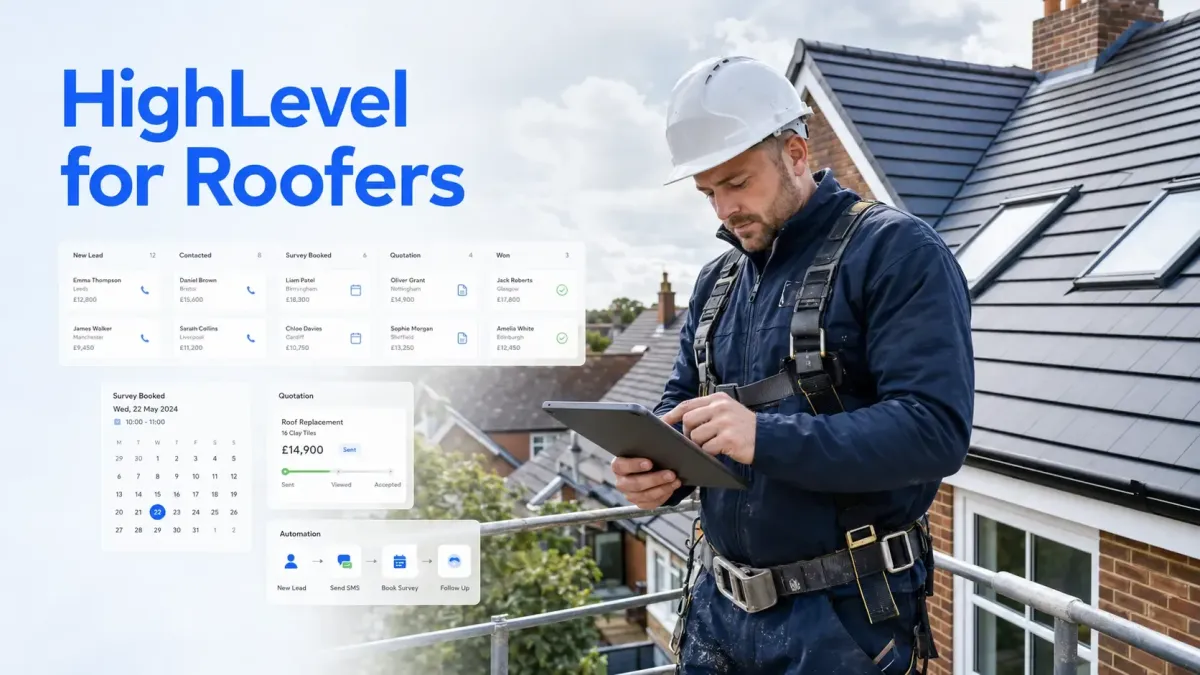
HighLevel gives roofing companies a central CRM, marketing automation and customer communication system. It can help a roofing contractor capture enquiries, organise its sales pipeline, book roof surveys, send follow-ups, manage quotations, request reviews and measure which marketing channels produce profitable work.
However, HighLevel should not be confused with specialist roofing take-off, project-management or field-service software. Its greatest strength is managing the commercial journey around the roofing work: from the first enquiry through to quotation, sale, follow-up and customer retention.
What Is HighLevel?
HighLevel is an AI-powered business operating system that combines several sales, marketing and customer-management tools within one platform.
Its capabilities include:
Contact and company records
Sales pipelines and opportunities
Websites and landing pages
Forms and surveys
Online calendars
Email, SMS and WhatsApp communication
Telephone and call tracking
Workflow automation
Estimates, invoices and payments
Documents, contracts and electronic signatures
Review-request automation
Reporting and advertising attribution
AI-assisted customer communication
For a roofing company, the value does not come from using each feature independently. It comes from connecting them into one organised process.
A new enquiry can create a contact, open an opportunity, notify the appropriate team member, send an acknowledgement, invite the customer to book a survey and start a follow-up sequence automatically.
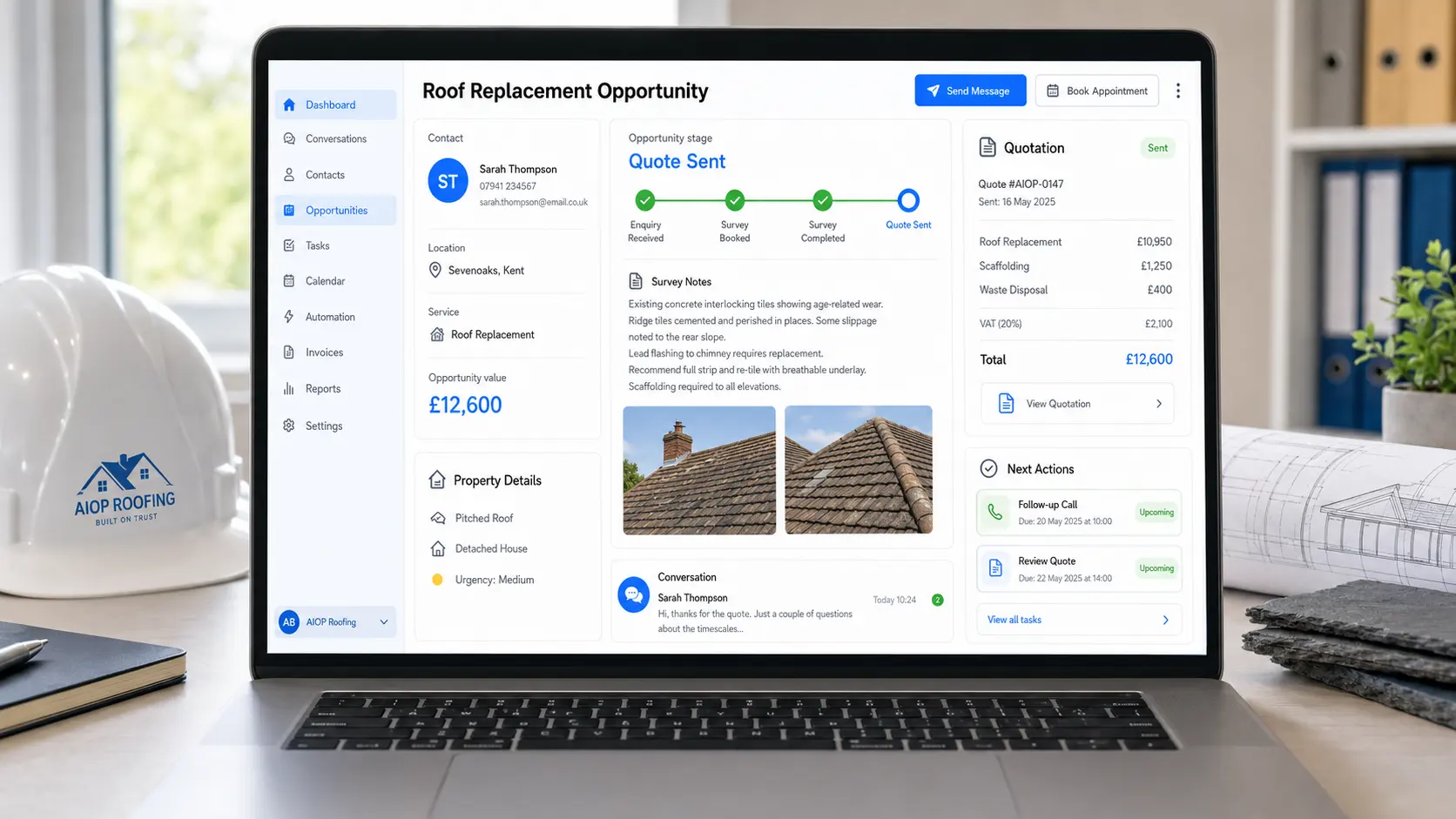
When the customer progresses, the same record can retain the property details, survey information, quotation status, communication history and marketing attribution.
Why Roofing Companies Need More Than a Basic Contact Database
Roofing is not normally an immediate online purchase.
A customer may notice a leak, damaged tiles, deteriorating flat roofing or another problem. They then contact several roofing companies, wait for site visits, compare quotations and decide who they trust.
Larger projects can involve an even longer decision process, particularly for:
Complete roof replacements
Commercial roofing projects
Flat-roof installations
Roofline and guttering work
Insurance-related repairs
Solar-panel preparation
Planned maintenance contracts
Property-management portfolios
A roofing CRM must therefore do more than store a name and telephone number. It should show where every potential job is within the sales process and what must happen next.
This is where HighLevel’s opportunities and pipelines become useful.
Building a Roofing Sales Pipeline in HighLevel
A sales pipeline provides a visual representation of every potential roofing job. Each opportunity moves through clearly defined stages as the customer progresses.
A practical residential roofing pipeline could include:
New Enquiry
Contact Attempted
Contacted
Survey Booked
Survey Completed
Quote Being Prepared
Quote Sent
Follow-Up Required
Quote Accepted
Deposit Paid
Work Scheduled
Work Completed
Review Requested
Closed Lost
Commercial roofing companies may require a more detailed process involving tender qualification, multiple stakeholders, site documentation, procurement and contract approval.
The exact pipeline should reflect how the roofing company actually makes money. It should not be copied from a generic CRM template without adapting it to the business.
Each opportunity can also include an estimated monetary value. This allows management to see:
The total value of open roofing opportunities
The value of quotations awaiting a decision
Which sales stages contain the most work
How many enquiries become surveys
How many surveys become quotations
How many quotations become customers
Average job value
Reasons why quotations are lost
Expected future revenue
This creates a much clearer picture than simply counting leads.
Capturing Roofing Leads from Multiple Sources
Roofing enquiries can arrive through several channels. HighLevel can bring many of these interactions into the same system.
Potential lead sources include:
Roofing company websites
Dedicated landing pages
Google Ads
Facebook and Instagram advertisements
Google Business Profile
Organic search
Telephone calls
Website chat
SMS
WhatsApp
Referral partners
Estate agents
Property managers
Direct email enquiries
Imported contact lists
A website form might ask for the customer’s name, telephone number, email address, postcode and a brief description of the roofing problem.
A more detailed roofing survey could collect:
Property type
Roof type
Approximate property age
Nature of the problem
When the issue started
Whether water is entering the building
Whether the enquiry is urgent
Whether scaffolding may be required
Whether the property is residential or commercial
Photographs of the affected area
Preferred survey date
Insurance involvement
Ownership or decision-making status
Not every enquiry form should be long. An emergency roof-repair landing page may perform better with a shorter form, while a commercial roofing assessment may justify more detailed qualification.
The important point is that the information should enter structured CRM fields instead of remaining trapped inside an email notification.
Responding to Roofing Enquiries More Quickly
Response speed is particularly important when a customer has an active leak or storm-damaged roof. The customer may contact several roofers and proceed with the first credible company that responds.
HighLevel workflows can send an immediate acknowledgement after an enquiry.
For example:
Hi Sarah, thank you for contacting ABC Roofing about your roof repair. We have received your enquiry and a member of our team will contact you shortly. If possible, please reply with photographs of the affected area and your property address.
This does not replace a personal response. It reassures the prospect that the enquiry has arrived and tells them what will happen next.
The workflow can also:
Create an opportunity in the roofing pipeline
Assign the lead to a salesperson or surveyor
Send an internal notification
Create a follow-up task
Send a booking link
Request photographs
Escalate urgent repair enquiries
Trigger a second contact attempt if nobody responds
Stop automatically when the customer replies or books
The objective is not to automate every conversation. It is to prevent genuine opportunities from being forgotten.
Recovering Missed Telephone Calls
Roofers cannot always answer the telephone while driving, surveying a property or working on site. Unfortunately, an unanswered caller may simply contact the next roofing company.
HighLevel’s missed-call text-back feature can automatically send an SMS after an inbound call is missed. HighLevel describes this as a way to acknowledge the missed call immediately and encourage the caller to continue the conversation by text.
An example message might be:
Sorry we missed your call to ABC Roofing. Please reply with your name, postcode and a brief description of the roofing work you need, and we will get back to you as soon as possible.
HighLevel also supports missed-call follow-up through WhatsApp where the necessary account, telephone and messaging requirements have been configured.
This is useful, but it must be implemented carefully. Repeated calls should not generate an excessive number of identical messages, and automated communication must respect applicable consent, privacy and electronic-marketing requirements.
Booking Roof Surveys and Site Visits
Many roofing enquiries cannot be priced accurately without inspecting the property. The next meaningful conversion is therefore not simply a lead; it is a booked roof survey.
HighLevel calendars can be used to arrange:
Roof inspections
Quotation visits
Emergency assessments
Commercial site surveys
Video consultations
Follow-up meetings
Maintenance inspections
A roofing company can create separate calendars for different surveyors, territories or appointment types. Availability rules, travel considerations and the company’s preferred booking process should be configured before making a calendar publicly available.
Once a survey is booked, workflows can send:
Confirmation by email or SMS
The appointment date and time
The surveyor’s details
Instructions about access
A request for photographs or documents
A reminder the day before
A reminder shortly before the appointment
Internal notifications for the assigned surveyor
Rescheduling information
These reminders reduce forgotten appointments and unnecessary journeys.
For complex field operations, however, HighLevel should not automatically be treated as a replacement for dedicated route planning, crew dispatch or roofing project-management software. It can manage the appointment and customer communication while a specialist operational platform manages the work itself.
Storing Roofing Information in Custom Fields
A well-designed HighLevel account should store important roofing information in structured fields.
Useful contact, property or opportunity fields could include:
Service address
Postcode
Property type
Residential or commercial
Roof type
Requested service
Repair or replacement
Emergency status
Leak present
Survey date
Surveyor
Estimated roof size
Quotation number
Quotation value
Quote sent date
Expected decision date
Deposit status
Proposed start date
Lead source
Lost reason
Warranty expiry date
Next maintenance date
Custom fields should hold the information that the company needs to search, report on or use in automation.
Tags can still be useful for temporary states and categories, but important business data should not exist only as an uncontrolled collection of tags.
For example, “Quote Value” should be a monetary field. “Requested Service” should usually be a controlled selection. “Urgent Leak” might be a field or clearly governed tag used to trigger an escalation workflow.
Managing Roofing Quotations and Follow-Up
One of the biggest opportunities for many roofers is improving quotation follow-up.
Preparing a roofing quotation requires time. A surveyor may visit the property, assess the roof, calculate materials, estimate labour and prepare a detailed scope. If the quotation is then emailed once and forgotten, much of that effort is wasted.
HighLevel can manage proposals, estimates, contracts and electronic signatures. Its document tools support reusable templates, PDF content, payments and workflow automation. HighLevel’s Documents and Contracts guide provides the current feature overview.
A quotation process might work as follows:
The roof survey is completed.
The opportunity moves to “Survey Completed”.
A task is created for quotation preparation.
The quotation is created and sent.
The quote value and sent date are stored.
The opportunity moves to “Quote Sent”.
The customer receives a confirmation message.
Follow-up tasks and messages are scheduled.
Automation stops when the quotation is accepted, rejected or manually closed.
The opportunity value and outcome are retained for reporting.
HighLevel can also link estimates and invoices to opportunities, keeping the commercial documents associated with the relevant deal.
Creating Better Quotation Follow-Up
Roofing quotation follow-up should be persistent without becoming aggressive.
A possible sequence could include:
Immediate confirmation that the quotation has been sent
A check-in two business days later
A reminder after seven days
A personal call task for higher-value projects
A final follow-up after 14 or 21 days
Longer-term nurture for postponed work
The messaging should help the customer make a decision rather than repeatedly asking whether they are ready to buy.
Useful follow-up topics include:
Whether the customer has questions about the scope
What is included and excluded
Material choices
Expected timescales
Guarantees and warranties
Insurance documentation
Deposit and payment arrangements
Access or scaffolding requirements
Examples of similar completed projects
Different job values should produce different follow-up processes. A minor repair does not require the same sales process as a complete commercial roof replacement.
Managing Email, SMS, WhatsApp and Calls
HighLevel provides a central Conversations area where supported customer communications can be viewed together.
This can reduce the fragmentation created when enquiries are spread across:
Personal mobile phones
Shared email inboxes
SMS conversations
WhatsApp
Facebook messages
Instagram messages
Website chat
Telephone calls
Centralisation gives the office team and authorised staff a clearer view of what has already been discussed.
For example, before calling a customer, a team member can review:
The original enquiry
Submitted photographs
Previous messages
Survey details
Appointment history
Quotation status
Internal notes
Outstanding tasks
Communication permissions, channel-specific rules and data-protection requirements still apply. Having the technical ability to send a message does not automatically provide the lawful basis or customer consent to send marketing communications.
Collecting Deposits and Payments
Depending on the roofing company’s process, HighLevel can be used to support:
Estimate acceptance
Electronic signatures
Deposit invoices
One-off payments
Payment links
Final invoices
Recurring invoices for maintenance agreements
Automated payment reminders
For example, an accepted roof-replacement proposal could trigger a deposit request. Once the required payment is recorded, the opportunity could move to “Deposit Paid” and notify the operations team that the work is ready to schedule.
The workflow should include human oversight. Roofing projects can involve variations, material availability, scaffolding, weather and site-specific conditions that should not be treated as a completely automated transaction.
Accounting, tax reporting and financial reconciliation may still be handled in specialist accounting software.
Automating Review Requests for Completed Roofing Work
Reviews are particularly important for roofing companies because customers are purchasing a high-trust service. They want evidence that the company is reliable, professional and capable of completing expensive work properly.
Once a job is genuinely completed and the customer is satisfied, HighLevel can send a review request by SMS or email. Review requests can be sent manually or triggered through workflows.
A practical process could be:
The opportunity moves to “Work Completed”.
The customer receives a completion message.
The office checks that there are no unresolved issues.
A review request is sent.
A reminder is sent if appropriate.
The opportunity is marked as “Review Requested”.
New reviews are monitored and responded to.
Roofing companies can also use completed projects to build location-specific proof. With the customer’s permission, photographs, project details and testimonials can support website case studies, social content and future sales conversations.
Review automation must not be used to suppress legitimate negative feedback or selectively mislead consumers.
Reactivating Old Roofing Leads and Customers
A CRM becomes more valuable as it accumulates structured history.
Previous contacts may include:
Customers who postponed a roof replacement
Prospects who selected another contractor
Enquiries that could not be reached
Landlords with multiple properties
Commercial customers requiring periodic inspections
Customers with future guttering or roofline requirements
Previous repair customers approaching warranty or maintenance dates
These contacts can be segmented for appropriate follow-up.
Examples include:
Annual roof-inspection reminders
Commercial maintenance reminders
Follow-up on previously deferred quotations
Seasonal gutter-clearance campaigns
Storm-damage information
Warranty reminders
Related-service campaigns
Reactivation should be targeted and permission-aware. Sending the same generic promotion to every historical contact is unlikely to produce the best commercial or reputational outcome.
Measuring Roofing Lead Quality and Marketing Performance
A roofing company should not evaluate marketing solely by counting form submissions.
A campaign that generates cheap enquiries may perform badly if those leads are outside the service area, impossible to contact or seeking work the company does not provide.
HighLevel can retain attribution and opportunity information so the business can compare marketing sources against meaningful outcomes.
Useful measures include:
Number of new enquiries
Cost per enquiry
Contact rate
Survey-booking rate
Survey-attendance rate
Quote rate
Quote acceptance rate
Average quotation value
Average won-job value
Revenue by lead source
Time from enquiry to first response
Time from survey to quotation
Sales-cycle length
Lost reasons
Return on advertising spend
For Google Ads, HighLevel includes a workflow action that can send offline conversion events back to a connected advertising account. This can be used for commercially important milestones such as a qualified roofing lead, completed survey or won customer, rather than limiting optimisation to the initial form submission.
This creates the foundation for closed-loop marketing.
Instead of reporting that Google Ads generated 40 leads, the roofing company can work towards understanding:
Which campaigns generated genuine roofing opportunities
Which keywords produced booked surveys
Which enquiries received quotations
Which leads became paying customers
Which advertising sources generated the highest revenue
The CRM stages and conversion definitions must be accurate. Sending poorly governed or duplicated events back to advertising platforms can make optimisation worse rather than better.
Using AI Within a Roofing Company
HighLevel’s AI capabilities can support parts of the customer journey, although they require careful configuration and human supervision.
Potential applications include:
Answering common initial questions
Collecting property and roofing details
Classifying the requested service
Identifying emergency enquiries
Requesting the service address and postcode
Booking roof surveys
Summarising customer conversations
Drafting follow-up messages
Assisting with missed-call handling
Routing enquiries to the appropriate person
An AI assistant might help establish whether the customer needs a roof repair, replacement, inspection or emergency response.
It should not make unsafe technical claims, guarantee prices, diagnose structural problems from limited information or give customers certainty that should only come from a qualified site inspection.
The safest model is usually AI-assisted administration with clear escalation to an experienced person.
An Example HighLevel Workflow for a Roofing Company
A complete residential roofing enquiry workflow could operate like this:
A customer submits a website form.
HighLevel creates or updates the contact.
The system stores the service address, postcode, requested service and lead source.
A new opportunity is created in the roofing pipeline.
The opportunity value remains blank until sufficient information is available.
The office team receives an immediate notification.
The customer receives an acknowledgement.
An urgent leak is routed to a priority response path.
Other enquiries receive a roof-survey booking option.
If no booking is made, a follow-up task is created.
Appointment confirmations and reminders are sent.
After the survey, the opportunity moves to “Survey Completed”.
A quotation-preparation task is assigned.
Once sent, the opportunity moves to “Quote Sent”.
A controlled quotation follow-up sequence begins.
Acceptance creates the next operational and payment tasks.
Completed work triggers an internal satisfaction check.
A review request is sent when appropriate.
The customer enters a suitable long-term maintenance or reactivation segment.
The final outcome and revenue remain available for reporting.
This is the difference between installing software and designing a business operating system. The system should reflect the actual roofing process, responsibilities and decision points.
Where HighLevel Fits—and Where It Does Not
HighLevel is strongest in:
Lead capture
CRM management
Sales pipelines
Appointment booking
Customer communication
Workflow automation
Quotation follow-up
Documents and signatures
Payment collection
Review management
Lead-source attribution
Customer reactivation
It is not automatically a complete replacement for:
Roof-measurement software
Aerial roof measurement
Material take-off tools
Structural surveying
Detailed job costing
Crew dispatch
Vehicle routing
Stock and material management
Health and safety systems
On-site project management
Specialist accounting software
Some smaller roofing businesses may be able to manage much of their commercial process directly in HighLevel. Larger or operationally complex companies may use HighLevel as the customer, sales and marketing layer while integrating it with specialist roofing, field-service, project-management or accounting platforms.
The correct architecture depends on how the company operates.
How to Implement HighLevel for a Roofing Company
A roofing business should not begin by activating every available feature.
A stronger implementation sequence is:
Map the current lead-to-customer process.
Define the pipeline stages.
Decide which information belongs in structured fields.
Connect the main enquiry sources.
Configure users, permissions and lead assignment.
Build the immediate-response workflow.
Configure roof-survey calendars and reminders.
Build quotation and follow-up processes.
Add payment and document automation where appropriate.
Create review and reactivation workflows.
Configure marketing attribution and reporting.
Test every entry route and exception.
Train the team.
Review performance and improve the system.
Automation should be added around a clear process. If the underlying sales process is inconsistent, automation can make the inconsistency happen faster.
How Suitable is HighLevel for Roofers?
HighLevel can be particularly effective for roofing companies that:
Generate enquiries through Google Ads, social advertising or SEO
Receive more leads than they can reliably manage manually
Frequently miss calls while working on site
Need a clearer quotation pipeline
Want to improve response times
Need consistent survey and quotation follow-up
Want more customer reviews
Want to connect marketing activity with revenue
Need several communication channels in one place
Want to reactivate previous leads and customers
Its suitability depends less on the size of the roofing company than on the complexity of its customer journey.
A small roofing contractor can use HighLevel to establish a disciplined enquiry and follow-up process. A multi-team roofing company can use it to standardise sales activity, improve reporting and coordinate customer communications across several people.
Turning HighLevel into a Roofing Business Operating System
The main advantage of HighLevel for roofers is not any individual feature.
It is the ability to connect the complete commercial journey:
An advertisement generates an enquiry.
The enquiry enters the CRM.
The customer receives a rapid response.
A roof survey is booked.
Reminders reduce missed appointments.
The opportunity moves through a visible pipeline.
The quotation is sent and followed up.
The customer accepts and pays a deposit.
The operations team receives a structured handover.
Completed work generates a review request.
Revenue is connected back to the original marketing source.
The customer remains available for future maintenance and related services.
When configured correctly, HighLevel helps a roofing company respond faster, follow up more consistently and make better decisions using its own sales data.
The result is not simply another CRM. It is a structured system for turning more roofing enquiries into surveys, more surveys into quotations and more quotations into profitable customers.
Get Help Implementing HighLevel for Your Roofing Company
Every roofing company has a different combination of services, territories, survey processes, quotation methods and operational requirements.
A successful HighLevel implementation should therefore be designed around the company’s real sales process—not installed as a generic roofing template.
AI OP can help roofing companies audit their existing process, configure HighLevel, design pipelines, build workflow automation, connect lead sources, implement advertising conversion tracking and train the team to use the system effectively.
Contact AI OP to discuss how HighLevel could be configured for your roofing business.