
HighLevel for Window Cleaners: AI, CRM, Digital Marketing, Automation
Window cleaning businesses often generate enquiries through several different channels. A potential customer might complete a website form, click a Facebook advert, call after finding the company on Google, send a WhatsApp message or ask for a quotation through social media.
The operational challenge is not simply generating more leads. It is responding quickly, collecting the correct property information, calculating a quotation, following up consistently and converting a one-off enquiry into a recurring customer.
When these activities are managed through mobile phones, spreadsheets, email inboxes and separate booking systems, enquiries can easily be forgotten. The business may also struggle to understand which marketing channels generate profitable customers rather than low-quality leads.
HighLevel gives window cleaners a central CRM, marketing automation and customer communication platform. It can be used to:
Capture window cleaning enquiries
Calculate or communicate estimated quotations
Collect property and access information
Manage leads through a sales pipeline
Book initial cleans or quotation visits
Automate email, SMS and WhatsApp follow-up
Recover missed telephone calls
Send appointment reminders
Request customer reviews
Manage recurring customer communication
Track advertising and lead sources
Reactivate old leads and customers
Report qualified leads and customers back to advertising platforms
HighLevel does not automatically replace specialist route-planning, round-management or field-service software. Its greatest strength is managing the commercial customer journey around the work: from the first enquiry through quotation, follow-up, booking, payment, review collection and long-term retention.
What Is HighLevel?
HighLevel is an AI-powered business operating system that combines CRM, sales, marketing and customer communication tools within one platform.
Its capabilities include:
Contact and company records
Sales pipelines and opportunities
Websites and landing pages
Forms and surveys
Online calendars
Email and SMS
WhatsApp integration
Telephone and call tracking
Workflow automation
Estimates and invoices
Payment collection
Documents and electronic signatures
Review management
Advertising attribution
AI-assisted customer communication
For window cleaning companies, the value comes from connecting these tools into one structured process.
A new lead can enter HighLevel, receive an immediate acknowledgement, have a quotation calculated, be added to a sales pipeline and start an automated follow-up sequence. When the customer accepts, the opportunity can move to the booking or onboarding stage while retaining the original source, quotation and communication history.
Why Window Cleaners Need HighLevel
A small window cleaning business may initially manage customers through a telephone, calendar and spreadsheet. This can work while the customer list remains small, but problems develop as the business grows.
Typical problems include:
Enquiries not receiving a quick response
Customer details being stored in personal messages
Quotations not being followed up
Property information not reaching the cleaning team
Customers forgetting their first appointment
Staff not knowing which leads require attention
Duplicate or inconsistent customer records
No structured record of lost enquiries
Reviews being requested inconsistently
Marketing performance being measured only by lead volume
Previous customers never being contacted again
A CRM provides a central source of truth for the customer relationship.
It can show:
Who the customer is
Where the property is located
Which services they requested
What they were quoted
Whether they accepted
When the first clean was booked
Whether access instructions were collected
Which messages were sent
Which marketing source generated the enquiry
Whether the customer became a recurring client
This gives the business a clearer and more scalable process.
Capturing Window Cleaning Leads
HighLevel can capture enquiries from multiple marketing and communication channels.
These can include:
A window cleaning website
Dedicated quotation landing pages
Google Ads
Google Lead Forms
Facebook and Instagram Lead Ads
Google Business Profile
Organic search
Telephone calls
Website chat
SMS
WhatsApp
Referral campaigns
Imported customer lists
HighLevel’s Google Lead Ads integration can send form-fill information directly into the CRM, where workflows can respond and move the prospect through the sales process.
The objective is to bring each lead into the same structured system, regardless of where the initial enquiry originated.
What Should a Window Cleaning Quotation Form Ask?
A basic enquiry form may only need the customer’s:
Name
Telephone number
Email address
First line of the property address
Postcode
Requested service
However, an instant or semi-automated quotation requires more information.
Useful window cleaning fields might include:
Property type
Number of bedrooms
Number of floors
Detached, semi-detached, terraced or flat
Front-only or full-property cleaning
Rear access
Conservatory
Extension
Skylights or roof windows
Large or unusual windows
Frequency required
First or one-off clean
Commercial or residential property
Gutter clearing required
Gutter, fascia and soffit washing required
Solar-panel cleaning required
Preferred contact method
Photographs of the property
Not every business will use the same pricing model. Some window cleaners price by property type, while others use the number of windows, estimated time, access difficulty or a combination of variables.
The form should reflect how the company genuinely calculates its prices.
Creating a Window Cleaning Quotation Calculator
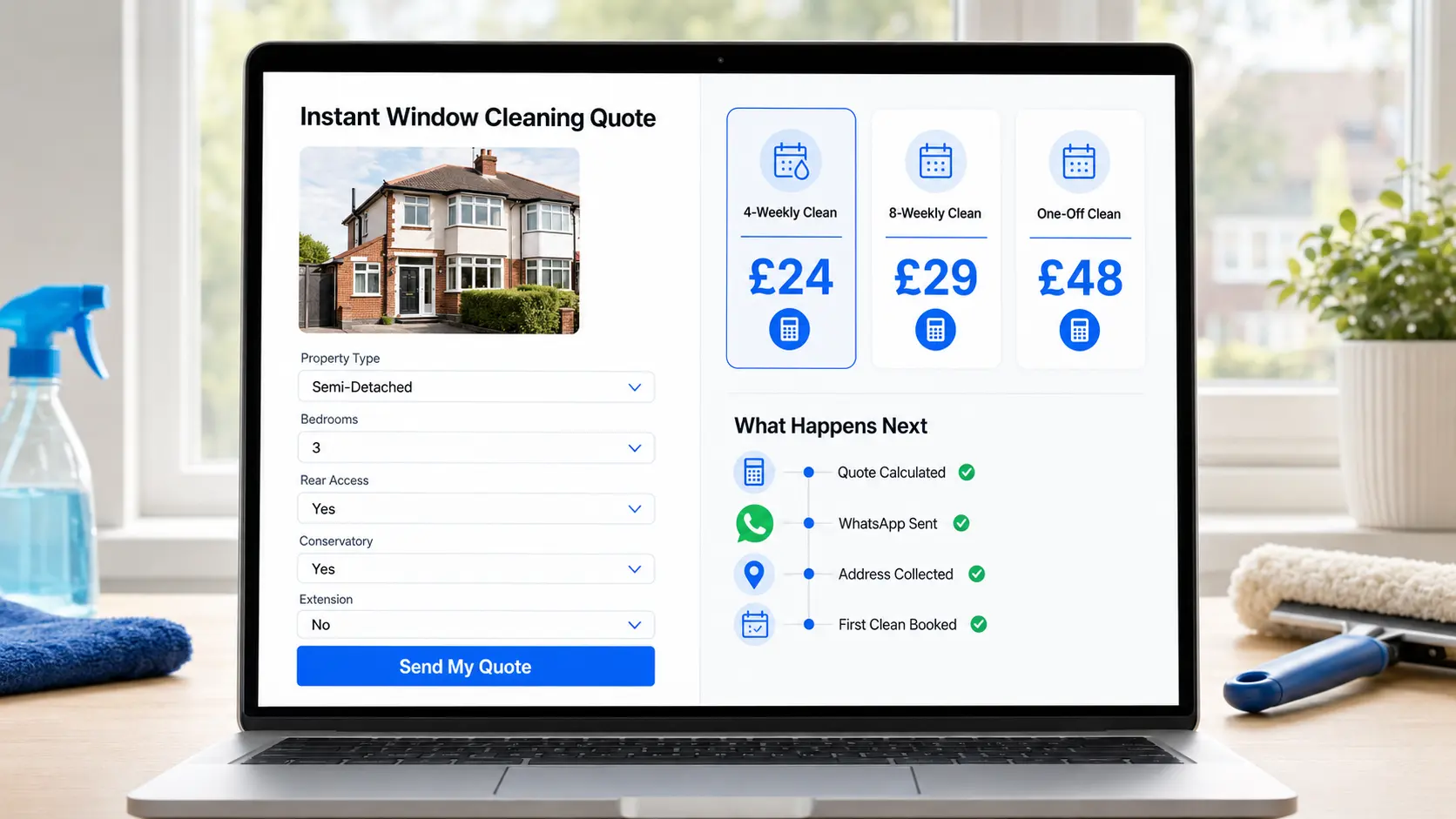
HighLevel forms and surveys support numerical and monetary calculations. They can also use scores and conditional logic to produce different outcomes based on the customer’s answers.
This makes it possible to create a window cleaning quotation calculator.
A simplified pricing model might consider:
Base property price
Property-type adjustment
Number of bedrooms
Cleaning frequency
Rear-access difficulty
Conservatory surcharge
Extension surcharge
First-clean multiplier
One-off-clean multiplier
Additional services
For example, the calculator could produce separate prices for:
Four-weekly window cleaning
Eight-weekly window cleaning
One-off window cleaning
Conditional logic can also identify enquiries that should not receive an automatic quotation.
These might include:
Flats above a specified floor
Commercial properties
Large or unusual homes
Properties with difficult access
Buildings requiring specialist equipment
Conservatories or extensions outside the standard pricing model
Properties outside the normal service area
Instead of forcing an unreliable price, the form can assign these enquiries to a “Manual Quote Required” route.
HighLevel’s current conditional-logic tools can show or hide fields, display messages, redirect visitors and create different form or survey paths.
Instant Quotes Versus Manual Quotes
An instant quotation can reduce friction and help a window cleaning company respond faster than competitors. However, it should only be used when the business has a reliable and well-tested pricing model.
A sensible process could divide enquiries into three categories.
Standard Automatic Quote
The customer’s property fits the company’s normal pricing rules. HighLevel calculates an estimated price and sends it to the customer automatically.
Estimated Price Subject to Confirmation
The customer receives an estimated price, but the message explains that the final amount is subject to checking the property, access and submitted information.
Manual Quote Required
The property is commercial, unusual, outside the standard area or otherwise unsuitable for automated pricing. HighLevel alerts a team member and sends the customer an appropriate acknowledgement.
This provides automation without pretending that every property can be accurately priced from a few form answers.
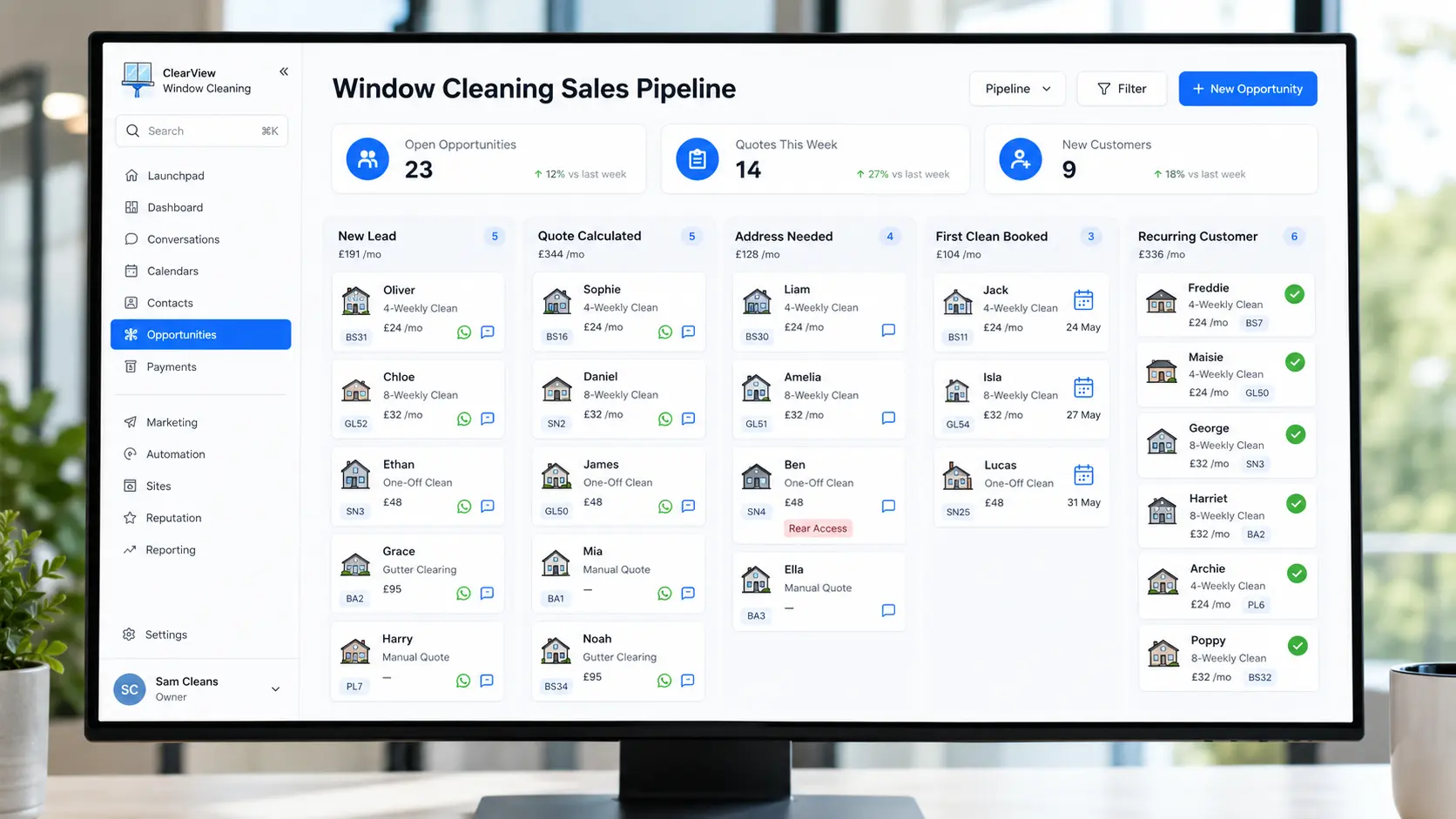
Building a Window Cleaning Sales Pipeline
Every genuine enquiry should become an opportunity in a defined sales pipeline.
A practical window cleaning pipeline could include:
New Lead
Quote Calculated
Manual Quote Required
Address Needed
Contact Attempted
Quote Sent
Needs Follow-Up
Ready to Schedule
Booking Made
First Clean Completed
Review Requested
Recurring Customer
Closed Lost
The stages should reflect the company’s real process rather than being copied from a generic sales template.
For example, “Address Needed” may be important because Facebook Lead Ads sometimes capture a customer’s name and telephone number without collecting the full service address.
“Ready to Schedule” can represent a customer who has accepted the price but has not yet received a date.
“First Clean Completed” can trigger onboarding, payment and review workflows.
The opportunity record can also store the estimated recurring value of the customer. This helps the business distinguish between a one-off £40 job and a customer who could be worth hundreds or thousands of pounds over several years.
Responding to New Leads Immediately
A customer requesting a window cleaning quotation is often contacting several companies. A fast response reassures the customer that the enquiry has arrived and explains what happens next.
A HighLevel workflow can:
Create or update the contact
Create a pipeline opportunity
Store the quotation details
Assign the enquiry to a team member
Send an internal notification
Send the customer an acknowledgement
Request any missing property information
Send the calculated quotation
Create a follow-up task
Start a controlled follow-up sequence
An example acknowledgement might be:
Hi Sarah, thank you for requesting a window cleaning quotation. We have received your details and will send your estimated price shortly. If possible, please reply with the first line of the property address and postcode so we can confirm that we cover your area.
The communication should be helpful and specific. Automation should support the sales process rather than make every interaction feel generic.
Using WhatsApp for Window Cleaning Quotations
WhatsApp can be particularly useful for local service businesses because customers are often comfortable using it to:
Request a quotation
Send property photographs
Provide access instructions
Confirm an appointment
Ask questions
Reschedule a visit
Discuss a missed clean
A window cleaning quotation workflow might send:
An introductory WhatsApp message
The calculated price
A request for the property address
A confirmation when the customer accepts
A notification before the first clean
WhatsApp templates, message categories, customer consent and the 24-hour customer-service window must all be handled correctly. A business should not assume that connecting WhatsApp creates unrestricted permission to send promotional messages.
Email or SMS can also provide a fallback when the contact does not have a valid WhatsApp number or a WhatsApp message fails.
Recovering Missed Calls
Window cleaners cannot always answer the telephone while driving, working at height or using cleaning equipment.
HighLevel’s missed-call text-back feature can automatically send an SMS when an inbound call is missed. This acknowledges the call and invites the customer to continue by text.
An example message might be:
Sorry we missed your call to ABC Window Cleaning. Please reply with your name, postcode and the service you need, and we will get back to you as soon as possible.
The feature requires careful configuration because HighLevel states that it can trigger a message for every missed call, including repeated attempts within a short period.
A dedicated workflow may be preferable where the business needs more control over timing, repeat messages and existing-customer handling.
Following Up on Window Cleaning Quotes
Sending a quotation once is rarely enough.
Customers may be busy, comparing suppliers or waiting until a convenient time. A structured follow-up sequence gives the company additional opportunities to convert the enquiry.
A simple sequence could include:
Immediate quotation delivery
A check-in after 45–90 minutes
A reminder the following day
A final follow-up after several days
A manual call task for higher-value enquiries
Longer-term reactivation if the customer does not proceed
The sequence should stop when:
The customer replies
A staff member replies
The customer accepts
The first clean is booked
The opportunity is marked as lost
The customer opts out
The contact becomes unsuitable
Follow-up messages should answer likely questions rather than repeatedly asking whether the customer is interested.
Useful topics include:
Whether purified-water pole systems are used
Whether frames and sills are included
How frequently the service operates
Whether anyone needs to be at home
How rear access is managed
How payment works
What happens in poor weather
Whether the first clean costs more
Whether guttering and other services are available
Booking the First Window Clean
Once the customer accepts the quotation, the next step is usually arranging the first clean.
HighLevel calendars can support:
Initial cleaning appointments
Manual quotation visits
Commercial site assessments
Gutter-clearance appointments
Conservatory-roof cleaning
Solar-panel cleaning
Follow-up inspections
Calendar notifications can be sent through email, SMS, WhatsApp and in-app notifications when appointments are booked, cancelled, rescheduled or approaching.
For example, a customer could receive:
Your first window clean is scheduled for Tuesday. Please ensure that the rear gate is accessible and any locked access points are available.
The business can also notify the assigned staff member and include relevant property information.
However, appointment calendars are not the same as specialist round-optimisation software. A window cleaning company with hundreds of recurring properties may still need dedicated tools for:
Route optimisation
Geographic round planning
Drag-and-drop work scheduling
Vehicle tracking
Technician dispatch
Weather-related mass rescheduling
Completion tracking
Crew productivity
Detailed round management
HighLevel can manage customer communication and CRM activity while specialist operational software handles the physical round.
Storing Window Cleaning Customer Information
A well-designed HighLevel account should use structured custom fields for important customer and property information.
Useful fields could include:
Service address
Postcode
Property type
Number of bedrooms
Number of floors
Rear access
Gate code
Conservatory
Extension
Roof windows
Cleaning frequency
Four-weekly price
Eight-weekly price
One-off price
First-clean price
Regular-service price
Additional services
Preferred payment method
Preferred communication channel
Last clean date
Next clean date
Assigned round
Assigned cleaner
Quote stage
Customer status
Lead source
Lost reason
Fields should be used for information that must be searched, reported on or used in automation.
Tags can still be helpful for temporary categories and workflow states, but core business information should not exist only as an uncontrolled collection of tags.
For example:
“Four-Weekly Price” should be a monetary field.
“Cleaning Frequency” should be a controlled selection.
“Rear Access” should be a clearly defined field.
“Quote Stage” should use consistent values.
This improves automation, reporting and data quality.
Communicating Access Instructions
Access is a recurring issue for residential window cleaners. Customers may need to unlock gates, move vehicles, secure pets or provide access through the property.
HighLevel can store these instructions and use them in reminders.
For example:
We are scheduled to clean your windows tomorrow. Please ensure the rear gate is unlocked before 9:00 am and that any pets are kept safely inside.
Internal notifications can also include the access information for the cleaning team.
Sensitive access details should be stored and shared carefully. Permissions should ensure that only authorised users can view information such as gate codes.
Managing Recurring Window Cleaning Customers
The commercial value of window cleaning often comes from recurring work rather than the initial clean.
Once the first clean is completed, the customer can move from a sales pipeline into a recurring-customer or service-management process.
HighLevel can help automate:
Welcome messages
Payment instructions
Service-frequency confirmation
Access reminders
Upcoming-clean notifications
Failed-payment follow-up
Satisfaction checks
Review requests
Additional-service campaigns
Customer reactivation
Recurring customers can be segmented by:
Four-weekly or eight-weekly service
Residential or commercial
Geographic area
Assigned round
Assigned team member
Service value
Additional services
Payment status
Customer lifecycle stage
The CRM should distinguish between a quotation lead and an active recurring customer. Treating every contact in the same way produces poor automation and unclear reporting.
Invoices and Recurring Payments
HighLevel can create estimates, invoices, payment links and recurring invoices.
Its workflow tools include a recurring-invoice action that can automate billing schedules.
Depending on the company’s payment process and connected providers, HighLevel can support:
Initial-clean invoices
One-off payment links
Recurring invoices
Automated invoice reminders
Payment-status workflows
Deposit collection for larger work
Gutter-cleaning or specialist-service invoices
Some window cleaners may prefer to use a dedicated direct-debit or accounting platform. In that situation, HighLevel can remain the CRM and customer-communication system while the specialist platform manages payment collection and financial reconciliation.
Requesting Customer Reviews
Reviews are extremely important for local window cleaning businesses.
A customer searching for a window cleaner may compare:
Google ratings
Number of reviews
Recency of reviews
Photographs
Local relevance
Response quality
Evidence of reliability
HighLevel can send review requests through email or SMS after the first clean or after another suitable customer milestone.
A controlled workflow might operate as follows:
The first clean is completed.
The customer receives a satisfaction message.
Any issue is routed to the team.
A review request is sent at an appropriate time.
A reminder is sent if justified.
The customer enters the recurring-service communication process.
The timing matters. A review should not be requested before the company has actually delivered the service.
Review automation must also be implemented fairly. It should not be designed to suppress legitimate negative feedback or misrepresent overall customer sentiment.
Selling Additional Exterior Cleaning Services
Once a customer trusts a window cleaning company, they may also purchase related services.
These could include:
Gutter clearing
Gutter, fascia and soffit washing
Conservatory-roof cleaning
Solar-panel cleaning
Pressure washing
Render cleaning
Cladding cleaning
Commercial window cleaning
One-off deep cleans
HighLevel can segment suitable customers and send targeted campaigns.
For example, customers with a conservatory could receive information about conservatory-roof cleaning, while homeowners who have not booked gutter clearing within the previous year could receive a seasonal reminder.
These campaigns should use relevant customer information. Sending every additional service to every contact is less effective and can create unnecessary communication fatigue.
Reactivating Old Window Cleaning Leads
Not every lead becomes a customer immediately.
Some prospects:
Do not respond
Decide the price is too high
Postpone the service
Choose another window cleaner
Move into the area later
Need a different service in the future
HighLevel can retain these contacts and place appropriate prospects into a reactivation workflow.
A reactivation message might ask whether the customer still requires window cleaning or offer an updated quotation.
The campaign should exclude:
Customers who opted out
Invalid contact details
People outside the service area
Contacts marked as unsuitable
Existing active customers
Customers with unresolved complaints
Reactivation works best when the CRM contains accurate lifecycle and lost-reason data.
Connecting Marketing to Paying Customers
Window cleaners often advertise through Google Ads, Facebook and Instagram.
If the business measures only form submissions, the advertising platform may optimise towards the cheapest leads rather than the customers most likely to accept a quotation and become recurring clients.
HighLevel can retain attribution information showing where a contact originated. Its attribution reporting is designed to compare sources such as Google Ads and Facebook Ads.
The business can then measure:
Cost per lead
Cost per valid service-area lead
Cost per calculated quote
Cost per accepted quotation
Cost per booked first clean
Cost per recurring customer
Average customer value by source
Revenue by campaign
Quote acceptance rate
Lead-to-customer conversion rate
This is much more commercially useful than measuring leads alone.
Sending Offline Conversions to Google Ads
HighLevel includes a workflow action that can send conversion events to a connected Google Ads account through the API.
Potential conversion events could include:
Qualified Lead
Quote Calculated
Quote Accepted
First Clean Booked
First Clean Completed
Recurring Customer
The exact events should be selected carefully.
Sending every minor CRM update as a primary advertising conversion can confuse optimisation. The conversion structure should distinguish between early lead indicators and meaningful business outcomes.
For many window cleaning campaigns, a qualified lead and a converted customer are more valuable optimisation signals than the initial form submission alone.
Sending Conversion Data to Meta
HighLevel workflows can also send events through Meta’s Conversions API. This can help a window cleaning business report events that happen after the initial Facebook or Instagram enquiry.
For example:
A prospect submits a Facebook Lead Ad.
The lead enters HighLevel.
The property information is collected.
A valid quotation is calculated.
The customer accepts.
The first clean is booked.
The relevant downstream event is reported to Meta.
Good CRM data is essential. Duplicate contacts, inconsistent pipeline stages and premature conversion triggers can undermine the value of the integration.
Using AI for Window Cleaning Enquiries
HighLevel’s AI features can assist with parts of the customer journey.
Possible applications include:
Answering frequently asked questions
Collecting the service address
Requesting a postcode
Identifying the required service
Asking about property type
Collecting rear-access details
Explaining cleaning frequencies
Providing quotation information
Booking an initial clean
Summarising customer conversations
Routing unusual properties for manual review
An AI assistant could recognise an informal message such as:
Hi, I’m in Maidstone and need the front and back windows cleaned every month. It’s a three-bed semi with a conservatory and side access.
It could then extract the relevant details into structured fields and ask only for the missing information.
However, AI should not invent prices, make unsupported promises or confirm that a difficult property can be serviced without the necessary checks.
The system needs clear rules, approved knowledge and human escalation.
An Example HighLevel Workflow for Window Cleaners
A complete website quotation process might operate as follows:
The customer completes a quotation form.
HighLevel creates or updates the contact.
The property answers are stored in custom fields.
The calculator determines the standard prices.
The customer is classified as automatic or manual quotation.
A new opportunity is created in the window cleaning pipeline.
The original lead source and advertising data are retained.
The customer receives an immediate acknowledgement.
The quotation is sent by the preferred valid channel.
Missing address information is requested.
The opportunity moves to “Quote Calculated”.
A controlled follow-up sequence begins.
Customer or staff replies stop the automated follow-up.
Acceptance moves the opportunity to “Ready to Schedule”.
The first clean is arranged.
Appointment and access reminders are sent.
Completion moves the opportunity to “First Clean Completed”.
The customer receives payment and service-frequency information.
A satisfaction check and review request are scheduled.
The contact becomes an active recurring customer.
The final conversion and value are available for marketing reporting.
The workflow should include exception routes for invalid data, unsupported properties, failed messages, manual replies and customers who change their minds.
Useful HighLevel Workflows for Window Cleaning Companies
A complete implementation may contain several smaller workflows rather than one enormous automation.
Useful workflows include:
New website enquiry
Facebook Lead Ad enquiry
Google Lead Form enquiry
Missed-call recovery
Window cleaning price calculator
Manual quotation required
Missing property type
Missing address
WhatsApp quote delivery
SMS fallback
Quotation follow-up
Customer replied
Staff replied
Quote accepted
First-clean booking
Appointment reminders
Rear-access reminder
First clean completed
Review request
Payment reminder
Recurring-customer onboarding
Old-lead reactivation
Gutter-cleaning campaign
Customer cancellation
Closed-lost reporting
Google Ads offline conversion
Meta conversion event
Modular workflows are generally easier to understand, test and maintain than a single workflow containing every possible branch.
Where HighLevel Fits—and Where It Does Not
HighLevel is particularly strong for:
Lead capture
Instant-response automation
CRM records
Quotation calculators
Sales pipelines
Email, SMS and WhatsApp communication
Booking and reminders
Quotation follow-up
Reviews
Reactivation
Marketing attribution
Advertising conversion reporting
It is not automatically a complete replacement for:
Geographic round planning
Route optimisation
Live technician tracking
Vehicle management
Weather-based route rescheduling
Detailed job costing
Stock control
Specialist field-service management
Full accounting software
A smaller window cleaning company may be able to manage most of its customer journey in HighLevel. A larger company may use HighLevel as the marketing, sales and customer-communication layer alongside operational software.
How to Implement HighLevel for a Window Cleaning Business
A structured implementation should normally follow this order:
Map the existing enquiry-to-customer process.
Document the company’s pricing rules.
Define automatic and manual quotation criteria.
Create the required custom fields.
Build the sales pipeline.
Connect the website and advertising lead sources.
Create and test the quotation calculator.
Build immediate-response automation.
Configure WhatsApp, SMS and email routes.
Build quotation follow-up.
Configure first-clean booking and reminders.
Design recurring-customer onboarding.
Create payment and review workflows.
Configure attribution and conversion tracking.
Import existing contacts carefully.
Train staff.
Test exceptions and failed-message routes.
Monitor performance and improve the system.
The most important work happens before the automation is built.
If pricing rules, pipeline stages and responsibilities are unclear, the technology will reproduce that confusion.
Is HighLevel Suitable for Window Cleaners?
HighLevel can be particularly useful for window cleaning companies that:
Generate leads through Google or Facebook Ads
Want to provide faster quotations
Frequently miss calls while working
Need consistent follow-up
Want to use WhatsApp more systematically
Need a clear sales pipeline
Sell recurring cleaning services
Offer several exterior-cleaning services
Want more customer reviews
Need to connect marketing with paying customers
Want to reactivate previous enquiries
Are outgrowing spreadsheets and personal mobile phones
The platform is most valuable when it is configured around the company’s genuine operating model.
A generic snapshot may provide a starting point, but it cannot automatically understand the company’s pricing, service area, cleaning frequencies, access rules, follow-up policy or customer journey.
Turning HighLevel into a Window Cleaning Business Operating System
The value of HighLevel is not simply having a CRM, form builder or email tool.
It is the ability to connect the entire commercial process:
An advert or website generates an enquiry.
The customer’s property information enters the CRM.
A quotation is calculated or assigned for manual review.
The customer receives a rapid response.
Follow-up happens consistently.
The first clean is booked.
Access reminders reduce avoidable problems.
The customer becomes a recurring client.
Reviews are requested at the correct time.
Related services are marketed appropriately.
Customer value is connected to the original marketing source.
When configured correctly, HighLevel can help window cleaners respond faster, convert more quotations, communicate more consistently and make better decisions using their own customer data.
The result is not merely a contact database. It is a structured system for turning enquiries into quotations, quotations into first cleans and first cleans into long-term recurring customers.
Get Help Implementing HighLevel for Your Window Cleaning Company
Every window cleaning business has different prices, service areas, frequencies, access requirements and operational processes.
A successful HighLevel implementation should therefore be designed around the way the company actually works.
AI OP can help window cleaning companies audit their existing process, configure HighLevel, create quotation calculators, design pipelines, build workflow automation, connect advertising lead sources, implement conversion tracking and train staff to use the system effectively.
Contact AI OP to discuss how HighLevel could be configured for your window cleaning business.