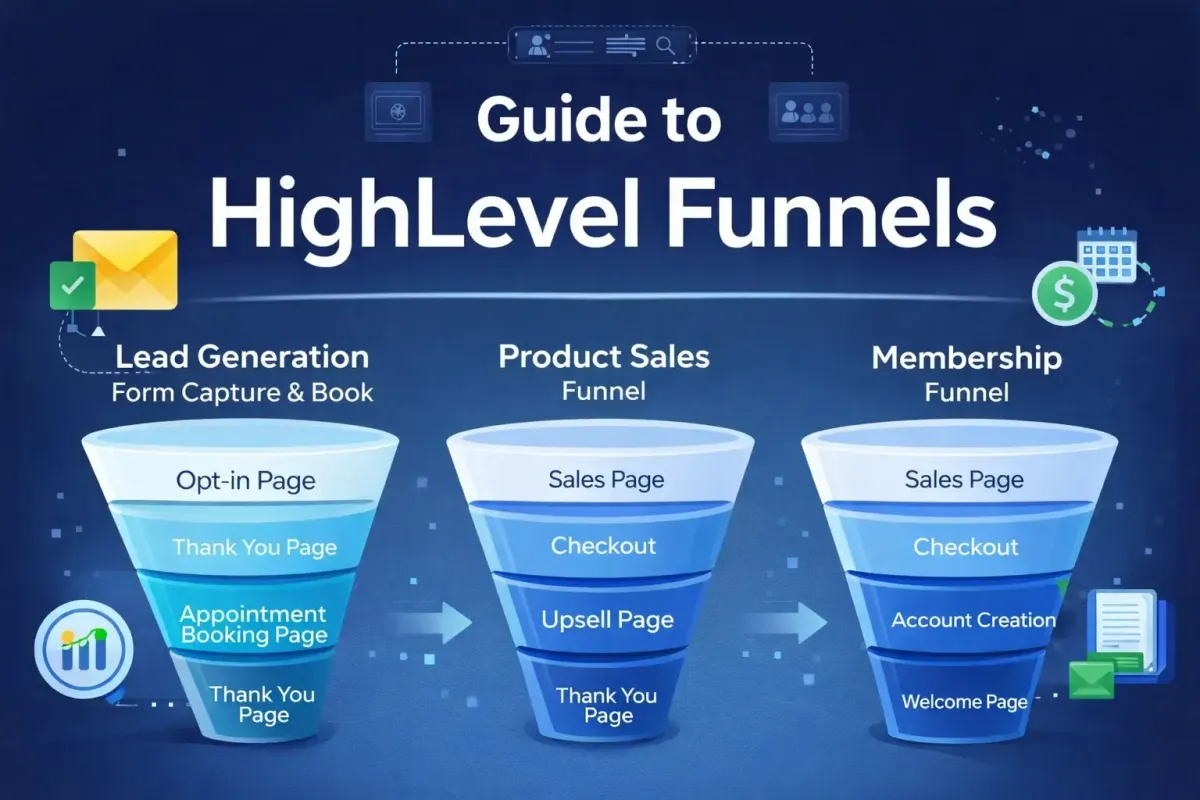
Types of HighLevel Funnels & How to Use Them
HighLevel funnels are not limited to a single predefined structure. A funnel is simply a sequence of pages designed to guide a visitor through a specific conversion journey—whether that journey ends in a booked consultation, an application submission, a purchase, a webinar registration, or an onboarding form.
While many people associate funnels with product sales, the majority of HighLevel implementations—particularly for agencies and service businesses—focus on lead generation, qualification, and appointment booking. In this context, funnels are not just landing pages. They are the front-end acquisition layer of a wider CRM system, capturing prospects and feeding them into pipelines, automation workflows, and multi-channel follow-up.
This article provides an end-to-end view of all practical HighLevel funnel types, grouped into two major categories:
Lead Generation Funnels (covered first, in depth)
All Other Funnel Types (sales, onboarding, retention, events, reputation, and optimisation)
It starts with the simplest structures and progresses to more advanced funnels that prioritise lead quality, conversion efficiency, and operational scalability.
HighLevel Funnel Types - A basic list.
Below is a complete inventory of the funnel types covered in this article. HighLevel does not enforce “official” funnel categories, but these patterns are the most commonly implemented in real client environments.
Lead Generation Funnel Types
Basic Landing Funnel (single page conversion)
Simple Landing Funnel (landing + thank you)
Lead Magnet Funnel (capture + deliver a resource)
Appointment Booking Funnel (convert to meetings)
Lead Generation Funnel (capture + book immediately)
Webinar Funnel (educate then convert)
Application Funnel (high-ticket qualification and routing)
Demo Request Funnel (demo-led qualification and booking)
Survey / Quiz Funnel (assessment-led segmentation and routing)
Multi-Step Form Funnel (step-based conversion optimisation)
Other Funnel Types
Product Sales Funnel (multi-step checkout conversion)
One-Page Sales Funnel (single-page offer + checkout/form)
Two-Step Checkout Funnel (conversion-optimised checkout flow)
Upsell / Downsell Funnel (order value optimisation sequence)
Tripwire Funnel (low-cost entry offer → nurture/upsell/booking)
Membership / Course Access Funnel (sell + provision access)
Challenge Funnel (multi-day engagement funnel)
Event Registration Funnel (in-person or online events)
Onboarding Funnel (client/customer intake + next steps)
Abandoned Checkout / Abandoned Booking Funnel (recovery)
Re-Engagement Funnel (reactivation / win-back)
Referral Funnel (structured referral capture)
Review / Reputation Funnel (feedback routing + public reviews)
The remainder of the article explains each category, how they work in HighLevel, and when they are used.
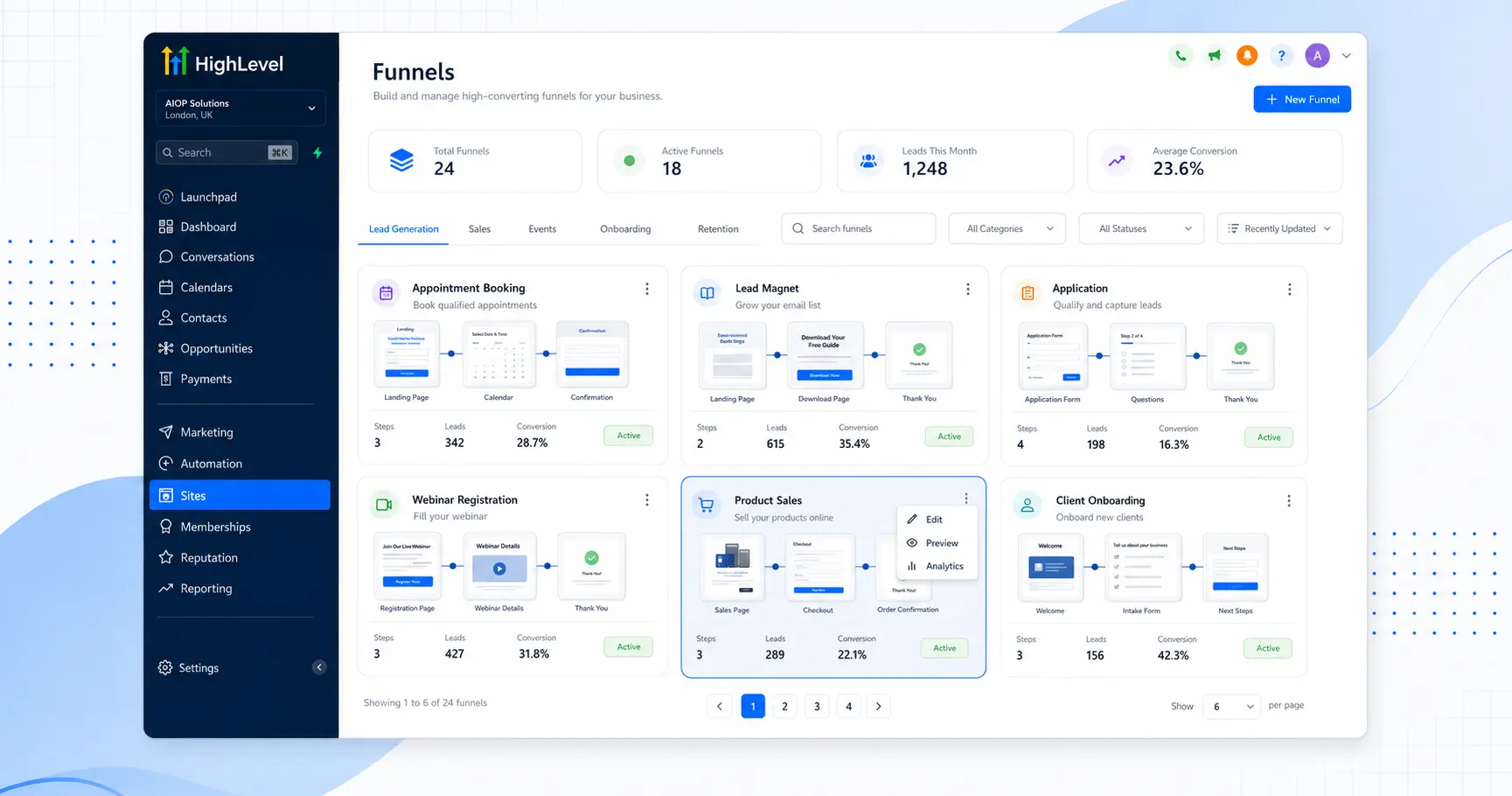
Understanding Funnel Marketing: The Basics
Funnel marketing is a strategy that guides potential customers through a structured, step-by-step journey—from their very first interaction with your brand through to conversion and long-term engagement.
Instead of relying on random interactions or hoping prospects will eventually convert, funnel marketing provides a deliberate framework for guiding behaviour. Each stage of the funnel aligns marketing messages, content, and offers with the prospect’s level of awareness and intent.
The concept is called a funnel because the process begins with a large audience at the top and narrows progressively as people move toward a final action, such as making a purchase, booking a consultation, or submitting an application.
A well-designed marketing funnel helps businesses move from sporadic lead generation to predictable demand generation. Rather than treating every visitor the same, the funnel adapts messaging and offers according to where the prospect is in their decision-making journey.
By implementing a clear funnel strategy, businesses can:
attract the right audience instead of broad, untargeted traffic
nurture leads over time through education and trust-building
convert interested prospects into paying customers
re-engage past customers to generate repeat revenue
measure conversion performance across each stage of the journey
Whether you are building your first marketing system or refining an existing one, understanding how funnel marketing works provides the foundation for more consistent growth.
Why Funnel Marketing Matters in Modern Digital Marketing
In traditional marketing, businesses often broadcast a single message to a wide audience. This “one message fits all” approach can generate awareness, but it rarely produces consistent conversions.
Modern digital marketing works differently. Today’s customers move through a research-driven buying journey, often interacting with multiple pieces of content before making a decision.
For example, a typical prospect might:
discover your business through a Google search or social media post
read an article or watch an educational video
download a guide or sign up for a newsletter
attend a webinar or request a demo
eventually book a consultation or purchase a product
Each step represents a deeper level of intent and trust.
Without a funnel structure, these interactions can feel disconnected. Prospects may encounter useful information but never progress toward a clear next step.
Funnels solve this problem by connecting these touchpoints into a coherent progression, guiding visitors from curiosity to commitment.
Why Funnels Matter for Lead Generation
A traditional website is designed for exploration. Visitors browse, compare, and navigate across pages in any order. This is useful for delivering information, but it is rarely optimal for conversion—especially when the traffic is paid.
Funnels take a different approach. A funnel removes distractions and focuses on one specific goal at a time, such as:
submitting a form
booking a consultation
downloading a resource
registering for a webinar
completing an application
Because the visitor is guided through a structured path, funnels often produce higher conversion rates than standard websites—particularly when the traffic is driven by paid acquisition such as Google Ads, Facebook Ads, or LinkedIn Ads.
Funnels also improve measurement. When you run ads, you need to know:
where conversions happen
what percentage of visitors convert
what the drop-off points are
which audiences produce the highest-quality leads
A funnel creates a clear, trackable journey from first click to conversion.
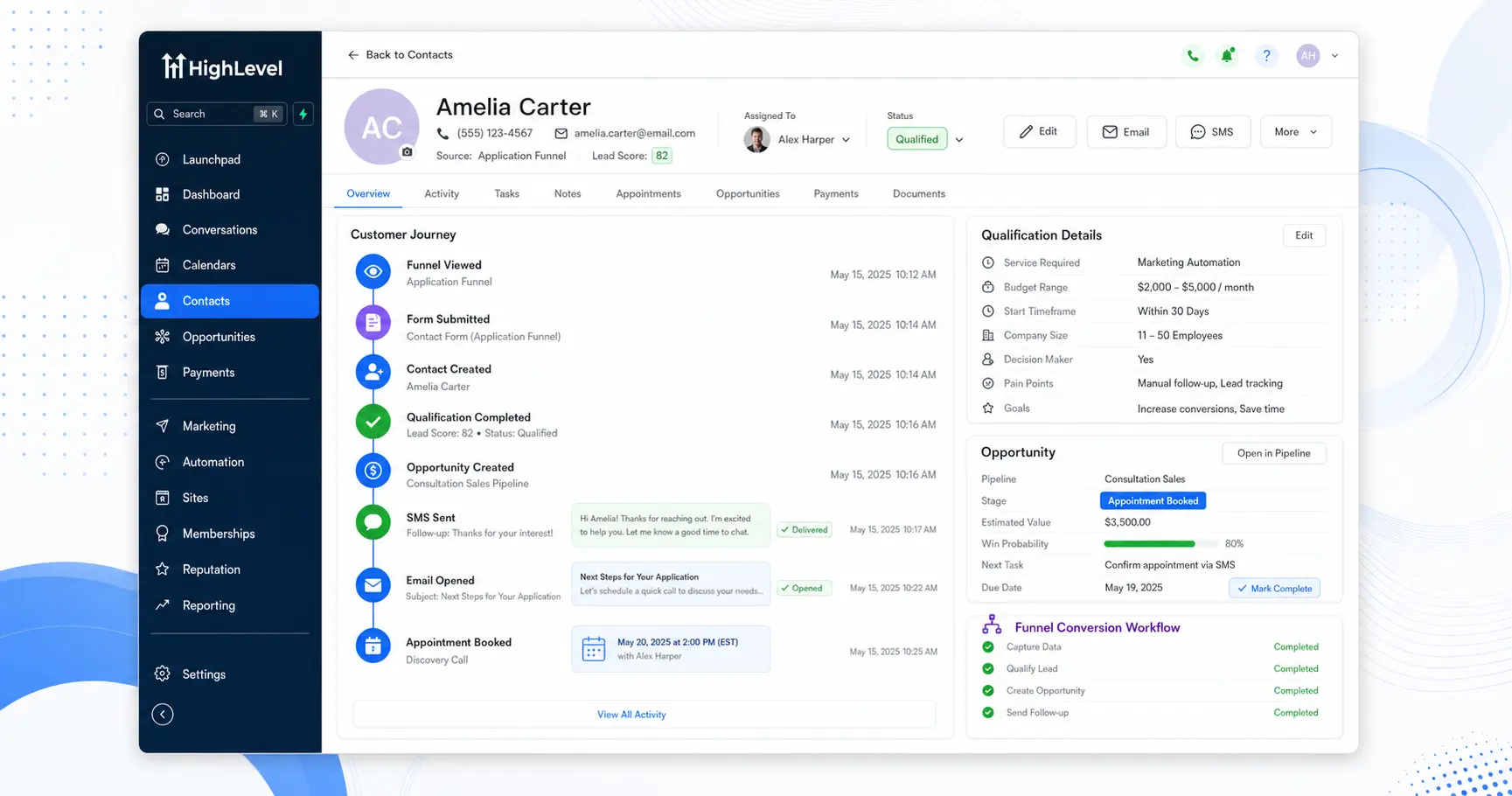
In HighLevel, this value multiplies because funnels are connected natively to CRM and automation features. Leads generated through funnels can automatically flow into:
the CRM contact database
sales pipelines (opportunities)
automation workflows
multi-channel follow-up campaigns (email, SMS, WhatsApp, where applicable)
This means marketing does not stop at conversion. The funnel becomes the entry point into a system that can route, nurture, and convert leads at scale.
The 3 Core Stages of Every Marketing Funnel
Every effective funnel marketing strategy is built on three primary stages. These stages reflect the psychological journey prospects go through when deciding whether to buy.
While some models include additional stages, most funnel frameworks can be simplified into three core phases: awareness, consideration, and decision.
Top of Funnel (TOFU): Awareness
The top of the funnel is where prospects first encounter your brand. At this stage, they are typically researching a problem or exploring a topic. They may not yet know your business exists, and they are rarely ready to buy.
The primary goal of this stage is visibility and education.
Instead of pushing a sales message too early, businesses focus on providing valuable information that helps prospects understand their problem and discover potential solutions.
Typical TOFU content includes:
blog articles and educational guides
social media posts and short-form content
YouTube videos and tutorials
search engine marketing campaigns
introductory webinars or workshops
At this stage, the key objective is simple: attract attention and build trust.
If a prospect perceives your brand as helpful and knowledgeable, they are more likely to continue engaging with your content and move further into the funnel.
Middle of Funnel (MOFU): Consideration
Once a prospect understands their problem, they begin evaluating different solutions. This is the middle of the funnel.
In this stage, prospects are no longer just learning about a topic. They are comparing providers, researching methods, and assessing which solution might be the best fit.
The goal of the middle of the funnel is credibility and relationship-building.
Businesses provide more detailed information that demonstrates expertise and differentiates their solution from alternatives.
Examples of middle-of-funnel content include:
lead magnets such as guides, templates, or checklists
webinars that explain a specific method or framework
comparison guides or product demonstrations
case studies showing real client outcomes
email sequences that educate prospects over time
This stage is where lead nurturing becomes essential. By maintaining regular contact and providing useful insights, businesses can gradually build the confidence prospects need to move forward.
The objective is not to rush the sale, but to position your solution as the logical next step.
Bottom of Funnel (BOFU): Decision
The bottom of the funnel is where prospects are ready to take action.
At this stage, they have already identified their problem, explored possible solutions, and narrowed down their options. They are now deciding whether to move forward with your business.
The goal of this stage is conversion.
Instead of broad educational content, prospects need reassurance that choosing your product or service is the right decision.
Common BOFU elements include:
product demonstrations
free trials or consultations
pricing pages
testimonials and case studies
proposal presentations
onboarding offers or guarantees
This stage is where removing friction becomes critical. The easier it is to understand the value of your offer and take the next step, the more likely prospects are to convert.
The Extended Funnel: What Happens After Conversion
Many businesses think the funnel ends at the sale, but modern marketing recognises an additional stage beyond conversion.
After a customer buys, the relationship continues. In fact, the post-purchase phase can be one of the most valuable stages of the entire funnel.
This stage often focuses on:
customer onboarding
product education
support and service delivery
upsell or cross-sell opportunities
customer advocacy and referrals
Businesses that invest in this stage often benefit from higher lifetime value and stronger brand loyalty.
Satisfied customers can become repeat buyers, advocates, and referral sources—effectively feeding new prospects back into the top of the funnel.
How Funnels Guide Prospects Toward a Purchase
Funnels work because they align marketing messages with the mindset of the buyer at each stage.
A prospect at the awareness stage does not need a sales pitch. They need useful content that helps them understand their situation.
As they progress into the consideration stage, they begin evaluating solutions and require more specific information about how your product or service works.
By the time they reach the decision stage, they need reassurance, proof, and a clear path to action.
This progression ensures that prospects are not overwhelmed too early with aggressive selling or left without enough information when they are ready to decide.
In practical terms, a funnel might look like this:
A visitor discovers your website through a search engine or advertisement.
They read an article or watch a video explaining a problem they face.
They download a guide that provides deeper insights.
They receive follow-up emails that explain potential solutions.
They attend a webinar or request a consultation.
They eventually make a purchase or commit to a service.
Each step builds trust and confidence.
This strategic process is often referred to as lead nurturing—a sequence of interactions designed to gradually warm up prospects until they are ready to convert.
Lead Nurturing Funnels and Long Sales Cycles
Not every purchase decision happens immediately. In many industries—particularly B2B services, consulting, and higher-value purchases—the sales cycle can span weeks or even months.
Lead nurturing funnels are designed to maintain engagement during this extended decision-making process.
Instead of relying on a single interaction, businesses create sequences that deliver useful content over time. These sequences might include:
educational email series
follow-up webinars or workshops
case studies and success stories
invitations to consultations or demos
By maintaining consistent communication, businesses remain visible and helpful while prospects evaluate their options.
When the prospect is finally ready to make a decision, the brand that provided the most value during the research phase often becomes the preferred choice.
The Role of Automation in Funnel Marketing
As marketing funnels become more sophisticated, automation plays a critical role in managing interactions at scale.
Modern platforms such as HighLevel allow businesses to automate many parts of the funnel, including:
lead capture through forms and landing pages
automated email and SMS follow-up sequences
appointment booking and reminders
lead scoring and segmentation
pipeline management for sales teams
Automation ensures that prospects receive timely communication without requiring constant manual intervention.
For example, when a visitor downloads a lead magnet, automation can immediately:
send the requested resource
add the contact to a nurture sequence
tag the lead according to their interest
notify the sales team if the lead meets certain criteria
This level of automation ensures that no opportunity is missed and that every prospect receives a consistent experience.
Measuring Funnel Performance
One of the most valuable aspects of funnel marketing is its measurability.
Each stage of the funnel can be tracked using key performance metrics, allowing businesses to identify where improvements are needed.
Typical funnel metrics include:
visitor-to-lead conversion rate
lead-to-opportunity conversion rate
opportunity-to-customer conversion rate
cost per lead and cost per acquisition
customer lifetime value
By analysing these metrics, businesses can optimise their funnel continuously.
For example:
If traffic is high but lead capture is low, the landing page may need improvement.
If leads are captured but few convert, the nurturing sequence may need stronger messaging.
If prospects book calls but rarely purchase, the sales process may require refinement.
This data-driven approach allows businesses to improve performance systematically rather than relying on guesswork.
Summarising Funnel Marketing Fundamentals
Understanding funnel marketing is one of the most important foundations for building a scalable business.
Rather than relying on isolated marketing activities, funnels create a structured journey that guides prospects from awareness through to conversion and long-term engagement.
By aligning content, messaging, and offers with the buyer’s mindset at each stage, businesses can:
attract more relevant traffic
nurture stronger relationships with prospects
increase conversion rates
generate predictable revenue growth
Modern funnel platforms such as HighLevel extend this concept even further by connecting funnels directly to CRM systems, automation workflows, and sales pipelines.
The result is not just a marketing funnel—but a complete customer acquisition and relationship management system.
How HighLevel Funnels Differ from Standard Landing Pages
It is common to describe funnels as “landing pages”, but HighLevel funnels are more accurately described as conversion systems.
A landing page can exist without a back-end. A funnel inside HighLevel is typically connected to:
forms or surveys for data capture
workflows that automate follow-up and internal actions
pipeline stages that reflect the sales process
calendars for appointment booking
tags and custom fields for segmentation
conditional logic for lead qualification
This matters for lead generation because the cost of acquiring a click is increasing across most platforms. If you generate leads but do not capture them reliably, follow up quickly, or segment them correctly, you leak value.
HighLevel funnels solve that by making it easier to connect the front-end conversion experience to the back-end lead management process.
Lead Generation Funnel Progression in HighLevel
Funnels usually evolve as a business matures.
Early-stage businesses want volume. They need simple, low-friction conversion points to build an audience and pipeline.
As lead volume increases, businesses need better systems. They introduce booking steps, segmentation, reminders, and qualification so sales teams can focus on the right prospects.
In HighLevel, the most common lead generation progression looks like this:
Basic Landing Funnel (single page conversion)
Simple Landing Funnel (landing + thank you)
Lead Magnet Funnel (capture + deliver a resource)
Appointment Booking Funnel (convert to meetings)
Lead Generation Funnel (capture + book immediately)
Webinar Funnel (educate then convert)
Application Funnel (high-ticket qualification and routing)
Not every business needs the most advanced structure. The best funnel is the one that matches your acquisition channel, lead intent, and sales model.
Basic Landing Funnel (Single Page Conversion)
This is the simplest form of lead generation funnel architecture: a single page that captures a conversion.
It is often used as a quick test or “minimum viable funnel” to validate an offer, message, or traffic source.
Typical steps
Landing page (with embedded form, survey, or booking widget)
A “thank you” message may display on-page after submission rather than using a separate thank-you page.
How it works in HighLevel
Even a minimal structure can still behave like a complete system:
the submission creates or updates a contact record
tags can be applied instantly for segmentation
a workflow can send an instant email or SMS response
a pipeline opportunity can be created automatically
internal notifications can alert your team to new leads
The key advantage is speed and simplicity. It reduces drop-off that can happen between pages.
When it is used
quick campaign tests
local service offers (fast conversions)
short-term promotions
simple lead capture initiatives
This funnel is particularly effective when you want to test multiple messages rapidly and optimise based on conversion data.
Simple Landing Funnel (Landing Page + Thank You)
This is the most common entry-level lead generation structure and one of the most widely used patterns across agencies.
Typical steps
Landing page / opt-in page
Thank you page
The landing page captures the lead. The thank-you page confirms success and tells the prospect what to do next.
How it works in HighLevel
When a visitor submits the form:
HighLevel creates a contact record in the CRM
form data maps into standard fields and/or custom fields
tags can be applied for lead source, offer, and segment
a workflow sends a welcome email or SMS, or both
the lead can be placed into a “New Lead” pipeline stage
The thank-you page is strategically important. It is an opportunity to increase conversion depth and shape the next action, such as:
setting expectations on response times
inviting the prospect to book a call
presenting a secondary offer
providing a download link or next step
When it is used
newsletter sign-ups
simple lead magnets
top-of-funnel paid campaigns
retargeting campaigns focused on capture
This funnel is ideal when your main objective is to convert anonymous visitors into known contacts you can nurture.
Lead Magnet Funnel (Capture + Delivery + Nurture)
Lead magnet funnels are designed to build your list while providing immediate value.
They are especially useful when the buying cycle is longer or when prospects require trust-building before speaking to sales.
Typical steps
Landing page (lead magnet offer)
Opt-in form (standalone or embedded)
Thank you page
Download/access page (and/or delivery via email)
How it works in HighLevel
When the prospect opts in:
a CRM contact is created or updated
the lead is tagged by topic, offer, or campaign
the lead magnet is delivered through one or more methods:
immediate access on a follow-up page
email delivery with a download link
both (recommended to reduce support issues)
a nurturing workflow begins automatically
The workflow is where lead magnets become commercially valuable. A well-designed nurture sequence can:
position authority
reduce uncertainty through case studies and proof
introduce the next logical offer step
route high-intent leads to booking
This improves lead quality over time, because only a subset of leads will progress into sales conversations.
When it is used
B2B lead nurturing
agencies building authority in a niche
SaaS education and onboarding
personal brands building demand
Lead magnets work best when they solve a specific problem and naturally bridge to your service.
Appointment Booking Funnel (Direct-to-Calendar Conversion)
Appointment funnels convert traffic into meetings with minimal delay. They are highly effective when your traffic is already warm or intent-driven.
Typical steps
Landing page
Calendar booking page
Booking confirmation page
How it works in HighLevel
HighLevel calendars integrate directly with the CRM:
when a prospect books, a contact record is created/updated
the appointment is stored against the contact profile
workflows trigger confirmation and reminders
pipeline stages update automatically (e.g., “Discovery Call Booked”)
internal notifications can alert your team instantly
The booking confirmation page is not just a receipt. It can significantly reduce no-show rates by reinforcing:
the value and purpose of the meeting
the agenda and preparation steps
rescheduling options
meeting location or video links
When it is used
agencies booking discovery calls
consultants and coaches
professional services (legal, financial, medical)
local services requiring quoting
This funnel performs best with warm audiences such as branded search, referrals, remarketing, or highly targeted campaigns.
Lead Generation Funnel (Capture then Book Immediately)
This structure combines form capture with booking, giving you the reliability of capturing leads even if they do not book. It is one of the most reliable funnels for paid lead generation.
Typical steps
Landing page / opt-in page
Thank you page
Appointment booking page
Confirmation page
Some businesses combine thank you and booking, but separating them often improves tracking and clarity.
How it works in HighLevel
This funnel creates two conversion opportunities:
form submission (micro conversion)
appointment booking (macro conversion)
Inside HighLevel:
the form submission creates the contact record
workflows can apply tags and initiate nurturing
the prospect is redirected to booking
if they do not book, HighLevel can follow up automatically
if they book, pipeline stages update and reminders trigger
A practical optimisation is a “non-booker sequence”, for example:
instant confirmation and value message
reminder after a few hours
next-day reminder with alternative times
final message offering Q&A via reply
This improves booked-call rate without increasing ad spend.
When it is used
agencies and B2B services
consultants and coaches
local services that sell via calls
cold traffic where booking intent varies
This is often the default structure for scalable lead generation campaigns.
Webinar Funnel (Educate then Convert)
Webinar funnels move prospects from awareness to intent through education. They work exceptionally well when the offer is complex or trust-heavy.
Typical steps
Webinar registration page
Registration confirmation page
Webinar broadcast page
Offer page
Thank you page
Some funnels include a replay step, which HighLevel can support using tags and conditional page routing.
How it works in HighLevel
When a prospect registers:
their CRM record is created or updated
they are tagged as “Webinar Registered”
reminder sequences begin automatically (email and SMS)
post-webinar follow-up runs based on engagement
Segmentation is critical. HighLevel can tag and route contacts based on behaviour such as:
attended live
watched replay
clicked offer
booked a call
no-show
This allows follow-up messaging to match intent rather than treating every lead the same.
When it is used
SaaS and technical services
B2B agencies selling higher complexity offers
training providers and educators
industries where education builds conviction
Webinars reduce the burden on sales calls by handling explanation and proof at scale.
Application Funnel (High-Ticket Qualification and Routing)
Application funnels protect sales capacity and improve close rates by ensuring only qualified prospects reach your calendar.
They introduce deliberate friction to improve lead quality.
Typical steps
Landing page
Application form page
Qualification page (dynamic routing)
Calendar booking page
Booking confirmation page
How it works in HighLevel
HighLevel stores application responses via custom fields, enabling logic such as:
lead scoring from answers
automatic tagging (“Qualified”, “Not Qualified”, “Hot Lead”)
routing to different outcomes
For example:
if budget is below threshold, redirect to a resource page and start a nurture sequence
if business size meets criteria, show calendar booking and create an opportunity
if timeline is urgent, send internal alerts immediately
Sales teams benefit because they can review the full application before the call, resulting in:
better preparation
stronger discovery
faster qualification
higher close rates
When it is used
high-ticket consulting
premium agencies with strict ICP targeting
coaching programmes and masterminds
any service where call volume must be controlled
Application funnels become essential once your calendar becomes a bottleneck.
Demo Request Funnel (SaaS and Technical Implementations)
A demo request funnel is a specialised lead generation flow designed around product demonstrations and technical discovery.
Typical steps
Demo request page
Qualification form
Calendar booking page
Confirmation page
How it works in HighLevel
HighLevel can capture demo requirements and route leads automatically:
responses map to CRM custom fields
workflows apply tags for product interest or use case
high-fit leads route directly to booking
low-fit leads route to education or self-serve content
This funnel is common where a “demo” is the primary sales mechanism.
Survey / Quiz Funnel (Segmentation-Led Lead Generation)
Quiz and survey funnels generate leads while collecting data that improves segmentation and personalisation.
Typical steps
Quiz start page
Question pages
Results page
Lead capture or booking step
Thank you page
How it works in HighLevel
Quiz answers can:
populate custom fields
trigger lead scoring
route users to different offers and pages
personalise the results page copy
These funnels are effective because they feel interactive and value-driven, increasing completion rates while improving lead intelligence.
Multi-Step Form Funnel (Conversion Rate Optimisation)
Multi-step form funnels reduce perceived effort by asking for small commitments first and collecting contact details later.
Typical steps
Step 1 (easy questions)
Step 2 (details)
Step 3 (contact info)
Thank you or booking
How it works in HighLevel
Multi-step structures improve conversion rate by:
increasing micro-commitment
reducing “form anxiety”
allowing earlier segmentation signals
HighLevel can tag and score based on the early steps even before contact capture completes (depending on implementation). It is commonly used to improve conversion rates for cold traffic in competitive markets.
Lead Generation Implementation Principles in HighLevel
The funnel type is only half the equation. Performance is determined by how well the funnel connects to systems.
CRM mapping and data model discipline
If form and survey data does not map into meaningful fields, you cannot segment, score, or route effectively. High-performing funnels define:
required fields (minimum viable data)
qualification fields (budget, service type, urgency)
segmentation fields (industry, role, region)
attribution fields (source, campaign, ad group)
Follow-up speed and channel stacking
HighLevel’s biggest operational advantage is immediate follow-up. In most service businesses:
SMS increases speed and response rates
email provides depth and resources
internal notifications ensure human response when required
The best follow-up systems blend automation and manual action.
Pipeline integration for sales visibility
For service businesses, pipelines reduce chaos. A lead should automatically create an opportunity and move stages based on behaviour:
new lead
contacted
appointment booked
attended
proposal sent
closed won / closed lost
Funnel-driven pipelines make lead management measurable and scalable.
Qualification logic as you scale
As lead volume increases, qualification becomes a necessity. This is the point at which businesses move from:
simple capture funnels
toapplication, survey, and multi-step qualification funnels
The goal is to protect sales capacity and improve close rates.
Common Lead Generation Mistakes to Avoid
Funnels often fail because the surrounding system is weak.
Treating funnels as pages rather than systems
If the funnel does not connect properly to:
CRM fields
tags
workflows
pipeline stages
calendars
then it is just a landing page, not a revenue system.
Not capturing the lead before asking for booking
Sending cold traffic directly to a calendar often reduces total captured leads. For cold traffic, capture-first structures are typically more reliable.
Slow follow-up or inconsistent contact attempts
Lead conversion is time-sensitive. A delay of hours can drastically reduce bookings. HighLevel is designed to solve this, but only if workflows are built correctly.
One-size-fits-all messaging
As volume grows, segmentation becomes essential. Even simple segmentation by:
funnel offer
lead source
service interest
will improve conversion rates and reduce unsubscribes.
Non-Lead-Generation Funnel Types in HighLevel
The funnel types below are not primarily about acquiring a lead. They are designed for sales conversion, customer onboarding, retention, and post-purchase optimisation. They often sit downstream of lead generation funnels or operate as standalone systems for product-based businesses.
Product Sales Funnel
A product sales funnel is designed for direct purchases.
Typical steps
Sales page
Checkout page
Order confirmation page
Thank you page
HighLevel can connect purchases to CRM records and trigger onboarding sequences, making it viable for many digital product and service-package offers.
One-Page Sales Funnel
A simplified sales funnel where the offer and conversion occur on one page.
Typical steps
One-page sales page (embedded checkout or form)
Thank you page
This structure reduces drop-off and is useful when the offer is simple and the traffic is warm.
Two-Step Checkout Funnel
Designed to improve checkout conversion by splitting user details and payment into separate steps.
Typical steps
Checkout step 1 (details)
Checkout step 2 (payment)
Confirmation / thank you
It improves completion rate for higher-price items and mobile-heavy traffic.
Upsell / Downsell Funnel
Optimises average order value by offering additional products immediately after the initial purchase decision.
Typical steps
Checkout
Upsell page
Downsell page (optional)
Thank you page
This funnel is common in digital products, courses, templates, and bundles.
Tripwire Funnel
A tripwire funnel uses a low-cost offer to convert cold traffic, then nurtures toward higher-value services.
Typical steps
Offer page or lead magnet page
Checkout
Thank you
Upsell or booking step
This is a strong model for agencies selling audits or low-cost entry offers.
Membership / Course Access Funnel
Used to sell and then provision access to gated content.
Typical steps
Sales page
Checkout
Account creation / access
Welcome / onboarding
HighLevel can trigger onboarding automations, tag users by product, and manage course/membership journeys.
Challenge Funnel
A multi-day engagement funnel that builds momentum before a conversion.
Typical steps
Registration
Confirmation
Daily content pages (or email delivery)
Offer / booking step
Thank you
Challenges work well for education, coaching, and community-led offers.
Event Registration Funnel
Designed for registering people for in-person or online events that are not necessarily webinars.
Typical steps
Event registration
Confirmation
Event details / logistics
Thank you / calendar add
HighLevel workflows can send reminders, directions, and follow-up offers.
Onboarding Funnel
Onboarding funnels reduce delivery friction by collecting information after conversion.
Typical steps
Welcome page
Intake / onboarding form
Scheduling / next steps
Confirmation
This is common for agencies, implementations, and service delivery.
Abandoned Checkout / Abandoned Booking Funnel
A recovery funnel designed to bring users back after drop-off.
Typical steps
Recovery page
Return to checkout or booking
Confirmation
This funnel is typically paired with automation sequences such as abandonment emails and SMS reminders.
Re-Engagement Funnel
A win-back funnel designed to reactivate dormant leads or customers.
Typical steps
Reactivation page
Offer or booking step
Thank you
This works best when you already have a large database and want low-cost conversions.
Referral Funnel
A structured funnel for capturing referrals and routing them to the right follow-up.
Typical steps
Referral invite page
Referral form
Thank you / reward details
It can be automated with tagging, tracking, and pipeline creation.
Review / Reputation Funnel
Designed to increase reviews and improve reputation by routing customers based on satisfaction.
Typical steps
Feedback capture
Positive route (public review link) / negative route (private feedback)
Thank you
This funnel can meaningfully improve local SEO and conversion rates over time.
How to Choose the Right Funnel Type
Not every business needs the most advanced structure. The best funnel is the one that matches:
acquisition channel (paid ads, organic, referral)
lead intent (cold, warm, hot)
sales model (book-a-call, ecommerce, hybrid)
capacity constraints (sales time and fulfilment bandwidth)
In practice:
if you need volume fast, start with basic or simple landing funnels
if you sell through calls, lead generation funnels are typically the most reliable default
if your calendar is limited or your offer is premium, application funnels protect sales capacity
if your market needs education, webinar funnels increase conviction and intent
if you sell products, sales funnels with upsells improve revenue efficiency
if you serve customers locally, review funnels strengthen long-term demand generation
The Anatomy of a HighLevel Funnel: Structure, Elements, and Page Layout
Understanding funnel types is important, but equally important is understanding what actually makes up a funnel page. Regardless of the funnel type—lead generation, webinar, application, or product sales—most funnels share a common structural anatomy.
The difference between a funnel that converts and one that fails often comes down to how these elements are structured and presented. A successful funnel is not simply a landing page with a form. Instead, it is a carefully designed sequence of components that guide behaviour, reduce friction, and encourage a specific action.
In HighLevel, these components are built using the funnel builder, which allows businesses to structure pages, embed forms or surveys, integrate calendars, process payments, and trigger automation workflows.
This section explains the core structural elements that appear across most funnel pages and how they work together to guide prospects through the conversion journey.
Core Structural Elements of Funnel Pages
Although the content of funnels varies depending on the offer, most high-performing funnels follow a similar page architecture. These elements appear repeatedly across different funnel types because they align with how users scan information and make decisions online.
Headline and Value Proposition
The headline is one of the most important components of any funnel page. It communicates the primary benefit or promise of the offer in a clear and compelling way.
A strong headline answers the prospect’s immediate question:
“What will I gain from this?”
Effective funnel headlines typically focus on:
solving a specific problem
achieving a measurable outcome
delivering a clear benefit
saving time or reducing effort
Examples include:
“Generate Qualified Leads With HighLevel Funnels”
“Book More Consultations With Automated Lead Systems”
“Download the Complete Guide to CRM Automation”
The headline usually appears above the fold, meaning visitors see it immediately when the page loads.
Supporting Subheadline
While the headline captures attention, the subheadline provides additional clarity and context.
It often explains:
how the offer works
what the visitor will receive
why the offer is valuable
For example, a subheadline might explain that a guide contains step-by-step strategies or that a consultation will reveal growth opportunities.
Together, the headline and subheadline establish the core message of the funnel page.
Hero Section
The hero section is the first visual block visitors encounter when they land on the page.
This section typically contains:
headline
subheadline
hero image or illustration
primary call-to-action
embedded form or booking button
The purpose of the hero section is to present the primary conversion action immediately.
In HighLevel funnels, this often includes:
submitting a lead capture form
booking a consultation
registering for a webinar
By placing the conversion element early on the page, friction is reduced and visitors can take action immediately.
Visual Elements and Illustrations
Visual elements help communicate ideas quickly and improve comprehension.
Common visuals used in funnels include:
process diagrams
product screenshots
icons representing benefits
testimonial photos
data or performance charts
For service businesses, visuals often demonstrate how a process works, such as showing the flow of a CRM system or illustrating a marketing framework.
HighLevel’s page builder allows these visuals to be inserted easily using image blocks, icon libraries, or embedded media.
Benefit Sections
After the hero section, funnels usually include a section highlighting the key benefits of the offer.
Rather than listing technical features, this section focuses on explaining how the offer improves the visitor’s situation.
Typical formats include:
bullet point benefits
short explanatory paragraphs
icons illustrating advantages
Examples might include:
automate follow-up using email and SMS
capture and qualify leads automatically
connect marketing campaigns with CRM pipelines
This section reinforces the value proposition and encourages the visitor to continue down the page.
Social Proof and Credibility
Trust is a critical factor in funnel conversion. Prospects are far more likely to take action when they see evidence that others have achieved success.
Common credibility signals include:
testimonials
client logos
case studies
industry certifications
performance statistics
Within HighLevel funnels, these elements typically appear as testimonial blocks or logo grids.
For service businesses and agencies, social proof demonstrates expertise and reduces perceived risk.
The Primary Call to Action (CTA)
The call to action is the element that converts visitors into leads or customers.
Examples of CTAs include:
submit a form
book a consultation
download a resource
register for a webinar
start a trial
Effective CTAs are:
clear and action-oriented
visually prominent
repeated throughout the page
In most funnels, the CTA appears multiple times—typically:
within the hero section
after benefit sections
near the bottom of the page
This ensures visitors can convert whenever they feel ready.
Forms and Surveys for Lead Capture
Forms are the primary method for capturing lead information within HighLevel funnels.
Forms may collect details such as:
name and email
phone number
company name
service interest
project requirements
HighLevel allows form fields to map directly to CRM contact properties, ensuring captured data is stored and structured correctly.
For more complex funnels, surveys can be used instead of simple forms. Surveys support:
multi-question forms
conditional logic
step-based interactions
These are commonly used in application funnels and qualification funnels.
Calendar Integration for Appointment Funnels
Many service businesses rely on funnels that convert visitors into scheduled consultations.
HighLevel calendars allow visitors to:
view available times
select a time slot
book instantly
Once a booking occurs, HighLevel automatically:
creates or updates the CRM contact
schedules the meeting
sends confirmation emails and SMS reminders
updates pipeline stages
This automation removes the traditional back-and-forth required when scheduling meetings manually.
Thank You Pages and Confirmation Steps
After a visitor completes a conversion action, they are typically redirected to a thank you page.
This page serves several purposes:
confirming the action was successful
explaining what happens next
delivering resources or instructions
encouraging additional engagement
For example, a thank-you page may:
provide a download link for a lead magnet
confirm webinar registration
display appointment details
It can also introduce secondary actions, such as inviting prospects to join a community or follow the brand on social media.
Multi-Step Funnel Layouts
Many funnels consist of multiple pages, each with a specific purpose.
Examples include:
Lead Generation Funnel
Landing Page → Thank You Page → Booking Page → Confirmation
Application Funnel
Landing Page → Application Form → Qualification → Booking Page → Confirmation
Product Sales Funnel
Sales Page → Checkout Page → Upsell → Thank You
This structure allows marketers to guide visitors through one decision at a time, which improves conversion rates.
Conversion Optimisation Principles in Funnel Layouts
High-performing funnels follow several proven optimisation principles.
Minimise Distractions
Unlike traditional websites, funnels usually remove:
navigation menus
external links
unrelated content
This keeps visitors focused on the primary conversion action.
One Goal Per Page
Each funnel page should guide the visitor toward one clear objective, such as:
submitting a form
booking a call
completing checkout
Multiple competing actions can reduce conversions.
Clear Visual Hierarchy
Successful funnels guide the eye through the page using:
headings and subheadings
colour contrast
spacing and layout
directional cues
This makes the page easier to scan and helps visitors move naturally toward the CTA.
Repetition of Key Messages
Important messages—such as benefits or outcomes—are repeated throughout the page in different formats.
This reinforces the value of the offer and ensures that visitors who skim the page still understand the core proposition.
How HighLevel Simplifies Funnel Construction
HighLevel simplifies funnel construction by providing an integrated set of tools within a single platform.
Inside the platform, users can:
design landing pages using a visual builder
embed forms and surveys
integrate calendars for booking
process payments through checkout pages
trigger automation workflows
manage leads within CRM pipelines
Because all of these components are integrated, businesses can create fully connected funnel systems without relying on multiple marketing tools.
Why Funnel Anatomy Matters
Many businesses focus heavily on traffic generation but overlook funnel design. However, small improvements to funnel structure can significantly improve conversion performance.
A well-designed funnel page:
communicates value immediately
builds trust through proof
removes friction from decision-making
guides the visitor toward a clear next step
By understanding the anatomy of funnels and applying proven layout principles, businesses can dramatically improve how effectively their funnels convert traffic into leads and customers.
Final Thoughts
Funnels are a fundamental component of modern digital marketing, particularly for businesses running paid acquisition or structured lead generation campaigns.
Inside GoHighLevel, funnels do not exist in isolation. They act as the intelligent front door to a broader revenue system, connecting website visitors directly with CRM records, automation workflows, and sales pipelines.
For agencies and service businesses, the best approach is usually to start with the most basic funnel structure that matches current traffic and sales capacity, then progress toward more advanced funnels as lead volume increases and qualification becomes more important.
By structuring the customer journey carefully and using HighLevel’s CRM and automation capabilities properly, businesses can improve lead quality, increase conversion rates, and build a predictable pipeline of opportunities.