
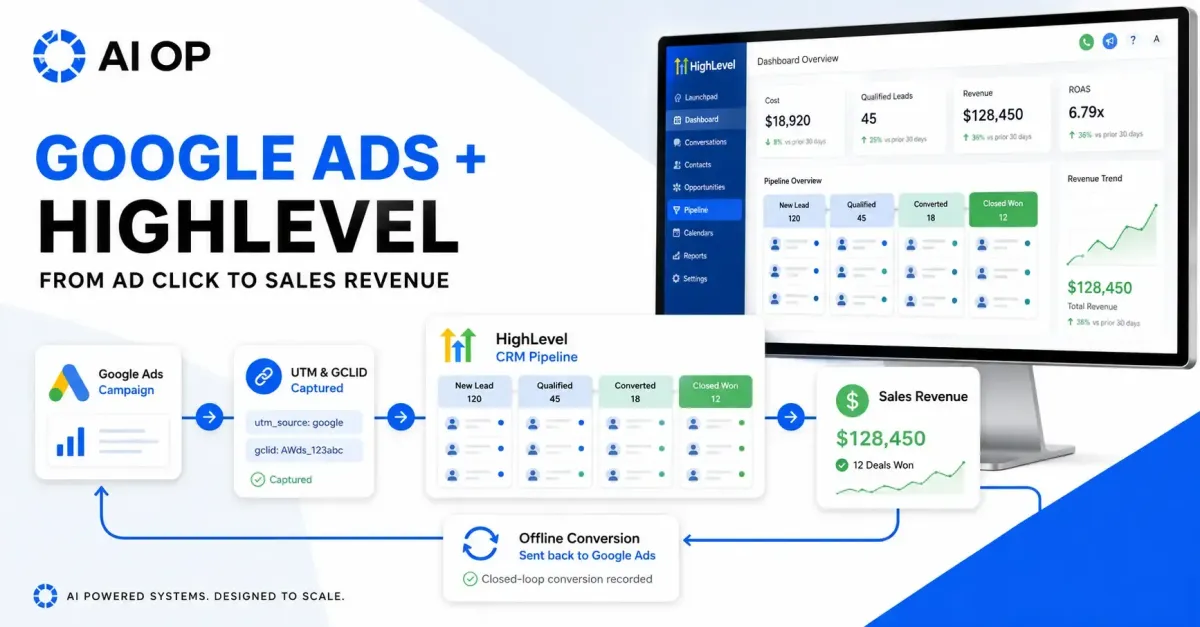
How to Use HighLevel with Google Ads
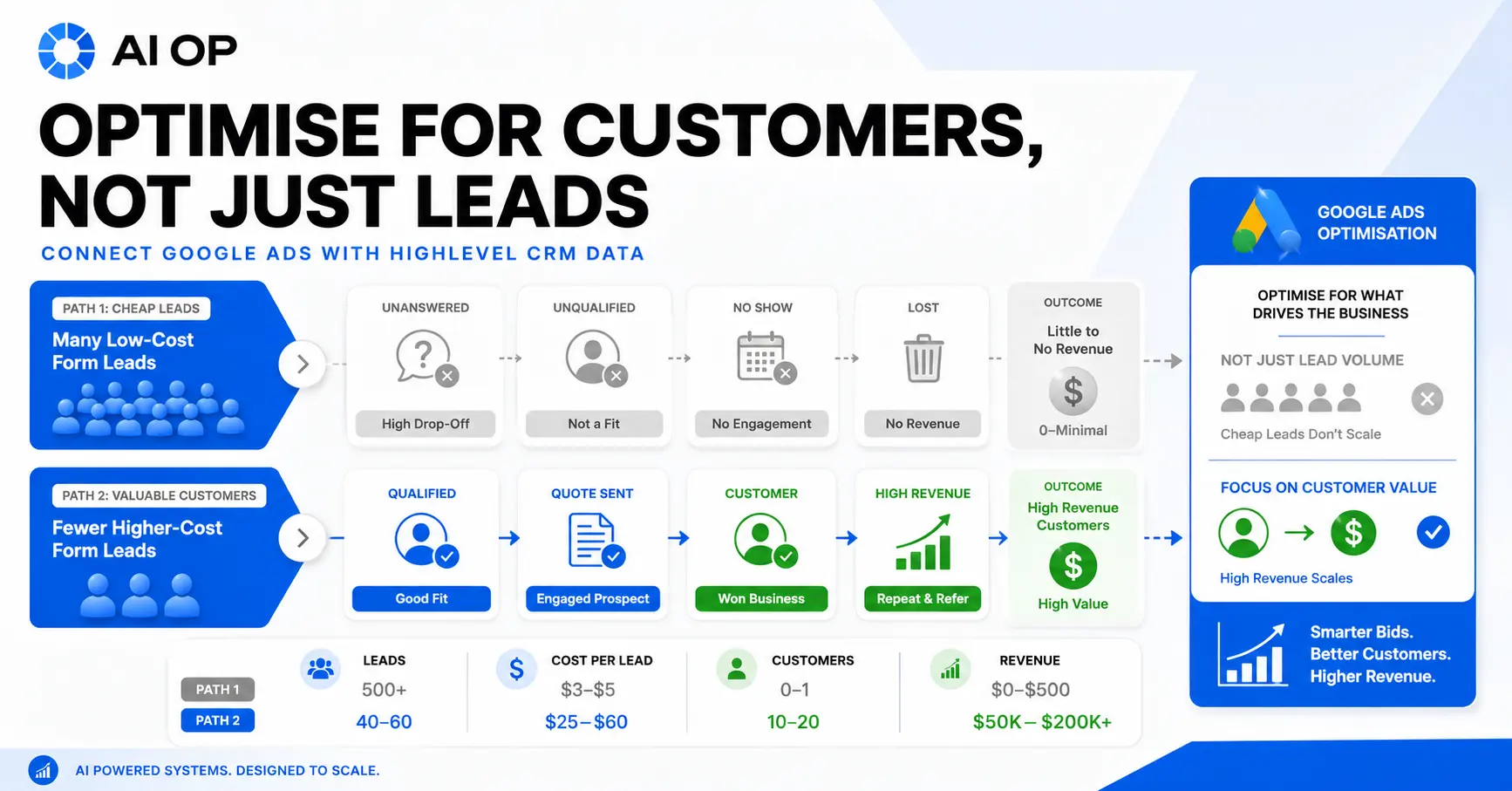
Google Ads is excellent at measuring online advertising metrics such as impressions, clicks and lead conversions. It can tell you precisely how many people clicked your advertisement, how much you paid for each click and how many of those visitors completed a form. It can even provide a clear cost-per-lead figure.
However, one important question remains: what was each lead actually worth to the business?
Here is the uncomfortable truth: by default, Google Ads has limited visibility into what happens after the initial enquiry. It cannot automatically see that half of your supposedly “cheap” leads never answered the telephone, failed to qualify or lived outside your service area. Equally, it may not know that several of your more expensive leads went on to become your most profitable customers.
Left to its own devices, an advertising platform will optimise towards the outcomes it can measure. Unfortunately, the easiest outcomes to measure—such as clicks and form submissions—are rarely the ones that matter most to your bank balance.
This is the gap that connecting Google Ads with HighLevel is designed to close.
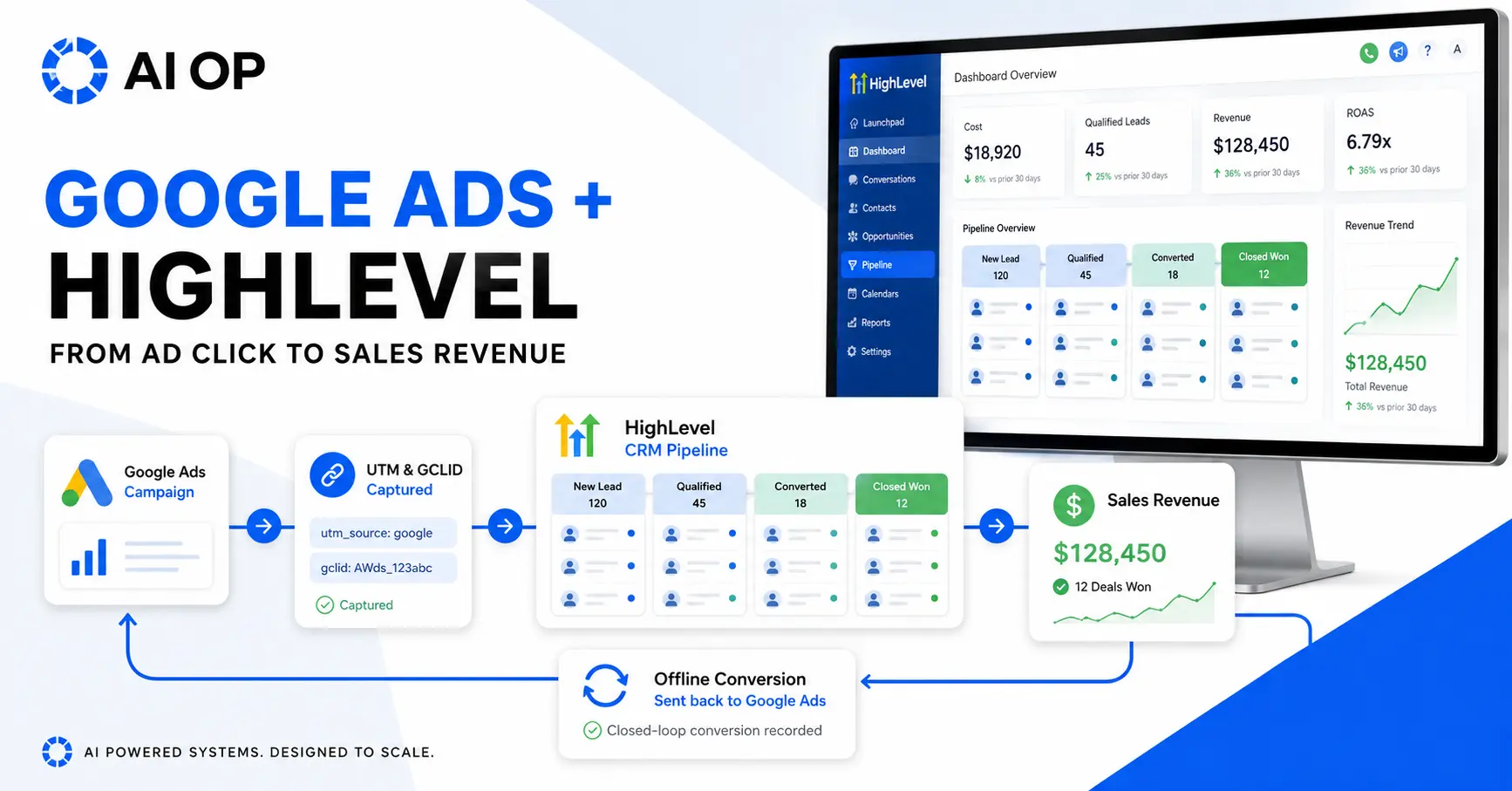
Instead of allowing the data trail to end at “form submitted”, a properly configured integration follows the prospect from the original advertisement click through qualification, quotation, appointment, sale and revenue. HighLevel can then return commercially meaningful outcomes—such as Qualified Lead, Converted Lead, Closed Won and confirmed sales value—to Google Ads as offline conversions.
That is what closed-loop marketing means in practice.
In this guide, we will explain how to connect HighLevel with Google Ads, capture campaign and keyword attribution against contact records, automate lead follow-up, synchronise sales-pipeline stages with offline conversions and move beyond basic cost-per-lead reporting towards measuring lead quality, customer acquisition cost and sales revenue.
The Problem With Lead-Volume Optimisation
Picture two campaigns running side by side.
Campaign A generates 60 leads at £50 per lead. Campaign B generates 32 leads at £78 per lead. Judged purely on cost per lead, Campaign A looks like the obviously better investment, and most advertisers would shift budget towards it without a second thought.
Now add a second layer of data:
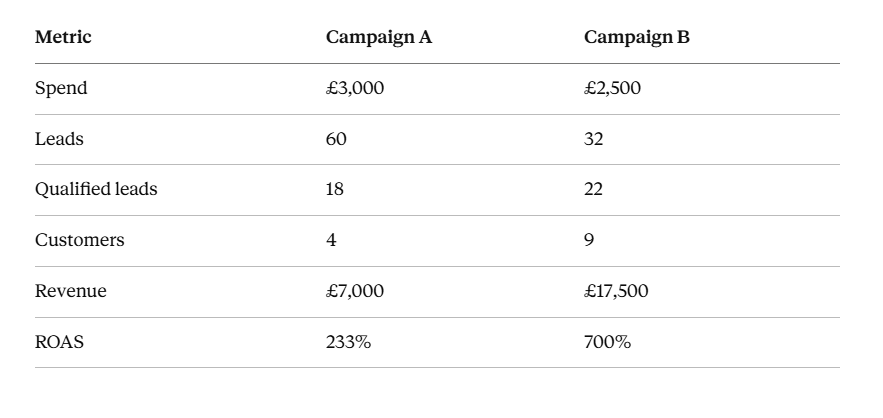
Campaign A wins on raw lead count and cost per lead. Campaign B wins decisively on qualified leads, customers, revenue, and return on ad spend. Without CRM data feeding back into the picture, a business would very plausibly pour more budget into the worse-performing campaign — the exact opposite of the right call.
This is not a flaw in Google Ads. It is a data gap. The platform is only ever as clever as the information it is given, and if all it ever learns is which adverts generate form submissions, that is all it will ever optimise for. Give it qualification data, sales outcomes, and revenue, and it starts optimising for the thing you actually care about: profitable customers.
What Closed-Loop Marketing Actually Means
Closed-loop marketing simply means connecting what the ad platform knows — impressions, clicks, spend, keywords, campaigns — with what the CRM knows: contacts, qualification, appointments, quotes, pipeline stage, customers, and revenue.
In a properly configured system, the loop looks like this:
Google Ads generates the click and the lead.
HighLevel captures the contact and stores advertising attribution against it.
Workflows deliver immediate follow-up and ongoing nurture.
Sales automation qualifies the prospect and, where appropriate, produces a quotation.
The opportunity moves through a defined pipeline.
Meaningful pipeline stages — qualified, converted, closed-won — are sent back to Google Ads as offline conversions.
Confirmed revenue is attributed to the original ad, campaign, ad group, and keyword.
CRM segments feed Customer Match, Custom, Matched, and Lookalike-style audiences across Google, Meta, and LinkedIn.
Google Ads' reporting and automated bidding improve because they are working from real commercial outcomes, not just click and form data.
HighLevel, in this context, is not simply a place to dump leads generated by Google Ads. It is the connective tissue between advertising, CRM, marketing automation, sales automation, audience targeting, and revenue attribution. With both datasets connected, a business can finally calculate cost per lead, cost per qualified lead, cost per appointment, cost per quotation, cost per converted lead, customer acquisition cost, lead-to-customer conversion rate, revenue per keyword, revenue per campaign, and true return on ad spend.
What the Integration Actually Consists Of
There is no single toggle labelled "the Google Ads integration." A complete implementation is a combination of several connected capabilities, including the Google Ads account connection itself, HighLevel Ad Manager, Google Lead Form synchronisation, website and funnel tracking, contact-level attribution, UTM parameter capture, Google click identifier capture (GCLID, GBRAID, and WBRAID), forms and surveys, appointment calendars, call tracking, opportunity pipelines, contact-and-opportunity stage synchronisation, speed-to-lead workflows, lead-nurturing automation, quote calculation logic, sales automation, offline conversion tracking, revenue attribution, and audience creation across Google, Meta, and LinkedIn.
The goal is never simply to move a lead from Google Ads into HighLevel and stop there. It is to preserve the thread connecting the original ad click to everything that happens after it — for weeks or months, across multiple touchpoints and team members.
HighLevel Ad Manager: The Consolidated Campaign Layer
HighLevel Ad Manager gives agencies and in-house marketers a single place to create, manage, and review advertising campaigns across multiple platforms, rather than switching between separate ad accounts and dashboards. Currently supported platforms include Google Ads, Facebook Ads, Instagram Ads, and LinkedIn Ads.
From Ad Manager, a marketer can review spend, impressions, clicks, conversions, click-through rate, and cost per click, and export campaign statistics for further analysis. For an agency running Google Search, Google Demand Gen, Facebook, Instagram, and LinkedIn lead-generation campaigns simultaneously, this consolidated view removes a considerable amount of manual reporting overhead.
The Full Data Flow, Step by Step
A properly configured integration moves a prospect through a traceable sequence. A prospect searches on Google and clicks an advert. Tracking parameters capture the campaign, ad group, ad, and keyword. The prospect submits a form, calls, starts a chat, or books an appointment. HighLevel creates or updates the contact record, and attribution data is stored against it. An opportunity is created in the relevant pipeline, and a workflow triggers an immediate response while alerting the sales team. HighLevel begins nurturing the lead, and sales automation may qualify the prospect and calculate a quote.
From there, the sales team advances the opportunity through pipeline stages. A "qualified" stage change fires an offline conversion back to Google Ads. A "converted" or "closed-won" stage change fires a second, deeper conversion, and confirmed revenue is sent back to Google Ads against the original click. CRM segments are then used to build or refresh advertising audiences, and Google Ads' reporting and bidding algorithms improve because they now have commercial-outcome data, not just top-of-funnel signals.
This is the practical difference between basic lead tracking and genuine closed-loop marketing. Basic tracking asks how many form submissions a campaign generated. Closed-loop marketing asks which campaigns, ads, and keywords generated qualified prospects, paying customers, and profitable revenue.
Setting Up the Connection
Audit Before You Connect
Before linking any accounts, audit the existing setup. Confirm the correct Google Ads account — and, for agencies, the correct client under the manager account — the correct HighLevel sub-account or location, and user permissions on both platforms. Check existing Google Ads conversion actions and which are primary versus secondary, website and landing-page domains, any existing Google Lead Forms, existing HighLevel forms, surveys, and calendars, and tracked telephone numbers.
It is also worth reviewing existing opportunity pipelines, contact lifecycle fields already in use, existing workflows that might conflict with new ones, opportunity-value and revenue fields, existing UTM conventions, GCLID/GBRAID/WBRAID capture status, and current audience lists on each ad platform.
The Google account used to authorise the connection must have access to the correct Google Ads account. This matters most for agencies managing several clients through a single Google Ads manager (MCC) account, where a connection can complete successfully while still being linked to the wrong client or location. Always verify by account ID rather than by account name, since names can be duplicated or renamed without anyone noticing.
Google Lead Forms
Google Lead Form Extensions let a prospect submit their details directly inside the advert, without ever visiting a landing page. HighLevel's Google Lead Ads integration can sync these submissions straight into the CRM, mapping form fields to contact fields and triggering workflows the moment a submission arrives.
This connection can be used to create or update a contact, map form answers into custom fields, create an opportunity, assign a lead owner, notify the sales team instantly, send an immediate email, SMS, or WhatsApp message, start a qualification or nurture workflow, and add the lead to the correct pipeline.
Lead Forms are valuable for speed, because there is no manual export or middleware step between Google and HighLevel. But they are only one entry point — a complete implementation also needs to handle website forms, surveys, calls, chat, and appointment bookings, since not every prospect will convert through a native lead form.
Capturing Attribution at the Contact Level
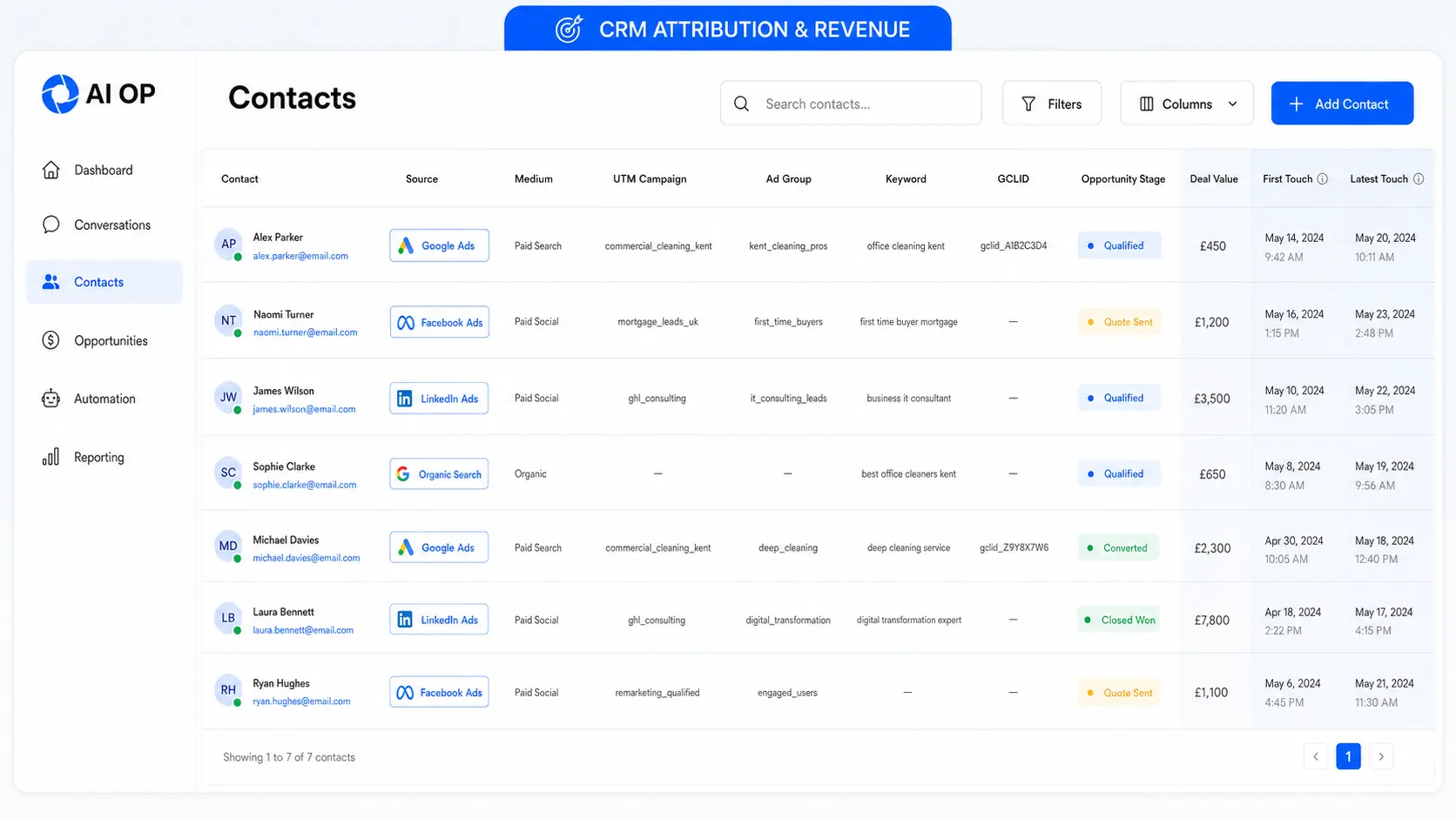
A contact record becomes far more useful once it explains where the person came from. Depending on configuration, a contact might carry the original source and latest source, UTM source, medium, campaign, content, and term, campaign ID, ad group ID, and ad ID, keyword and match type, landing page URL, GCLID, GBRAID, or WBRAID, and first-touch and latest-touch attribution.
With this in place, a salesperson opening a contact record can see that the person arrived via Google Ads, through a specific campaign, ad group, keyword, and landing page — and, on the same record, whether they were contacted, whether they qualified, what quote they received, whether they booked, whether they bought, and how much revenue resulted. That is a materially richer picture than "Paid Search" appearing as an isolated line in a traffic report.
UTM Parameters
A Google Ads Final URL suffix might look something like this:
utm_source=google&utm_medium=cpc&utm_campaign={campaignid}&utm_content={adgroupid}&utm_term={keyword}&utm_matchtype={matchtype}&campaign_id={campaignid}&ad_group_id={adgroupid}&ad_id={creative}
This captures source, medium, campaign ID, ad group ID, keyword, match type, and ad ID as readable, storable values. Tracking templates using {lpurl} need careful testing, because some websites, content management systems, and redirect chains mishandle query strings or tracking templates. This can cause an advert to fail its URL test even though the landing page itself works perfectly well without the parameters attached.
A sensible test sequence runs as follows: check whether the site already uses query parameters for anything else, decide between a tracking template, a Final URL suffix, or both, test the exact resulting URL including all redirects, submit the HighLevel form using that URL, inspect the resulting contact record, confirm UTM values were retained, and confirm the relevant Google click identifier was captured. Seeing UTM parameters sitting in the browser address bar is not proof that they reached the contact record — the full journey has to be tested end to end.
First-Touch vs Latest-Touch Attribution
These two views answer different questions. First-touch attribution shows how the relationship began — perhaps a non-brand Google Search campaign that introduced the prospect to the business for the first time. Latest-touch attribution shows the most recent recorded source before a later conversion — the same person might return weeks later via a brand search, a remarketing advert, or an email link before finally submitting a second form or accepting a quote.
Both views matter. First-touch data shows which campaigns generate new demand; latest-touch data shows which channels influence the final decision. A sound data model preserves first-touch data permanently while allowing a separate latest-source field to update as the contact re-engages through different channels.
Google Click Identifiers and Offline Conversions
UTM parameters make advertising data human-readable. Click identifiers — GCLID, GBRAID, and WBRAID — are what let Google Ads match a later CRM conversion back to the original ad click. When an eligible advert is clicked, an identifier can be appended to the landing page URL, and HighLevel must capture and retain it so it can be included when an offline conversion is later sent back.
HighLevel's "Add to Google Ads" workflow action requires a contact to have a valid GCLID, GBRAID, or WBRAID from a legitimate Google Ads click. The conversion action name selected in the workflow must match the name of the conversion action created in Google Ads exactly, including capitalisation, spacing, and punctuation. Without a valid identifier, Google simply has no way to tie the sales event back to the original ad.
Google's current guidance points towards enhanced conversions for leads as the preferred approach for new offline lead-measurement implementations, using hashed first-party data to improve match durability and accuracy over time. Because HighLevel's supported implementation continues to evolve, it is worth checking current documentation before designing an offline conversion strategy specifically around this method
Capturing Leads From Forms, Surveys, Appointments, and Calls
Forms and Surveys
HighLevel forms create or update contacts, populate custom fields, and trigger workflows. Typical fields include name, contact details, service required, location, budget, preferred appointment time, qualification data, marketing consent, and attribution data.
Surveys are useful when more information is needed up front — a multi-step survey can gather requirements and even calculate a score or indicative quote before routing the lead into the right workflow.
Forms should be tested specifically for contact creation, duplicate handling, field mapping, attribution capture, mobile usability, consent capture, opportunity creation, workflow entry, and thank-you page behaviour. If a form is embedded on a third-party site, do not assume attribution passes through automatically — test it. Installing website tracking does not guarantee that every embedded or third-party form will forward the required data.
Appointment Bookings
For many service businesses, a booked appointment is worth more than a raw enquiry. HighLevel calendars can handle phone consultations, video calls, site visits, demonstrations, surveys, sales appointments, and installation bookings, and can track outcomes such as booked, confirmed, attended, cancelled, no-show, or rescheduled.
A booked appointment can serve as a secondary conversion signal; an attended and qualified appointment is usually a stronger sales-quality signal still. Be careful not to count a form submission and its resulting appointment as two separate leads — they are two stages of the same journey and should be labelled to reflect that.
Call Tracking
Phone calls remain one of the most valuable lead types for local-service and higher-consideration businesses. HighLevel call tracking connects inbound calls to contacts and source data, and number pools can associate a specific call with the website session and advertising source that produced it.
Call data can include caller details, timestamp, direction, duration, status, recording, assigned user, linked contact and opportunity, and attribution. A workflow can fire a Google Ads conversion when a call meets defined conditions — but duration alone is a weak qualifier. A call lasting ninety seconds is not inherently more valuable than one lasting forty seconds; the stronger signal is whether the call led to a genuine enquiry, correct service and location match, a booked appointment, a qualified status, or a requested quote.
Speed to Lead
Generating a good lead is only half the job — a slow response can waste it entirely. Speed to lead measures how quickly a business responds to a new enquiry, both in terms of the first automated touch and the first meaningful human contact.
A HighLevel workflow can respond within seconds by sending an email or SMS confirmation, an approved WhatsApp message, an initial quote, an appointment link, or by assigning the lead, creating a call task, alerting the sales team, or escalating an untouched lead after a defined delay.
Useful measurements here include time to automated acknowledgement, time to first human response, the percentage of leads contacted within five minutes or within an hour, contact rate and reply rate, appointment-booking rate, qualification rate, and conversion rate segmented by response-time band. This turns "respond faster" from a vague instruction into a measurable operational system.
Lead Nurturing With Workflows
Not every lead answers the first call or buys immediately — and a paid lead becomes expensive fast if it gets one call, one email, and nothing else.
A short-term nurture workflow might send an immediate acknowledgement, notify the assigned salesperson, create a call task, follow up if there is no reply, offer an appointment link, share relevant service information or a testimonial, escalate if the lead stays untouched, pause on reply, and end when the opportunity converts or is disqualified. A longer-term workflow might deliver educational content, FAQs, case studies, seasonal reminders, service comparisons, re-engagement messages, or special offers.
Automation should respond to actual behaviour — it should not keep sending generic marketing after a contact has replied, booked, purchased, or opted out. Sensible exit conditions include the customer or employee replying, an appointment being booked, a quote being accepted, payment being received, the opportunity closing as won or lost, an email unsubscribe, an SMS opt-out, or manual removal. Good nurturing supports the sales process; it should never compete with it.
Sales Automation and Quote Calculation
Beyond initial contact, HighLevel workflows can automate deeper sales-process tasks: lead qualification, opportunity creation, pipeline movement, quote calculation and delivery, quote follow-up, scheduling, contract delivery, payment collection, onboarding handover, review requests, and renewals.
This matters because Google Ads performance is not determined by keywords and bids alone — the sales operation's response time, follow-up discipline, and conversion rate all directly affect how many customers, and how much return on ad spend, a given budget ultimately produces.
Worked Example: Automated Quote Calculation
Consider a window-cleaning business — call it Cleanest Windows. A form or ad-sourced lead might supply property type, number of bedrooms, cleaning frequency, rear access, conservatory, extension, additional services, and location.
HighLevel can use custom fields, calculations, and conditional logic to wait until the required fields are populated, check whether the property type is supported, calculate four-weekly, eight-weekly, and one-off prices, save the figures to the contact, flag the quote as calculated or route unusual properties to manual review, deliver the quote by email, SMS, or WhatsApp, create or update the opportunity, and start a quote-follow-up workflow.
It is worth keeping calculation and communication as separate steps — the calculator computes and stores values; a separate workflow handles delivery. This separation makes the system easier to test, debug, and reuse for other quote types. Done well, this kind of automation dramatically improves speed to lead: instead of waiting for someone to manually price an enquiry, a qualifying prospect can get an indicative quote while their interest is still high.
Designing the Opportunity Pipeline
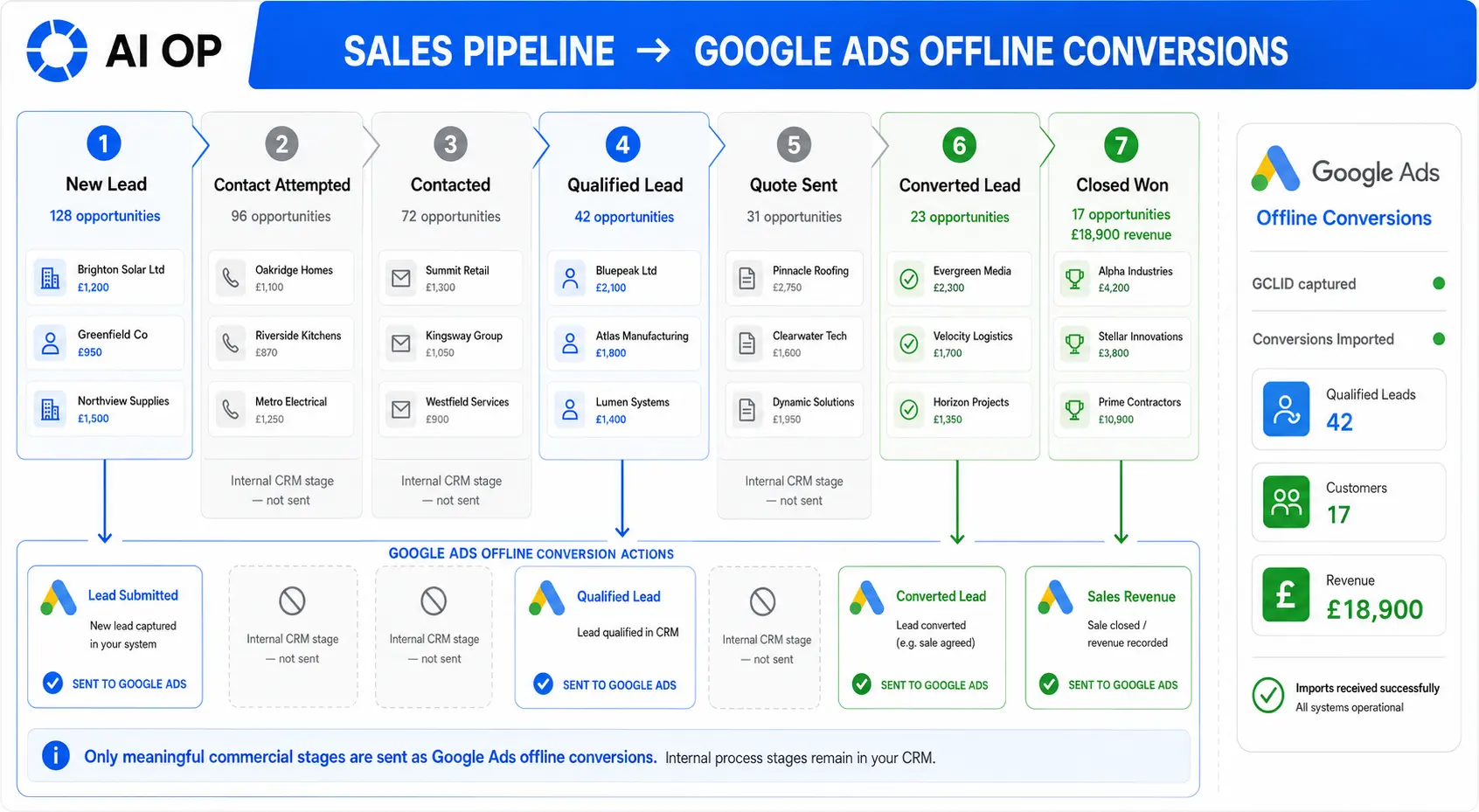
The pipeline should reflect how the business actually makes money — not a generic template borrowed from somewhere else. A service-business pipeline might look like New Lead, Contact Attempted, Contacted, Qualified Lead, Quote Calculated, Quote Sent, Appointment Booked, Proposal Accepted, Converted Lead, and Closed Won, with Closed Lost and Manual Quote Required sitting as parallel outcomes.
There is no universal pipeline — a law firm, a mortgage broker, a window-cleaning company, and a B2B consultancy will each need different stages. Each stage should answer a specific, testable commercial question. Qualified Lead should confirm whether this person meets the agreed qualification criteria. Quote Sent should confirm whether a formal price has actually been supplied. Converted Lead should confirm whether the prospect has taken the action that defines a sale. Closed Won should confirm whether the transaction has been confirmed, and Closed Lost should confirm whether the opportunity has genuinely and finally ended.
Vague stages like "Waiting," "Follow Up," or "In Progress" may be operationally handy internally, but they should not generally be sent to Google Ads as conversion events — they are not commercially meaningful on their own.
Synchronising Contact and Opportunity Stages
Businesses often need lifecycle status at two levels: the contact, representing the overall relationship, and the opportunity, representing a specific sales attempt. A contact might carry a simple lifecycle field — New Lead, Qualified Lead, Converted Lead, Customer, Closed Lost — while the linked opportunity tracks more granular stages like Quote Calculated, Quote Sent, Appointment Booked, Deposit Paid, and Closed Won.
A controlled one-way sync is usually easier to govern than free two-way sync. For example, treat a contact-level "Quote Stage" field as the source of truth; when it changes, a workflow moves the corresponding opportunity into the matching pipeline stage. This reduces inconsistent data, simplifies workflow triggers, prevents circular automation loops, and makes offline conversion rules more reliable. Two-way sync can work, but it needs explicit protection against loops and conflicting simultaneous updates.
Turning Pipeline Stages Into Offline Conversions
This is arguably the most commercially valuable part of the whole integration: the opportunity pipeline itself becomes a live source of offline conversion data for Google Ads.
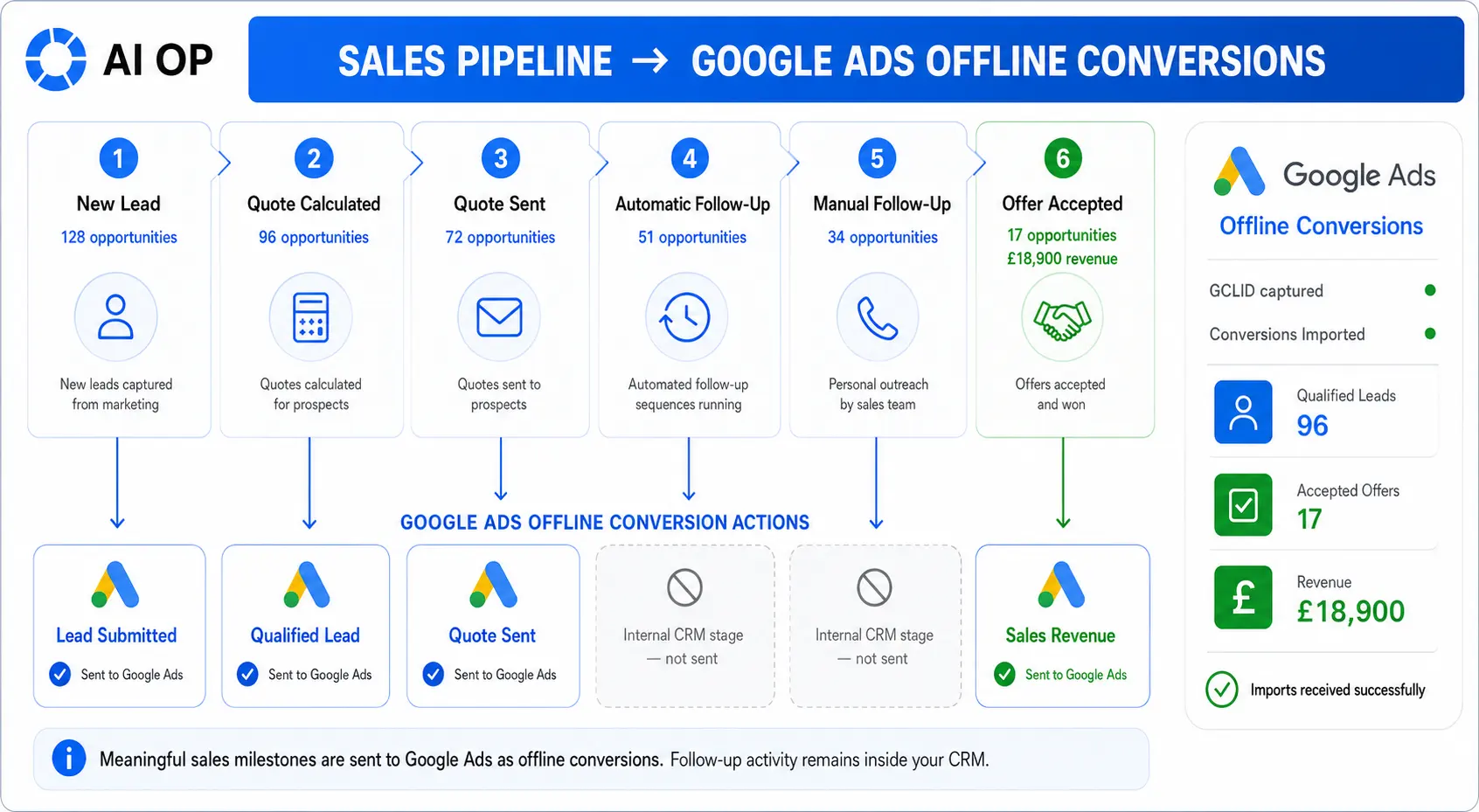
A representative mapping might send a New Lead stage back as a "Lead Submitted" conversion for initial reporting, a Qualified Lead stage as a "Qualified Lead" conversion for lead-quality measurement, an Appointment Attended stage as an "Appointment Attended" conversion for deeper-funnel reporting, a Quote Accepted stage as a "Converted Lead" conversion for sales optimisation, a Closed Won stage as a "Customer Acquired" conversion for customer measurement, and a Revenue Confirmed event as a "Sales Revenue" conversion for value and ROAS reporting.
Not every stage belongs in this mapping, though. Good candidates for offline conversion events are clearly and unambiguously defined, commercially meaningful, applied consistently by everyone on the team, hard to trigger by accident, backed by enough monthly volume to be statistically useful, and protected against duplicate firing. Purely operational actions — "Email Sent," "Called Once," "Task Created" — are not meaningful offline conversions and should not be sent to Google Ads.
Example B2B (Business-to-Business Pipeline:
From Pipeline Stage to Live Offline Conversion
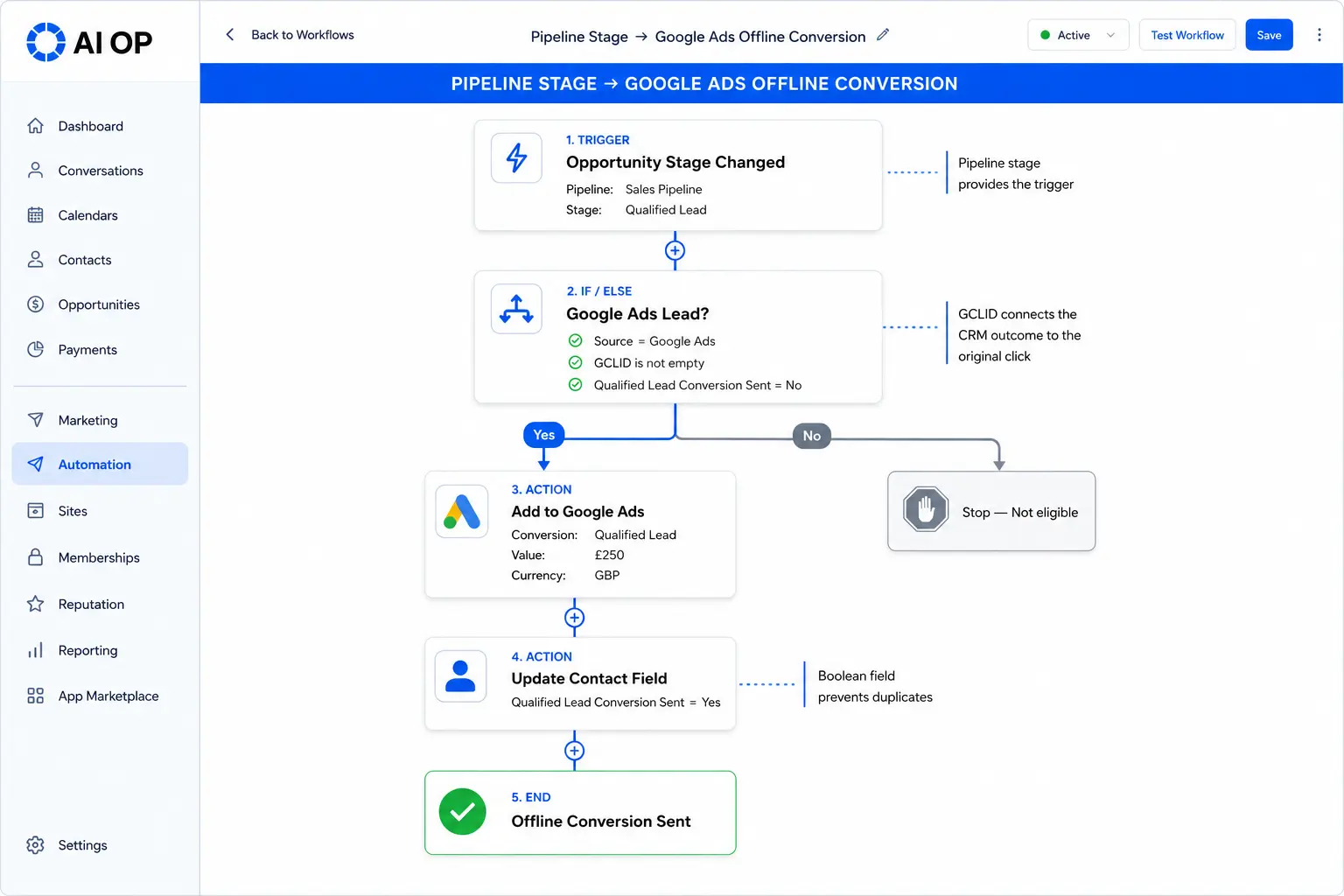
The process runs as follows: create the conversion action in Google Ads with a clear, exact name, such as "Qualified Lead." Decide whether it starts as primary or secondary. Ensure the GCLID, GBRAID, or WBRAID is being captured against the contact. Trigger a HighLevel workflow when the opportunity hits the relevant stage. Add the "Add to Google Ads" workflow action. Select the matching conversion action. Supply the conversion currency and value. Add duplicate-conversion protection. Then test the full process end to end.
The conversion name must match the Google Ads conversion action exactly — a stray space or capitalisation mismatch can silently prevent the event from being accepted. For lead-generation events, it is generally appropriate to count one conversion per advertising interaction rather than every repeated occurrence; revenue events may need a different counting approach depending on the business model.
Qualified Leads as a Conversion Signal
A form submission only confirms that someone filled in a form — not that they are a viable prospect. "Qualified" typically requires meeting criteria such as correct service need, correct geography, valid contact details, suitable budget, genuine intent, decision-making authority, and appropriate timescale.
Once those conditions are met, HighLevel can update the contact or opportunity to "Qualified Lead," and that change can trigger the corresponding offline conversion. This is often where the real insight shows up: Google Ads might otherwise learn that a certain search term drives lots of form submissions, without ever learning that those submissions rarely become viable prospects. With qualification data flowing back, that distinction becomes visible — by campaign, keyword, landing page, and search intent.
Converted Leads and Closed-Won Customers
A "converted lead" is typically a later, more commercially significant milestone — quote accepted, contract signed, deposit paid, or appointment completed. Distinguishing a Converted Lead, where the prospect has said yes, from Closed Won, where payment or contract is fully confirmed, lets a business measure different parts of the sales process without collapsing them into a single, less precise conversion event.
Example B2C Pipeline (Business to Consumer).
Sending Sales Revenue Back to Google Ads
Lead and customer counts alone do not capture differences in commercial value. Ten customers at £200 each and five customers at £2,000 each look very different once revenue is included — even though the first campaign "wins" on customer count alone.
HighLevel can store commercial value in an opportunity-value field, a quotation field, a payment value, a contract-value field, or a custom revenue field, and a workflow can send that value — along with the correct currency — to Google Ads once a sale is confirmed. Possible values include the initial sale value, deposit value, full contract value, confirmed recurring value, estimated lead value, or estimated customer lifetime value.
Confirmed, actual revenue is the strongest starting point, because it is grounded in a real transaction. Estimated lifetime value can be useful too, but only when it is backed by reliable retention, margin, and revenue data — inflated or inconsistent value estimates can mislead value-based bidding just as easily as inaccurate conversion counts.
Turning CRM Data Into Advertising Audiences
CRM data is not only useful for conversion tracking — it is also a source of far more precise advertising audiences than the platforms' own behavioural signals alone can provide. Useful CRM segments include all leads, qualified leads, unqualified leads, appointment bookers, quote recipients, converted leads, existing customers, high-value customers, lost opportunities, lapsed customers, and customers interested in — or due for renewal of — a specific service.
Depending on the platform and connection type, audiences may be created directly inside HighLevel Ad Manager, synced automatically through a supported connection, or exported and uploaded manually. Terminology differs meaningfully by platform, so it is worth being precise about which is which.
Google Customer Match
Google's term for CRM-based audiences is Customer Match — using first-party data like emails and phone numbers to reach or exclude known contacts across eligible inventory. HighLevel Ad Manager supports Google Audience Segments, including Customer Match, website visitors, interest segments, and Lookalike segments, created directly within the Google campaign workflow.
Customer Match is commonly used to exclude existing customers from acquisition campaigns, re-engage unconverted leads, upsell existing customers, reach lapsed customers, analyse performance for known groups, or seed audience expansion. Google's current guidance requires a Customer Match list to contain at least 100 members added or updated within the previous 540 days to remain eligible, though effective delivery in practice usually needs considerably more matched users than the bare minimum.
Google Lookalike Segments
For Demand Gen campaigns, Google offers Lookalike segments — new prospects who share characteristics with a seed audience such as a Customer Match list, website visitors, app users, or YouTube engagers. Seed quality matters enormously. A seed built from every lead, spam included, gives Google a weak, noisy signal of what a good customer actually looks like. A cleaner seed of verified customers or high-value customers is a much stronger foundation. Lookalike segments are currently limited to Demand Gen campaigns, and Google has signalled changes to how they behave during 2026, so current availability should be checked before building a long-term strategy around them.
Meta (Facebook) Custom and Lookalike Audiences
Meta's equivalent is the Custom Audience built from a customer list — matching CRM contacts by email, phone, name, location, and similar identifiers against Facebook and Instagram users. Not every contact will match, so the resulting audience is normally smaller than the source list. Meta also supports Custom Audiences from website visitors, engagement, video views, lead forms, and app activity.
Customer-list Custom Audiences are particularly powerful for letting CRM status directly steer advertising — excluding existing customers from acquisition campaigns, retargeting qualified-but-unconverted leads, promoting an upgrade to existing customers, or re-engaging lapsed ones. Meta requires the list to follow its formatting rules, whether CSV or TXT, with correctly formatted identifiers.
A Meta Lookalike Audience finds new people resembling an existing source audience. As with Google, seed quality is the deciding factor — a Lookalike built from the entire CRM, including spam, suppliers, job applicants, and out-of-area enquiries, dilutes the signal, while one built from closed-won customers, above-average order values, repeat purchasers, or long-tenure customers gives Meta a much sharper target. Meta generally recommends a source audience of roughly 1,000 to 5,000 people for best results, though smaller eligible sources can still work.
LinkedIn Matched and Predictive Audiences
LinkedIn's first-party audience feature is called Matched Audiences, built from contact lists, company lists, website visitors, Company Page followers, ad engagement, or Lead Gen Form submissions. For B2B businesses, company-list audiences can be especially valuable, since the CRM often holds target accounts, not just individual contacts — think target companies, sales-qualified contacts, lost opportunities, past webinar attendees, or contacts from a particular industry.
LinkedIn discontinued its traditional Lookalike Audiences in February 2024. The replacement is Predictive Audiences, which take a contact list, company list, conversion event, Lead Gen Form, or retargeting audience as a source and combine it with LinkedIn's own modelling to find people predicted to take similar actions. The underlying logic — clean seed in, better prospects out — still applies; only the terminology has changed.
Choosing the Right Seed Audience
The most important audience decision is not a platform setting — it is which CRM segment you use as the seed. If the objective is more customers, a customer list is a better seed than "all leads." If the objective is more high-value customers, the seed should contain high-value customers specifically, not every buyer regardless of value. If the objective is remarketing, a broader pool of qualified-but-unconverted prospects makes more sense. Audience strategy should be driven by lifecycle stage and customer value, not simply by what data happens to be lying around.
Keeping Audiences Current
An audience built from a one-off export starts going stale the moment it is created — new customers are missing, recently lost opportunities are still included, unsubscribed contacts may still be present, and existing customers may remain inside acquisition campaigns they should already have been excluded from.
A sustainable process needs a clear CRM filter, documented inclusion and exclusion criteria, regular refresh cycles, consent checks, suppression of opted-out contacts, removal of invalid data, monitoring of match rates, consistent naming conventions, and visible update dates. Where the platform connection supports scheduled or automatic sync, that reduces manual admin considerably; where it does not, the export-and-upload process needs to be documented and actually followed. Creating an audience once does not mean it stays synchronised with future CRM changes on its own.
Using Audiences for Exclusion
Exclusions are often just as valuable as targeting. It is worth excluding existing customers from new-customer offers, current subscribers from subscription-acquisition campaigns, converted leads from quote-reminder adverts, existing employees, invalid or unsuitable leads, and customers from services they already own. A customer who has already accepted a quote should not keep seeing adverts pushing them towards requesting that same quote — it wastes spend and can look sloppy. The pipeline stages and CRM fields already being tracked are exactly what is needed to define these exclusion groups.
Using CRM Data for Bidding — Carefully
Offline conversion tracking does not mean every pipeline stage should immediately become a primary bidding signal. Google Ads distinguishes between primary conversion actions, which appear in the Conversions column and can be used directly for bidding, and secondary actions, which are generally observation-only and visible in "All conversions" — though custom goals need extra care since behaviour can differ.
A sensible transition path is to keep the existing top-of-funnel lead action as primary for now, add "Qualified Lead" as a secondary conversion, validate the qualified-lead data over several weeks, compare HighLevel and Google Ads counts for consistency, confirm click identifiers and conversion delays are behaving correctly, review monthly qualified-lead volume for statistical adequacy, and only once the data is reliable, test "Qualified Lead" as a primary bidding goal. From there, layer in "Converted Lead" and revenue as deeper-funnel signals, and move towards value-based bidding only once values and volume genuinely support it.
The most commercially meaningful event is not automatically the best sole bidding signal. Closed-won customers may be highly valuable but too infrequent or too delayed for stable optimisation; "Qualified Lead" often strikes a better balance between commercial relevance and enough volume for the algorithm to learn from.
Preventing Duplicate Conversions
Duplicate conversion events distort both reporting and bidding. Common causes include a workflow firing every time an opportunity re-enters a stage, contact-level and opportunity-level workflows both sending the same event, a website conversion and an offline conversion representing the same underlying action, multiple opportunities being created for one enquiry, a closed-won deal being reopened and re-closed, repeated form submissions, test contacts entering live workflows, or two separate integrations sending the same event independently.
Protection typically involves boolean fields like "Qualified Lead Conversion Sent," workflow entry restrictions, opportunity-status filters, unique conversion identifiers, clear test-contact exclusions, and explicit ownership of each conversion event so two workflows never both claim responsibility for firing it. For example, a Qualified Lead workflow can check whether "Qualified Lead Conversion Sent" is false before firing, then set it to true afterwards — preventing the same event from re-firing if the opportunity later moves backward and forward through that stage.
Reporting Across Google, Facebook, and LinkedIn
Although Google Ads is the focus of this guide, the same architecture supports a genuinely cross-channel view. Ad Manager displays Google campaigns alongside Facebook, Instagram, and LinkedIn, giving a consolidated read on spend, impressions, clicks, conversions, click-through rate, cost per click, and ROAS across the whole paid mix.
More importantly, the CRM gives every channel a consistent destination. A Facebook lead, a LinkedIn lead, and a Google Search lead can all land in the same contact database, enter a relevant pipeline, go through the same qualification fields, hit the same speed-to-lead workflows, get quoted through the same automation, and roll up into the same revenue reporting and audience segments.
The platforms stay different; the commercial definitions should not. "Qualified Lead" should mean exactly the same thing whether the contact came from Google, Facebook, or LinkedIn — that consistency is what makes cross-platform comparisons credible rather than apples-to-oranges.
Building a Lead-to-Revenue Dashboard
A useful dashboard follows the funnel end to end rather than stopping at the ad platform's native metrics. It should track spend, impressions, clicks, and CPC at the advertising level; leads and cost per lead at the lead-generation level; contact rate and speed to lead at the contact level; qualified leads and cost per qualified lead at the qualification level; appointments, quotations, and proposals at the sales-activity level; converted leads and customers at the conversion level; sales value, acquisition cost, and ROAS at the revenue level; and list size, match rate, and refresh status at the audience level.
It should ideally be filterable by advertising platform, campaign, ad group, keyword, landing page, service, location, lead owner, pipeline stage, original source, latest source, and customer value — so that marketing and sales are always working from the same shared numbers rather than two disconnected sets of reports.
Testing the Full System Before You Trust It
Do not switch offline conversions into bidding until the whole pipeline has been tested end to end. Open a tagged landing-page URL and confirm every parameter survives, submit the form and confirm the contact is created correctly, inspect the attribution and UTM data on the new contact, and confirm a valid click identifier was stored. Check opportunity creation and lead-owner assignment, test the immediate email, SMS, or WhatsApp response, and check the sales notification fired. Test the quote calculation and confirm the saved values are correct.
Move the opportunity to Qualified Lead and confirm the offline conversion workflow runs, move it to Converted Lead and confirm the second conversion fires, add a sales value, move to Closed Won, and confirm revenue is sent. Deliberately repeat stage changes to verify duplicate protection actually works, create a test CRM audience segment and check inclusions and exclusions are correct, verify the resulting audience appears correctly inside the ad platform, check conversion diagnostics inside Google Ads, and reconcile HighLevel contact counts against Google Ads conversion counts.
Offline conversions do not always appear instantly — processing can reasonably take several hours, and HighLevel's own guidance notes it can sometimes take 24 to 48 hours, so do not assume something is broken just because a conversion has not shown up within minutes.
Common Problems Worth Watching For
Most integration failures are data-design or process problems, not technical faults. Watch out for the wrong Google Ads account or wrong HighLevel location being connected, auto-tagging being disabled, or a GCLID being stripped out by a redirect. A website that breaks tracking-template URLs, UTM values that are visible in the URL but never reach the contact record, and external or embedded forms that fail to pass attribution through are all common culprits.
Also watch for duplicate contacts or duplicate opportunities being created, pipeline stages applied inconsistently across the sales team, a Google conversion action name that does not match HighLevel exactly, and a workflow triggering more than once for the same event. Revenue fields left blank, or the wrong currency supplied, conversion actions promoted to primary before they have been validated, and too few lower-funnel conversions to be statistically meaningful can all quietly undermine an otherwise sound setup.
Finally, keep an eye out for sales staff not keeping opportunity stages up to date, test submissions leaking into live reporting, client-side and server-side conversions being double-counted, customer lists left stale and never refreshed, the entire database being used as a weak Lookalike seed instead of a clean subset, existing customers not being excluded from acquisition campaigns, audience consent not being properly considered, and CRM fields being formatted incorrectly for platform matching requirements.
A technically flawless connection cannot compensate for an unclear pipeline, inconsistent qualification standards, weak audience segmentation, or missing revenue data. The plumbing matters, but the definitions matter more.
Data Protection and Consent
A UK implementation needs to account for UK GDPR, the Privacy and Electronic Communications Regulations (PECR), and each ad platform's own customer-data policies. Relevant areas include cookie consent, marketing consent, SMS opt-outs, email unsubscribes, WhatsApp consent, call-recording notices, data minimisation, retention limits, access permissions, Customer Match and Custom Audience eligibility rules, lawful basis for using first-party data, avoiding sensitive personal data categories, documenting the purpose of each audience, and having a clear process for suppression and deletion requests.
Only collect and share the data actually required for a defined marketing or measurement purpose. Having someone's details in the CRM does not, on its own, grant permission to use that data for every conceivable advertising purpose — consent and lawful basis need to be considered on a per-use-case basis.
Implementation Checklist
Working through this in order tends to produce the most reliable results: connect the correct Google Ads account, set up and review HighLevel Ad Manager, audit existing Google Ads conversion actions, install and test website tracking, and configure UTM and ValueTrack parameters. Preserve GCLID, GBRAID, and WBRAID through every redirect, connect Google Lead Forms where relevant, track HighLevel forms and surveys, configure calendars, and configure call tracking.
From there, define contact lifecycle fields, build the opportunity pipeline, and establish a source of truth for stage synchronisation. Create speed-to-lead workflows and lead-nurturing workflows, and add quotation and sales automation. Define "Qualified Lead," "Converted Lead," and "Closed Won" precisely, map pipeline stages to Google Ads conversions, add duplicate-conversion protection, store opportunity and revenue values, and send confirmed revenue back to Google Ads.
Finally, create Google Customer Match lists and relevant Lookalike segments where available, create Meta Custom and Lookalike Audiences, and create LinkedIn Matched or Predictive Audiences. Add existing-customer exclusions, establish an audience-refresh process, and review Facebook and LinkedIn campaigns in Ad Manager. Build lead-to-revenue reporting, test every conversion route, introduce CRM conversions into bidding gradually, and review data quality on an ongoing basis.
Final Thoughts
The real value of connecting Google Ads to HighLevel is not that leads show up in a CRM — that is table stakes. The value is in preserving the entire commercial journey, start to finish.
Google Ads shows the ads, clicks, costs, campaigns, and keywords. HighLevel shows the contacts, conversations, qualification decisions, appointments, quotations, pipeline movement, customers, and revenue. HighLevel workflows respond to leads instantly, nurture prospects over time, calculate quotes, coordinate sales tasks, and stop opportunities from quietly falling through the cracks. The pipeline then feeds qualified-lead, converted-lead, and closed-won events back to Google Ads as offline conversions — and Ad Manager adds a consolidated layer bringing Google alongside Facebook, Instagram, and LinkedIn into one interface.
CRM data also flows the other way, powering Google Customer Match, Google Demand Gen Lookalike segments, Meta Custom and Lookalike Audiences, and LinkedIn Matched and Predictive Audiences — so the CRM ends up valuable in both directions. Advertising platforms send leads into HighLevel; HighLevel sends qualification, revenue, and audience intelligence back out.
That is the point of closed-loop marketing. Instead of asking which campaign produced the cheapest form submissions, a business can finally ask which campaigns generated genuinely qualified prospects, which keywords produced paying customers rather than just enquiries, which ads generated the most revenue rather than just the most clicks, which customer groups should be excluded from acquisition spend, which CRM segments make sense for remarketing, which high-value customers should seed a Lookalike Audience, what each customer actually cost to acquire, and which campaigns produced the strongest real return on ad spend.
That is the difference between lead tracking and genuine revenue attribution. Google Ads should not be optimised purely towards whoever is statistically most likely to fill in a form — it should be given enough reliable CRM data to learn which of those people actually become valuable customers. HighLevel provides the operational backbone that makes that possible.