
What is HighLevel? aka GHL GoHighLevel- The Business Operating System (Not Traditional CRM)
In the rapidly evolving landscape of business software, few platforms have generated as much debate about their fundamental identity as HighLevel. Ask a dozen digital marketing professionals what HighLevel actually is, and you will likely receive a dozen different answers. Some will call it a CRM. Others will describe it as marketing automation software. An increasing number will refer to it as a business operating system or, more recently, an AI-powered operating system.
This confusion is understandable. HighLevel does not fit neatly into the conventional software categories that have defined the industry for the past two decades. It is not merely a customer relationship management tool in the traditional sense, yet it contains powerful CRM functionality. It is not solely a marketing automation platform, yet its workflow engine rivals dedicated automation tools. It is not exclusively a funnel builder, yet thousands of businesses construct their entire online presence within it. It also builds websites, portals, and membership sites. It also has a whole range of other features that can replace many of the existing apps in your tech stack.
The most accurate description, and the one gaining traction among industry practitioners, is that HighLevel functions as a business operating platform. This distinction matters because it represents a fundamental shift in how businesses, particularly small and medium-sized enterprises, can structure their technology infrastructure. Understanding why this distinction exists, and what it means for business owners and agencies, requires a detailed examination of the platform's architecture, philosophy, and trajectory.
The Fundamental Distinction Between CRM and Operating Platform
To appreciate why HighLevel defies simple categorisation, it is essential first to understand what traditional CRM systems were designed to accomplish. Customer relationship management software emerged from a straightforward premise: businesses needed a centralised place to store information about their customers and prospects. Early CRM systems were essentially sophisticated databases with specialised fields for contact information, interaction history, and sales pipeline stages.
The Traditional CRM Model
Traditional CRM platforms such as Salesforce, HubSpot, and Pipedrive were built around data management as their primary function. Their architecture reflects this origin story. The core of any traditional CRM is the contact record, and everything else in the system exists to support, enrich, or act upon that record.
When you examine a conventional CRM, you find that its primary functions include contact and company record storage, deal pipeline management and forecasting, sales activity tracking, and reporting and analytics based on historical data. Features for marketing automation, email campaigns, or funnel building, when they exist at all, are typically added as separate modules, bolt-on extensions, or integrations with external tools. They are not the heart of the system; they are appendages to it.
This modular approach works well for many organisations, particularly medium-sized and enterprise businesses that prefer to select best-in-class tools for each function and integrate them together. A company might use Salesforce for CRM, HubSpot for marketing automation, Mailchimp for email campaigns, Calendly for scheduling, and Twilio for communications, then connect everything through Zapier or Make. This approach offers flexibility and specialised functionality, but it also introduces significant complexity.
The HighLevel Operating Model
HighLevel approaches the problem from the opposite direction entirely. Rather than starting with a database and adding operational tools around it, HighLevel begins with workflow orchestration, communications, and automation, then layers CRM functionality into that operational environment.
This distinction is subtle but profoundly important. In the HighLevel architecture, the contact record exists not as an end in itself, but as a participant in an ongoing series of automated workflows, communications, and interactions. The database supports the operations rather than the operations serving the database.
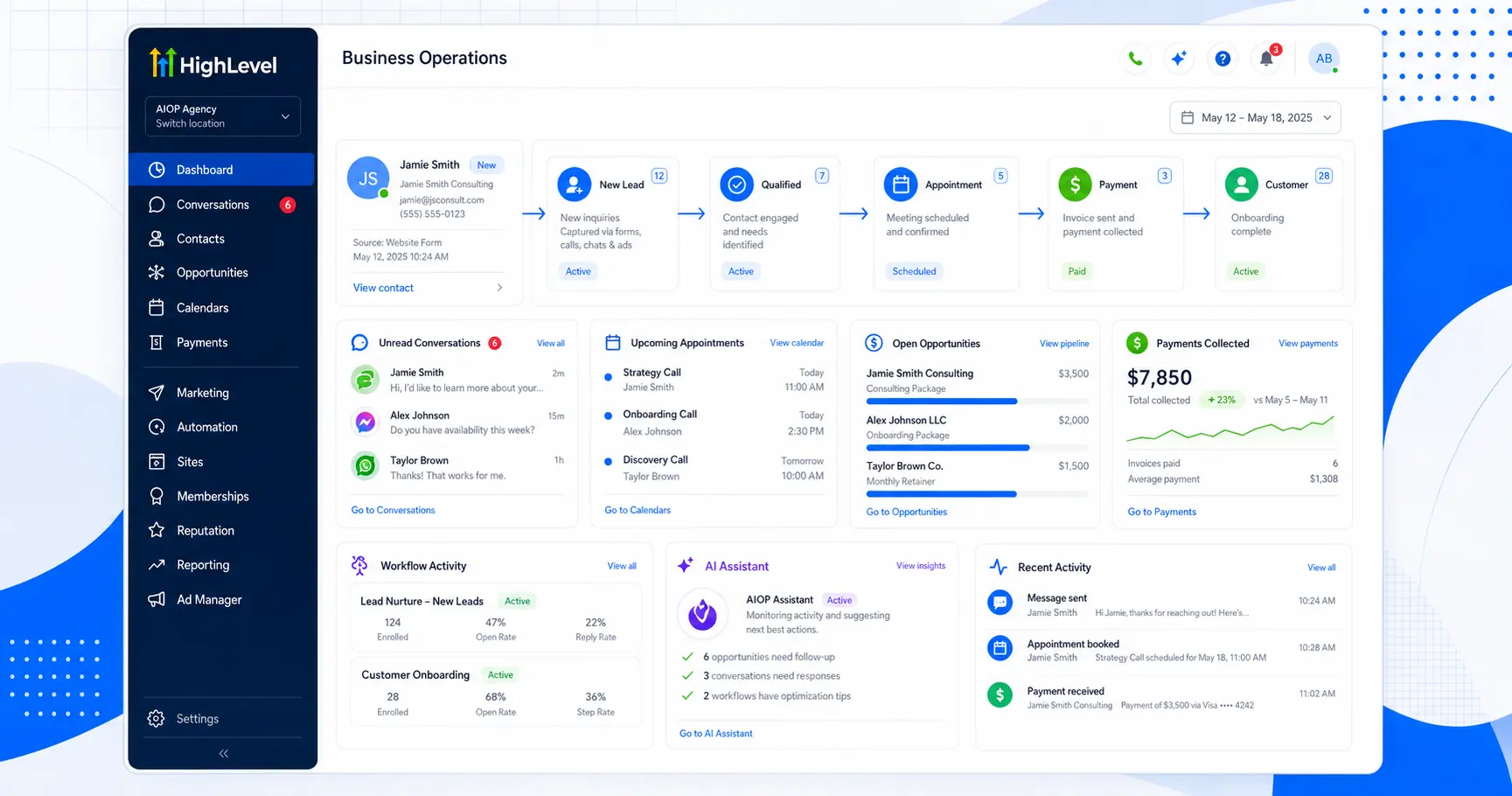
The platform includes an extensive array of capabilities that would require multiple tools in a traditional stack. These include CRM and contact management, sales pipeline management, funnel and website builders, marketing automation workflows, SMS and email communication channels, voice communication tools, appointment scheduling systems, payment collection processing, reputation management features, website and portal builders, membership site functionality, and increasingly, AI-driven conversation and automation tools.
Rather than acting as a database supported by other tools, HighLevel functions as the execution environment where customer acquisition and lifecycle management actually occur. This is why many organisations now treat it as the central execution layer for marketing, sales, and service workflows, rather than simply a place where contacts are stored.
Why the Business Operating System Description Exists
The description of HighLevel as a business operating system has emerged organically from the practitioner community, and several structural characteristics explain why this terminology has gained such traction.
Consolidation of Multiple Operational Layers
First and foremost, HighLevel consolidates multiple operational layers within a single platform. In many small and mid-sized organisations, this allows the platform to replace a large number of separate tools that would otherwise need to be purchased, managed, integrated, and maintained independently.
Consider the typical technology stack for a lead-driven business. Such a business might require a CRM to manage contacts and deals, an email marketing platform for broadcast campaigns and automated sequences, an SMS service for text message communications, a funnel builder for landing pages and sales pages, a website builder for their main online presence, a portal system for client access, a membership platform for delivering digital products or courses, a scheduling tool for appointments and consultations, a payment processor for collecting deposits and payments, a workflow automation tool to connect everything together, and a reputation management system for collecting and managing reviews.
In a traditional approach, each of these functions would require a separate software subscription, each with its own monthly cost, its own login credentials, its own learning curve, and its own integration requirements. The business owner or agency would then need to become an integration specialist, connecting these disparate tools through middleware platforms such as Zapier or Make, troubleshooting failed automations, and managing the inevitable data inconsistencies that arise when information must pass through multiple systems.
HighLevel collapses this entire stack into a single platform. The website and funnel builder creates pages that capture leads directly into the CRM. The CRM triggers workflows that send emails and SMS messages through the native communication channels. Those workflows can check calendar availability and book appointments automatically. The appointments can trigger payment requests. Client portals provide access to resources and information. Membership sites deliver content and courses. The entire customer journey, from first click to completed transaction and ongoing engagement, happens within a unified environment.
Heavy Emphasis on Automation-Driven Workflows
The second characteristic that supports the operating system description is HighLevel's intense focus on automation. Instead of using separate applications for communication, automation, and CRM, these functions are managed inside a single workflow engine.
Actions such as sending emails, triggering SMS messages, updating pipeline stages, assigning tasks to team members, granting portal access, updating membership levels, or sending webhooks to external systems are all managed from the same workflow builder. This means that complex, multi-step customer journeys can be designed and implemented without ever leaving the platform.
A typical workflow might begin when a new contact is created from a website form. The workflow could immediately send a welcome SMS message, then wait one hour before sending an email. If the contact opens that email, the workflow might move them to a different pipeline stage, assign a sales representative to follow up, and grant them access to a client portal with relevant resources. If they do not open it, the workflow could send a follow-up SMS the next day. Throughout this process, every interaction is logged to the contact record automatically, creating a complete audit trail without any manual data entry.
This level of workflow integration is possible in a traditional stack, but it requires careful configuration of multiple tools and often depends on middleware to pass data between them. In HighLevel, it is simply how the platform works by design.
Agency-Style Multi-Account Management
The third characteristic that reinforces the operating system analogy is HighLevel's support for agency-style multi-account management. The platform was built from the ground up with agencies in mind, and its architecture reflects this origin.
Agencies can create and manage unlimited client accounts from a single dashboard, which allows them to deploy CRM systems, funnels, websites, portals, automation, and communication tools to many businesses simultaneously. This capability extends to white-labelling, where agencies can brand the entire platform as their own solution, removing HighLevel references and presenting a customised experience to their clients.
For agencies, this transforms HighLevel from a tool into a service delivery platform. They can build standardised systems for lead generation, client onboarding, service delivery, membership management, and reporting, then deploy those systems to new clients with minimal configuration. This architecture naturally lends itself to the idea of an operating platform, because it effectively provides the operational infrastructure for an entire agency practice.
Increasing Emphasis on AI-Driven Automation
The fourth characteristic, and arguably the most significant for the platform's future trajectory, is the increasing emphasis on AI-driven automation. HighLevel's product roadmap for 2026 and beyond explicitly positions AI as the growth operating system, with trainable agents handling end-to-end tasks such as campaigns and bookings.
Features such as conversation AI, voice AI, automated lead qualification, AI-generated messaging, and workflow-driven decision making are designed to automate large portions of the customer journey. Rather than providing AI purely as a content generator, the system increasingly uses AI to support operational processes.
This direction is why some users now refer to the platform as an AI business operating system. The intention is that AI agents will eventually manage significant portions of customer communication and internal processes, with human oversight focused on strategy and exception handling rather than routine tasks.
Detailed Comparison: Traditional CRM Versus Business Operating Platform
The difference between traditional CRM systems and HighLevel's operating platform approach becomes clearer when examining specific aspects of their design and functionality.
Core Focus and Philosophy
Traditional CRM platforms focus primarily on contact and deal management, with reporting and analytics providing visibility into sales performance. Their philosophy is that if you manage customer relationships effectively, business outcomes will follow. The system is designed to support sales and marketing activities by providing a reliable record of interactions and pipeline status.
HighLevel's core focus is on full operations, encompassing CRM, marketing, AI, funnel building, website creation, portal management, and membership functionality. Its philosophy is that if you orchestrate the entire customer lifecycle effectively, from first contact through ongoing engagement and service delivery, relationship management becomes a natural byproduct of well-designed operations. The system is designed to execute customer journeys rather than simply record them.
Integration Approach
Traditional CRM systems depend heavily on integration ecosystems. Connecting CRM data to advertising platforms, messaging tools, finance software, or analytics tools usually requires middleware platforms such as Zapier or Make. Even when native integrations exist, they often provide limited functionality compared to the specialised tools themselves. The burden of maintaining these integrations falls on the user, who must monitor for broken connections, manage API changes, and troubleshoot failed data transfers.
HighLevel still supports integrations with external systems, and it even embeds Zapier functionality directly into its workflows, but it increasingly attempts to internalise common operational functions. The goal is to minimise the number of external systems required for everyday operations. A notable development is the ability to trigger automation actions directly within HighLevel workflows that send data to external systems, reducing the need to build separate automation structures elsewhere.
Agency Fit and Scalability
For agencies and service providers, the differences are particularly pronounced. Traditional CRM platforms typically follow a modular pricing model, where each additional feature or user increases the monthly cost. Building a complete solution for a client often requires assembling multiple modules or integrating separate tools, each with its own subscription. This approach can become expensive quickly, and it squeezes agency profit margins as tool costs accumulate.
HighLevel offers flat pricing with unlimited sub-accounts, making it economically viable to serve many clients from a single subscription. The white-label capabilities allow agencies to present the platform as their own solution, strengthening their brand and client relationships. This architecture is built for agency scalability and profitability.
AI Capabilities
The AI capabilities of traditional CRM platforms typically take the form of bolt-on tools that provide specific functions such as content generation or basic chatbots. These features are often developed through acquisitions or partnerships and may not be deeply integrated with the core platform.
HighLevel's AI capabilities are built directly into the platform, with features such as conversation AI, voice AI, and trainable agents that can be customised for specific business needs. The AI can handle lead qualification, automated conversations, call analysis and summaries, response generation, follow-up sequences, and workflow decision making. Because the AI operates within the same platform that contains all customer data and workflow logic, it has access to the full context of each interaction.
The Strategic Implications for Small and Mid-Sized Businesses
The operating system concept is particularly relevant for small and medium-sized organisations, which often face unique challenges in managing their technology infrastructure.
The SMB Technology Challenge
Many small and medium-sized businesses operate with fragmented software stacks that have accumulated over time. A typical scenario might involve a business that started with a simple contact list in a spreadsheet, added an email marketing tool when newsletters became important, adopted a separate SMS service when text messaging proved effective, purchased a funnel builder to create better landing pages, built a website with a different tool, added a client portal system when customer self-service became necessary, subscribed to a membership platform to deliver digital products, and finally invested in a CRM to try to bring some order to the chaos.
Each addition made sense at the time, but the cumulative result is a complex, expensive, and difficult-to-manage technology ecosystem. The business owner spends significant time and mental energy simply maintaining the connections between tools, troubleshooting problems, and managing multiple subscriptions with different billing cycles and login credentials.
How the Operating System Model Addresses This
HighLevel's architecture attempts to simplify this situation by providing a unified operational environment. Businesses can manage the entire customer journey in one place, from initial lead capture through communication, conversion, service delivery, and ongoing engagement.
The practical benefits extend beyond cost savings and convenience. When all customer data lives in a single system, that data becomes more valuable. A lead's interaction with an email can inform the timing of an SMS follow-up. A phone call transcript can be analysed to determine lead quality. A booked appointment can trigger a payment request and a calendar reminder. A completed purchase can grant access to membership content and a client portal, all without manual intervention.
For businesses that work with agencies, the benefits multiply. Agencies can deploy consistent operational frameworks across multiple clients, applying proven workflows and automation strategies without rebuilding from scratch each time. The agency becomes not just a service provider, but the operator of the client's marketing, sales, and service infrastructure.
Strategic Implications for Agencies and Consultants
For agencies and consultants, particularly those working with CRM implementations, marketing automation, and digital presence platforms, the positioning of HighLevel as a business operating platform has profound implications for how they structure their practices and position their services.
From Tool Configuration to Operational Architecture
The first implication is that the implementation focus shifts from tool configuration to operational architecture. Instead of simply installing a CRM and showing clients how to use it, consultants now design entire customer lifecycle systems including websites, funnels, workflows, messaging sequences, portals, membership structures, and automation logic.
This elevates the consultant's role from technician to strategist. The value provided is no longer just technical expertise in a particular software platform, but strategic insight into how customer journeys should be designed and optimised. Consultants who embrace this shift can command higher fees and build deeper client relationships.
Platform-Centric Service Models
The second implication is that agencies can offer platform-centric service models, where the CRM, automation engine, communication tools, website, portals, and marketing infrastructure all sit inside the same environment. This allows for service offerings that would be difficult to deliver with a fragmented tool stack.
For example, an agency might offer a complete digital presence solution where they build and manage websites, create funnels for specific campaigns, run advertising traffic, nurture leads through automated workflows, provide client portals for ongoing service delivery, manage membership sites for digital products, and deliver comprehensive reporting on results, all within a single platform. The client never needs to learn multiple tools or manage integrations; they simply receive leads, serve customers, and watch their business grow.
White-Label Service Delivery
The third implication is the support for white-label service models. Agencies can deploy HighLevel systems to clients while branding the platform as their own operational solution. This strengthens the agency's brand, increases client stickiness, and positions the agency as the owner of the technology infrastructure rather than simply a user of third-party tools.
Clients see a seamless experience that appears to be entirely the agency's creation. They log into a system with the agency's branding, use websites and portals that the agency has built for them, and receive support from the agency when questions arise. The underlying platform becomes invisible, and the agency's value proposition becomes correspondingly stronger.
Limitations and Realistic Expectations
Although the business operating system label is useful conceptually, it should not be interpreted too literally. HighLevel does not replace every type of enterprise software, and maintaining realistic expectations about what the platform can and cannot do is essential for successful implementation.
What HighLevel Does Not Replace
Most organisations will still use external systems for accounting and finance functions, which require specialised capabilities for tax compliance, financial reporting, and integration with banking systems. Specialist industry software for verticals such as real estate, healthcare, or legal practice often contains functionality that general-purpose platforms cannot replicate. Advanced analytics and business intelligence may require dedicated tools for complex data modelling and visualisation. Large-scale enterprise integrations with legacy systems or specialised business applications will still need custom development and middleware.
The Appropriate Scope for HighLevel
In practice, HighLevel functions best as the customer acquisition and revenue operations layer, rather than a complete replacement for all business software. It excels at managing the front-end of the business: attracting leads, communicating with prospects, converting sales, delivering digital services through portals and memberships, and initiating customer relationships. It is less suited to back-end functions such as inventory management, supply chain coordination, or complex financial operations.
Understanding this scope helps businesses make appropriate decisions about what to migrate into HighLevel and what to leave in specialised systems. The goal is not to force every business function into a single platform, but to create a coherent operational environment for the functions that benefit most from integration and automation.
The Future Trajectory: AI as the Growth Operating System
The most significant development in HighLevel's evolution is the integration of AI-driven automation throughout the platform. This direction, explicitly articulated in the company's 2026 roadmap, positions AI not as a feature but as the fundamental operating logic of the platform.
Current AI Capabilities
Today's HighLevel already includes substantial AI functionality. Conversation AI handles automated dialogues with prospects, answering questions and qualifying leads without human involvement. Voice AI extends this capability to phone calls, with natural language processing that can understand and respond to spoken inquiries. AI-generated messaging creates personalised email and SMS content based on contact attributes and conversation history. Workflow decision making uses AI to determine appropriate next steps based on context and business rules.
The Roadmap Ahead
The roadmap envisions AI agents that can be trained on specific business knowledge and then deployed to manage end-to-end processes. These agents will handle campaign execution, from content creation through audience selection and performance optimisation. They will manage booking conversations, negotiating times and handling rescheduling requests automatically. They will qualify leads through multi-turn conversations, gathering information and assessing fit before passing qualified prospects to human sales representatives. They will even assist with content creation for websites, portals, and membership materials.
This vision explains why the platform is increasingly described as an AI operating system. The AI becomes not just a tool within the platform, but the layer that orchestrates activity across all platform functions. Human users define strategies and goals, while AI agents execute the detailed work of making those strategies real.
Conclusion: Why This Distinction Matters
The question of whether HighLevel is a CRM or a business operating system is more than semantic debate. How we categorise the platform shapes how we think about its capabilities, how we structure our use of it, and what we expect it to accomplish for our businesses.
Viewing HighLevel as a CRM leads to underutilisation. Businesses implement contact management and pipelines, perhaps add some basic automation, but never explore the full range of what the platform can do. They continue to use separate tools for functions that HighLevel could handle, missing the opportunity for true operational integration.
Viewing HighLevel as a business operating system opens different possibilities. Businesses think holistically about their customer acquisition, service delivery, and revenue operations. They design complete customer journeys rather than isolated touchpoints. They leverage websites, portals, and memberships as integrated components of a unified system. They use automation and AI to handle routine work, freeing human attention for strategy and relationship building.
The most accurate description, and the one that best captures the platform's unique value, is that HighLevel provides the operational infrastructure for modern, AI-augmented businesses. It combines the data management capabilities of traditional CRM with the execution power of marketing automation, the flexibility of website and funnel builders, the engagement potential of client portals and membership sites, the immediacy of modern communication channels, and the intelligence of artificial intelligence.
For agencies and small business owners willing to embrace this broader vision, HighLevel offers something rare in the software industry: a genuine platform for business operations that can grow and evolve alongside the businesses it serves. It is not merely a tool for managing customer relationships, but a system for running the customer-facing parts of a business with unprecedented efficiency and intelligence.
As the platform continues to evolve and its AI capabilities deepen, the distinction between CRM and operating system will only become more pronounced. Businesses that recognise this distinction today will be better positioned to take advantage of the capabilities that emerge tomorrow. They will be operating on a platform designed for the future, rather than a tool built for the past.