
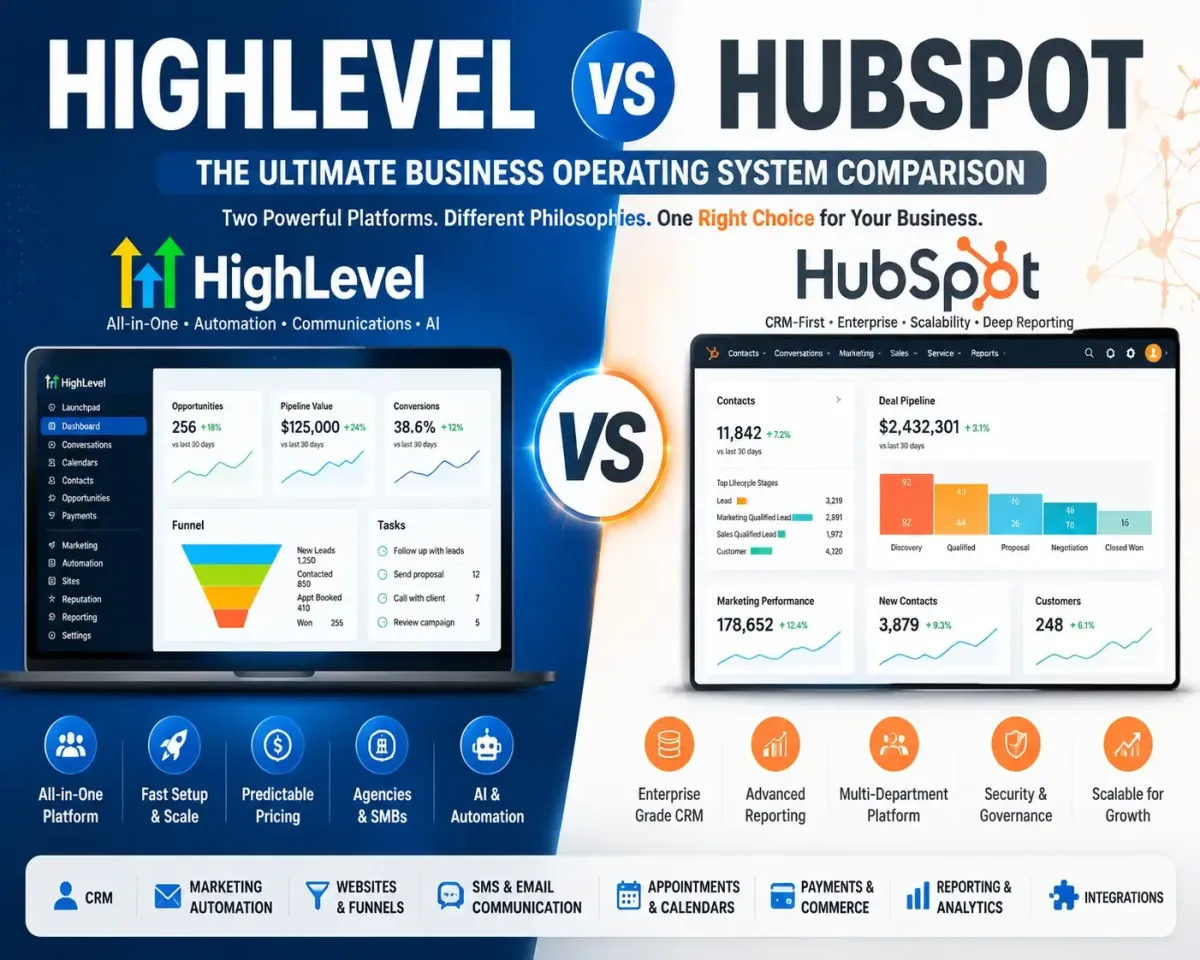
HighLevel vs HubSpot: The AI Business Operating System versus The CRM
Choosing between HighLevel and HubSpot is no longer a straightforward CRM comparison. Both platforms now combine customer relationship management, marketing automation, sales pipelines, websites, communications, reporting, payments and artificial intelligence. However, they approach these capabilities from fundamentally different directions.
HubSpot is primarily a sophisticated CRM platform. Its strength lies in structuring customer data, modelling complex relationships and helping marketing, sales and service teams collaborate across longer customer journeys. HighLevel is better understood as an AI-powered business operating system that has a CRM, a platform designed to execute the daily processes of generating leads, responding to enquiries, booking appointments, collecting payments and communicating across multiple channels.
This distinction influences almost every part of the comparison, including automation, AI, reporting, data architecture, pricing and scalability. HubSpot typically performs best within larger B2B organisations that require advanced governance, relational data and revenue reporting. HighLevel is generally better suited to B2C companies and smaller B2B organisations that prioritise operational automation, rapid implementation and predictable costs. HighLevel is used most heavily by local service providers and agencies.
This guide compares HighLevel and HubSpot across their target markets, CRM architecture, automation, artificial intelligence, marketing, sales, reporting, integrations, agency functionality and total cost of ownership. The objective is not simply to determine which platform offers more features, but to establish which underlying approach best matches the way your organisation operates.
Target Market
From the outset, our view is that the target market using the CRM—and the types of customers that the business serves—provides the most useful starting point for comparison. The right platform depends heavily on the organisation’s business model, sales process, customer journey, team structure, operational requirements, and software budget.
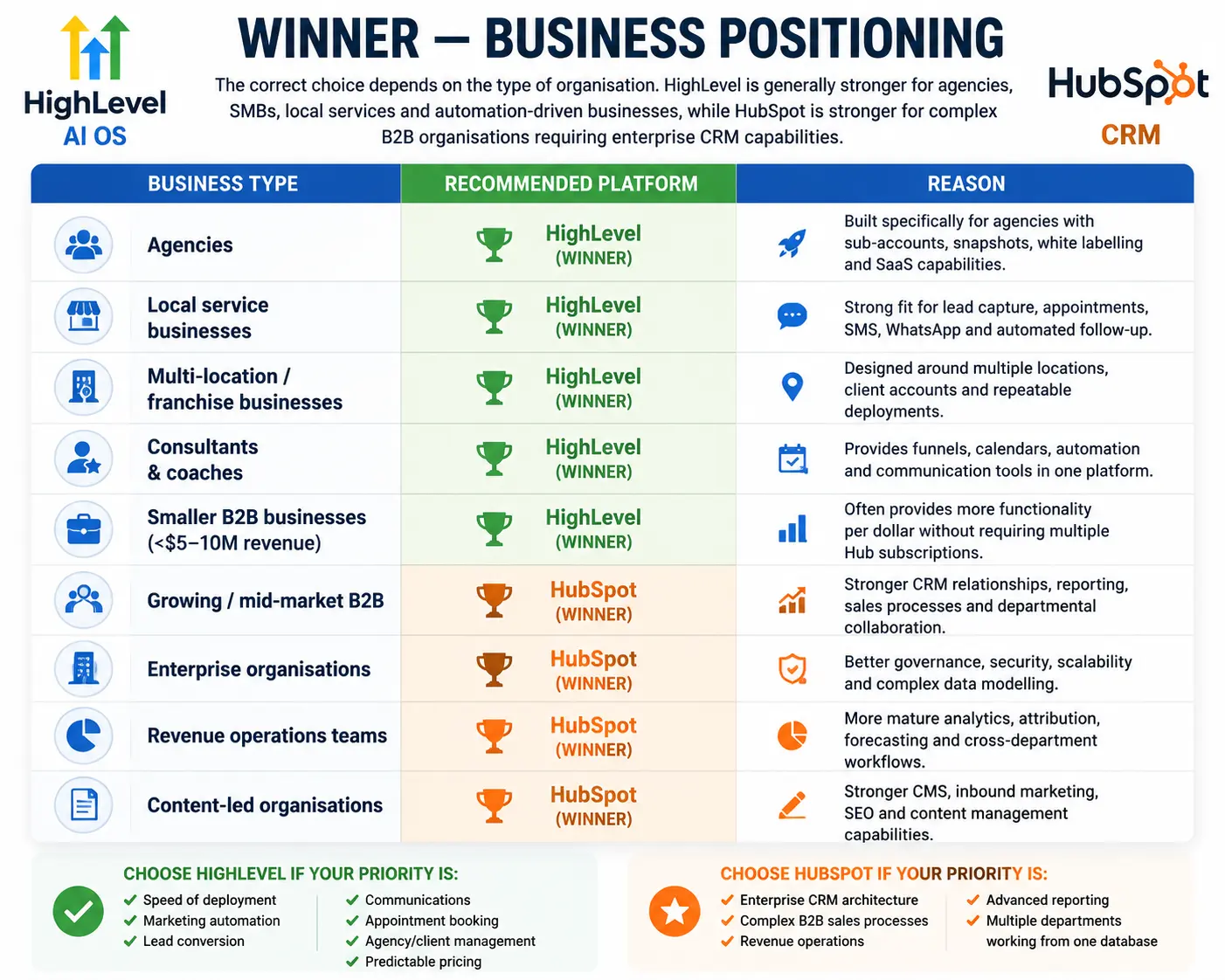
HighLevel is often seen as the stronger fit for B2C-focused companies, local service businesses, agencies and smaller B2B organisations with fewer than 30 employees.
Its rapid development over the past two years has transformed it from a marketing automation platform into a serious CRM and AI-powered business operating system. As a result, it is increasingly being compared with established platforms such as HubSpot.
HubSpot remains the clear leader in B2B organisations with sales cycles lasting months or years. These are typically mid-market and enterprise organisations generating more than $10 million in annual revenue, where deeper CRM architecture, advanced governance, comprehensive reporting and revenue operations functionality can justify the additional cost and complexity.
The remainder of this guide explains why these distinctions matter, where each platform performs best and how to determine which approach aligns more closely with your organisation.
Positioning HubSpot Versus HighLevel.
HubSpot positions itself as a CRM. It is a sophisticated, enterprise-grade relational database designed to be the single source of truth for customer data, which has expanded outward to include marketing, sales, and service "Hubs."
HighLevel positions itself as an AI Business Operating System. It is an operational execution engine designed to run the daily mechanics of a business—communications, appointments, funnels, payments, and AI workers—which happens to include a CRM module inside it.
Both include CRM functionality, marketing automation, sales pipelines, website builders, email, SMS, AI, commerce and reporting. But beneath the surface, one is an operating system designed for business execution, and the other is a database designed for customer record-keeping. Neither approach is inherently better - but they are not equally good matches for every business.
Operating System versus CRM
To understand why these two platforms behave so differently, you have to understand the difference between a database and an operating system.
The CRM Philosophy (HubSpot)
A CRM is fundamentally concerned with data. It asks: "Who is this person? What company do they work for? What stage is their deal in? Who owns the relationship?"
HubSpot is built around the concept of a sophisticated, enterprise-grade relational database. Its primary job is to ensure that every piece of customer data is perfectly structured, easily reportable, and accessible across different departments. Marketing, sales, and service are built as separate "Hubs" that orbit around this central database of records. It is a philosophy rooted in B2B enterprise sales, where understanding complex, multi-stakeholder relationships over a six-month sales cycle is the highest priority.
The AI Business Operating System Philosophy (HighLevel)
An operating system is fundamentally concerned with execution. It asks: "What needs to happen next? How do we communicate with this person right now? Is the appointment booked? Did the AI answer their question? Did the payment go through?"
HighLevel is built around the concept of consolidating the actual daily operations of a business into one platform. The CRM is just one module inside a much larger engine of workflow execution, multi-channel communication, and AI automation. It is a philosophy rooted in B2C, local services, and agency environments, where the speed of lead response, the volume of appointments booked, and the automation of routine communications are the highest priorities.
Why this distinction matters:
If you buy a CRM when you actually need an operating system, you end up with beautifully organised data but clunky, slow operational execution. If you buy an operating system when you need a massive relational database, you end up with fast execution but lack the deep data modelling required for complex enterprise reporting.
The Evolution: How We Got Here
Historically, software categories were cleanly separated. Businesses bought one CRM, one email platform, one website builder, one booking tool, one SMS platform, and one reporting tool, and stitched them together with Zapier.
Those boundaries have collapsed. Businesses are replacing six or seven separate subscriptions with one integrated platform. But they arrived at this destination from opposite directions.
HubSpot’s Path: Inbound Marketing Tool -> Marketing Automation -> CRM -> Multi-Hub CRM Platform.
HubSpot started by helping businesses attract leads via content. To manage those leads, they built a CRM. To serve different departments, they built Hubs. It is a bottom-up approach where the data record is the centre of the universe.
HighLevel’s Path: Agency Tech Stack Replacement -> Business Operating System -> AI Business Operating System, which includes a CRM.
HighLevel started by replacing ClickFunnels, Calendly, Mailchimp, Twilio, and a standalone CRM in a single subscription. It was built from day one not just to store data, but to execute the daily operations of a business. Now, with the addition of AI Employees, it has evolved into an AI Business Operating System where software agents actually perform tasks. It is a top-down approach where the business process is the centre of the universe.
Both vendors are chasing the same prize: becoming the central nervous system of the business. They just have entirely different definitions of what that nervous system should do.
Target Market: Matching the Platform to the Business
A platform should match both where your business is today and where it is headed in five years.
Company Size. HighLevel performs exceptionally well for sole traders to companies with millions in turnover. This includes SMB's. B2C, agencies, and local businesses. As a practical observation, businesses well under the $1 million revenue mark, and often up to several million, tend to get more usable value per dollar out of HighLevel's operating system than out of HubSpot's CRM. They can access nearly the full execution power of the platform on the entry tier. The pattern holds consistently: the smaller and more communications-heavy the business, the better HighLevel's model works.
HubSpot scales more naturally toward mid-market, enterprise, and international organisations. A business generating upwards of roughly $10 million in annual revenue is far more likely to be using enough of the platform, across enough departments, to justify the Suite-level CRM pricing.
Team Structure. A business with distinct marketing, sales, service, success, and operations teams all needing to collaborate on the same data benefits from HubSpot's multi-department CRM architecture. A leaner team—or one where a single person or small group runs marketing, sales, and support—tends to move much faster inside HighLevel's unified operating system.
Revenue Model. Project-based businesses, appointment-based businesses, subscription businesses, and service businesses all have different data needs. The operating system should reflect how the business actually makes money.
Growth Strategy. Will you acquire companies? Open more locations? Franchise? Lean into AI as a core part of operations? Picking a platform solely for where you are today is one of the most common causes of an expensive, painful migration two or three years later.
Customer Profile of HighLevel Clients
HighLevel is frequently described as a platform for small businesses and marketing agencies. While this remains its core market, the description can be misleading. HighLevel is increasingly used by multimillion-pound agencies, franchises, multi-location businesses and established service organisations.
HighLevel does not publish a detailed breakdown of its customers by annual revenue. However, available company-size data suggests the following broad pattern:
Most HighLevel customers generate less than £5 million annually.
Largest customers commonly fall within the £5 million–£50 million range.
Multi-location businesses and franchise groups can generate £50 million–£250 million or more.
Some billion-pound organisations use HighLevel for particular brands, locations, campaigns or lead-generation processes. This is more departmental or business function rather than company-wide.
The important distinction is between a company using HighLevel somewhere within its organisation and using it as its central company-wide CRM. A large enterprise might use HighLevel for a particular marketing funnel or division while retaining an enterprise CRM for corporate reporting, finance and governance.
Third-party technology data estimates that 86.2% of identifiable HighLevel customers have between one and ten employees, while 97.3% have no more than 50 employees. However, the same research also detects HighLevel within substantially larger organisations, including national franchises and businesses with thousands of employees. In many of these cases, the platform appears on a specific subdomain, campaign or agency-managed asset rather than across the entire organisation. TechnologyChecker’s HighLevel customer analysis
HighLevel’s own case studies also demonstrate that agencies can build substantial businesses on the platform. ChurchCandy, for example, reported more than $300,000 in monthly recurring revenue—approximately $3.6 million annualised—and $5.6 million in reported revenue during 2025. HighLevel’s ChurchCandy case study
Revenue alone is therefore not the only way to determine whether a business is suited to HighLevel.
A £50 million multi-location service business with relatively straightforward customer journeys may be an excellent fit. Conversely, a £5 million B2B company with multiple sales teams, complex account hierarchies, international operations and extensive governance requirements may need the deeper enterprise data architecture offered by HubSpot, Salesforce or Microsoft Dynamics.
The more useful question is not just, “How large is the company?” It is:
How complex are its customer data, sales processes, reporting requirements and governance obligations?
HighLevel’s natural market extends from microbusinesses to organisations generating tens of millions of pounds annually. Beyond that level, it may still play an important operational role—but it is more likely to function as a marketing, communications and lead-conversion platform alongside an enterprise CRM, rather than replacing the organisation’s entire technology stack.
B2B vs B2C vs B2B2C
This is arguably the single biggest factor in the decision, and it maps perfectly onto the OS vs. CRM distinction.
B2B Requirements typically include company records, multiple contacts per account, account ownership, decision-maker tracking, long sales cycles, target accounts, data enrichment, forecasting, quotes, contracts, and custom objects. HubSpot's CRM performs exceptionally well here because its architecture is genuinely built around modelling relationships between data points.
B2C Requirements typically prioritise speed, volume, automation, multi-channel communication, appointment booking, SMS, WhatsApp, reviews, and payments. HighLevel's operating system excels here because executing these actions is deeply native to the platform. You don't have to navigate between Hubs to make a B2C journey happen; the funnel, the SMS, the appointment, and the payment are all in the same operational workflow.
B2B2C Requirements—local services, agencies, franchise organisations—often need multiple relationship layers that go beyond simple contact management. This is where HighLevel's multi-location operating system structure shines, allowing a central hub to manage the operations of dozens of sub-accounts.
Quick Takeaways
Before comparing a single feature, the most useful question you can ask is: Which markets was this platform actually built for, and who are their customers?
HighLevel comes from a B2C and agency background, built to execute operations. HubSpot comes from a B2B background, built to track relationships. That single fact explains most of the differences you will find in this guide.
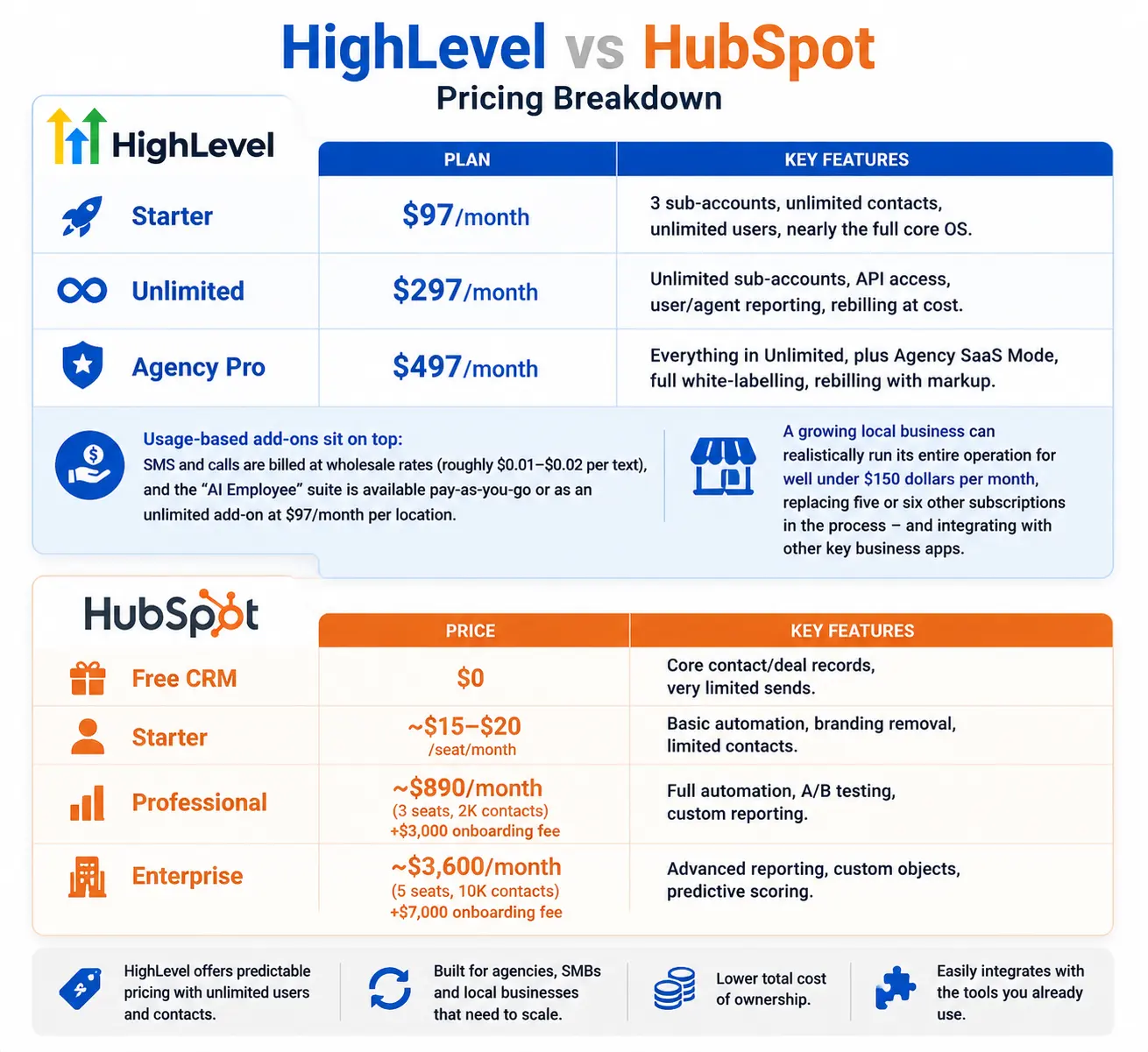
Budget is the second filter. HighLevel's operating system pricing starts at $97/month and includes nearly the entire platform—CRM, funnels, websites, unlimited contacts, unlimited users, and up to three sub-accounts (businesses/websites) on the entry tier. HubSpot's real-world entry point for a functioning marketing and sales setup over
$2K per month for a small team under 10 users, once you move past the free and heavily restricted Starter tiers.
HubSpot's pricing genuinely starts to make commercial sense once a business has the revenue, contact volume, and departmental structure to need a massive, strictly governed relational database. In practice, this tends to mean established B2B companies, often north of $10 million in annual revenue.
Below that level, a lot of companies end up buying HubSpot for the brand recognition and end up with only part of the system. HighLevel's flat, all-in operating system pricing avoids that specific trap by design.
1. Are you B2C, a local service business, or a smaller B2B business? Lean HighLevel.
2. Are you a larger, complex B2B organisation with multiple departments that need to model complex data relationships? Lean HubSpot.
3. Is your budget tight, or is predictable pricing a priority? Lean HighLevel.
4. Are you B2B, with an annual turnover exceeding 10 million per year? Lean HubSpot.
HighLevel is also expanding into more B2B-friendly territory—better reporting, forecasting, custom objects, and company-level relationship data. Because of this, it is increasingly common for B2B companies with 5–10 users, sitting in the middle of HubSpot's "half a system" problem, to move across to HighLevel's operating system and get more usable functionality for a fraction of the cost.
Total Cost of Ownership Reality Check
For a business with one company on HighLevel's $97/month Starter plan, and low-cost utility credits on pay-as-you-go, the pricing difference is phenomenal. A 10-person company running HubSpot Marketing Hub and Sales Hub Professional can easily land north of $3,000/month.
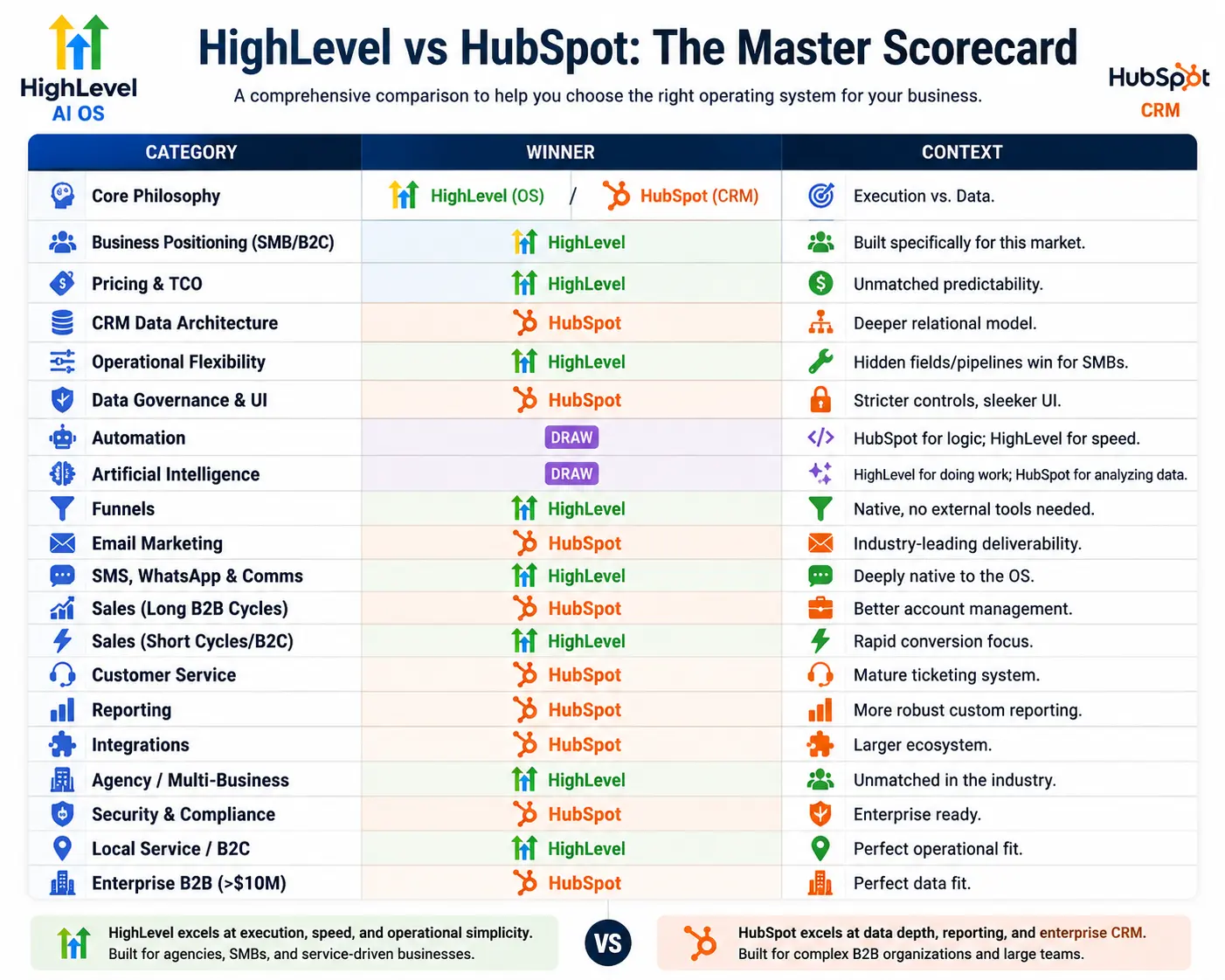
Winner — Pricing: HighLevel
For SMBs with revenue under 10 million per year, local service businesses, B2C companies, and smaller B2B companies, HighLevel's flat, predictable, all-inclusive operating system pricing is a genuine structural advantage. HubSpot's pricing makes sense specifically for businesses large enough to actually use most of what they are paying for.
Architecture: Execution Engine vs. Relational Database
This is the most overlooked part of any platform comparison—and arguably the most important for anyone thinking beyond the next twelve months.
Most buyers notice the UI. Software architects notice the data model. The businesses that get the best long-term outcomes behave like architects.
The CRM Architecture (HubSpot): Deep Relational Data
HubSpot’s architecture includes Contacts, Companies, Deals, Tickets, Products, Quotes, and Custom Objects, with relationships modelled between each—a genuinely flexible, relational structure. Imagine a property company managing Properties, Tenancies, and Landlords—HubSpot can model this perfectly using Custom Objects. This level of flexibility is why HubSpot performs strongly within complex B2B organisations. It is a database architect's dream.
The Operating System Architecture (HighLevel): Fast Operational Execution
HighLevel historically focused on a simpler model: Contacts, Opportunities, Companies, and Conversations. That simplicity is a massive strength for fast deployment. An operating system shouldn't require a database administrator to set up a basic lead-to-appointment workflow.
That gap is closing rapidly, though. HighLevel has introduced custom objects—up to ten per location on all plans, supporting many-to-many relationships—along with company-level relationships. It is a genuinely significant step toward CRM-style data modelling.
The caveat is that HighLevel's custom object support does not yet extend into every surface (like bulk email campaigns or the core Conversations UI). In practice, custom objects exist for CRM purposes, but the operating system's primary focus remains workflow execution.
HighLevel's Practical Flexibility: Hidden Fields & Pipelines
While HubSpot relies on enterprise-level custom objects for flexibility, HighLevel is highly customisable in other, arguably more accessible ways. HighLevel makes extensive use of "Hidden Fields" and unlimited, highly specific pipelines.
Instead of building a complex custom object to track a specific metric, a HighLevel user can create a custom field, hide it from the user interface to keep the dashboard clean, use it to track complex attribution or data points dynamically via workflows, and route contacts through specialised pipelines.
For a $100k to $5M revenue company, this type of flexibility is often much easier to manage than HubSpot's enterprise data architecture. It keeps the interface simple while allowing for deep operational tracking in the background. (Note: While both platforms offer UI customisation, neither is as deeply customizable at the interface level as Salesforce.
Fields vs Tags vs Lists
One of the most common design mistakes—on either platform—is confusing these three concepts.
* Fields describe the current state (Industry, Pipeline Stage, Quote Value). These should be structured.
* Tags describe something that has happened (Downloaded a guide, attended a webinar). They are historical.
* Lists describe groups of records. Lists should normally be generated from fields, not tags.
HighLevel relies heavily on Tags for rapid operational automation, which works brilliantly for high-volume B2C marketing. HubSpot forces better discipline with strict property management, which benefits complex B2B reporting.
Winner — Architecture: HubSpot (for complex data), HighLevel (for operational speed)
HubSpot remains the deeper architecture for complex B2B data modelling. However, for the SMB market, HighLevel's hidden fields and pipeline flexibility often provide a more practical, user-friendly form of operating system customisation.
Data Quality, UI, and Governance
The most expensive platform failures rarely come from software limitations—they come from bad data. AI simply magnifies whatever data quality already exists; poor data produces poor AI.
The User Interface Factor
HubSpot undoubtedly has a better, more modern user interface. It is polished, intuitive, and feels like a premium enterprise product. This makes it easier to train new employees.
HighLevel's UI is highly functional and practical. By using features like hidden fields to avoid cluttering the screen with dozens of data points, HighLevel keeps the front-end clean while doing heavy operational lifting in the background. It may not look as sleek as HubSpot, but it is designed for speed of execution.
Governance
Modern platforms build in validation—mandatory fields, required dropdowns, duplicate prevention—and governance controls over who can edit fields or change pipelines. Without governance, systems become chaotic.
Winner — Data Quality & Governance: HubSpot
HubSpot's permissions, field-level controls, and audit capabilities remain more mature for larger teams that need strict data governance. This is an area HighLevel is actively investing in, but HubSpot currently has the edge for large enterprises.
Automation Architecture
Automation stopped being "send an email after a form submission" a long time ago. Modern workflow engines increasingly resemble business process engines.
Traditional Automation follows a simple chain: Form submitted → Wait → Send email → Wait → Send SMS.
Event-Driven Automation responds to real business events—Quote approved, Payment received, Appointment confirmed—with each event triggering the next process.
Hybrid AI Automation is where the market is heading. AI interprets the customer's intent, updates a structured field, and a traditional if/else workflow executes the business process based on that field.
HubSpot provides one of the most sophisticated workflow engines on the market, particularly for multi-department, multi-object logic. HighLevel provides faster deployment, broader native channel coverage (SMS, WhatsApp, voice, social) inside a single workflow, and a genuinely simpler experience for agencies building automation for many clients at once.
Winner — Automation: Draw
HubSpot wins on complex multi-object logic. HighLevel wins on speed of deployment and multi-channel operational execution.
Artificial Intelligence
AI is the biggest shift the software industry has seen. But AI behaves very differently inside a CRM versus an AI Business Operating System.
HubSpot's AI: Breeze (The CRM Analyst)
HubSpot’s AI suite, Breeze, is built on top of a complete, mature CRM. It focuses heavily on strategic AI—helping humans understand their data.
Capabilities
AI Agents: Prospecting Agent researches accounts; Customer Agent resolves questions from the knowledge base; Data Agent answers custom questions by analysing CRM records.
Conversation Summaries: Transcribes and summarises sales and support calls.
Predictive Lead Scoring: Machine-learning-based lead scoring using historical data.
AI Reporting: Generates complex revenue reports from natural-language requests.
Breeze draws from the full customer journey, making it exceptional for B2B revenue teams who need to understand pipeline health and buyer intent. It is an incredibly powerful data analyst.
HighLevel's AI: AI Employees (The Digital Workforce)
HighLevel's AI tools are sold under the "AI Employee" umbrella. Because HighLevel is an operating system, its AI doesn't just analyse data—*it does the work*. This is operational AI.
Voice AI: An AI receptionist that answers business phone lines 24/7, holds natural conversations, and books appointments directly into the calendar.
Conversation AI: An AI responder across SMS, email, WhatsApp, Facebook/Instagram, and live chat that understands context and replies intelligently to leads in real-time.
Reviews AI: Reads Google Reviews and writes customised, context-aware replies automatically to boost local SEO.
Content AI: AI writer for emails, blog posts, and ads.
Pricing: AI usage is pay-as-you-go by default. However, if you want unlimited usage, the AI Employee Unlimited add-on costs $97/month per company/location. However, most companies will be fine on a utility pay-as-you-go, as the pricing is extremely good.
The AI Distinction
If you are a B2B company with a $50M pipeline, you want Breeze sitting on top of your CRM telling you which deals are at risk.
If you are a local dental practice, a plumbing business, or an agency managing 50 local clients, you want HighLevel's Voice AI answering the phones when your receptionist is busy, and Conversation AI replying to Facebook messages at 10 PM to book an appointment. HighLevel's AI replaces human labour; HubSpot's AI augments human analysis.
Winner — Artificial Intelligence: Draw
HighLevel wins on operational AI (doing the work). HubSpot wins on strategic AI (analysing the data). HighLevel is adding AI features at a blistering pace compared to HubSpot, and for the SMB market, operational AI is usually far more valuable.
Marketing, Funnels & Unified Communications
Email Marketing remains one of HubSpot's clear strengths—deliverability, segmentation, dynamic lists, and personalisation are all mature. (It is worth noting that HubSpot was recently hit with a Google SEO spam penalty that significantly reduced its own organic search visibility. HighLevel's email functionality is solid but places more emphasis on multi-channel communication.
SMS and WhatsApp are where HighLevel's operating system becomes exceptionally strong. These channels are not an afterthought bolted onto a CRM—they are native to the operating system. Businesses can combine SMS, WhatsApp, email, voice, and Messenger inside a single automation. For local service businesses, this dramatically improves response rates. In HubSpot, WhatsApp is more of a bolt-on, and SMS is used far less frequently.
Funnels are one of HighLevel's strongest structural advantages—a native, drag-and-drop funnel builder covering lead funnels, sales funnels, upsells, downsells, and checkout pages without needing separate software. HubSpot offers strong landing pages, but it is fundamentally a CMS-first CRM rather than a page builder first.
Winner — Marketing: Draw (HighLevel favoured for SMB/B2C)
HighLevel wins on funnels, SMS, WhatsApp, and local-business marketing. HubSpot wins on email depth and personalisation.
Sales Enablement
HubSpot excels in complex B2B sales: deal and company relationship management, revenue forecasting, sales sequences, and revenue attribution give sales managers strong visibility across a longer pipeline.
HighLevel focuses on rapid lead conversion: appointment booking, fast follow-up, payment collection, and immediate communication—a natural fit for B2C where the sales cycle is measured in days. HighLevel has recently introduced its own forecasting capability, narrowing this gap for smaller B2B teams.
Winner — Sales: HubSpot for complex B2B; HighLevel for fast-moving B2C.
Customer Communications
Customer expectations have moved well past email. Businesses increasingly need to talk to customers across email, SMS, WhatsApp, Facebook, Instagram, live chat, and voice—in one place.
HighLevel's unified inbox pulls conversations from every channel into one view, meaningfully reducing context-switching. HubSpot's tools are strong but remain more email-centric—entirely appropriate for many B2B organisations, but less so for B2C.
Winner — Customer Communications: HighLevel
Reporting & Business Intelligence
Reporting quality depends on structured data and clean relationships.
HubSpot remains one of the strongest reporting platforms on the market, particularly for attribution, cohorts, pipeline velocity, and multi-touch revenue analysis.
HighLevel has meaningfully improved here—attribution, custom objects, relationships between objects and forecasting.. Using hidden fields, HighLevel can calculate complex metrics. There is a growing library of preset report templates. It is not yet at HubSpot's depth for advanced enterprise reporting, but the gap is narrowing.
Winner — Reporting: HubSpot
Customer Service
HubSpot's Service Hub—ticketing, helpdesks, portals, knowledge bases, and AI support—is significantly more mature as a dedicated CRM function. HighLevel offers pipelines adapted for support tracking and leans heavily on its conversations infrastructure. A custom object can be used for tickets, but lacks a dedicated, granular ticketing system.
Winner — Customer Service: HubSpot
Integrations & Ecosystems
HubSpot's app ecosystem remains one of the largest in the industry, with deep native integrations.
HighLevel's philosophy leans toward replacing separate software rather than integrating with it. But its workflow engine now supports connecting to a much wider range of third-party APIs as both triggers and actions, functioning like Zapier or Make built directly into the OS—even for services without a pre-built native integration. Both support webhooks.
Winner — Integrations: HubSpot (with HighLevel closing the gap via workflow APIs)
Agency and Multi-Business Features
This is where HighLevel's operating system philosophy fundamentally destroys the traditional CRM model. Managing many businesses simultaneously is an operational problem, not a data problem.
White-Labelling
HighLevel allows agencies to become software vendors. Clients see the agency's own branding, not HighLevel's.
Snapshots: The OS Deployment Mechanism
Perhaps HighLevel's single greatest innovation. A complete business operating system—CRM structure, custom fields, pipelines, workflows, funnels, websites, forms, calendars, AI configuration, reputation management, dashboards, memberships, and payment structures—can be packaged into a Snapshot and deployed into a new client account in minutes.
This turns implementation into a repeatable deployment process. A growing partner ecosystem now sells industry-specific snapshots for verticals like real estate, dental, and fitness. HubSpot simply does not have an equivalent to this operational deployment capability.
The Partner Experience
Partners get a significantly better experience with HighLevel, resulting in much lower partner turnover. Because HighLevel's pricing is fixed, agency clients do not suffer from "bill shock" when their contact list grows.
Winner — Agency & Multi-Business Features: HighLevel (By a Landslide)
Security, Governance & Developer Platform
Security & Governance: HubSpot offers substantially deeper enterprise governance—permissions, audit logs, GDPR tooling, encryption, and SSO. Winner: HubSpot.
Developer Platform: HubSpot currently offers a stronger developer ecosystem across REST APIs and SDKs. HighLevel is improving quickly, allowing its workflows to connect to hundreds of popular business apps directly. Winner: HubSpot.
Real-World Scenarios
A dental practice with two locations, wanting online booking, review automation, and a missed-call text-back system.
Textbook HighLevel scenario. B2C, appointment-driven, multi-location, communication-heavy. You need an operating system to execute these tasks, not a complex relational database. A $297/month Unlimited plan covers both locations perfectly.
A 15-person SaaS company selling into mid-market enterprise accounts with a six-month sales cycle.
Textbook HubSpot scenario. Multiple stakeholders per deal, account-based marketing, revenue attribution across a long funnel. You need a CRM to model these complex relationships.
A boutique marketing agency running social media, ads, and email for 20 local business clients.
HighLevel's sub-account operating system, snapshots, and white-labelling were built exactly for this. Deploying a proven OS into a new client account in minutes is an efficiency gain that compounds.
A £4 million B2B manufacturer with a small sales team and a handful of existing HubSpot Hubs it isn't fully using.
A very common migration story: a business that adopted HubSpot ended up on Marketing Hub Pro with Sales Hub Starter, and is now paying for a partial system. They move to HighLevel's flat-rate OS and get more of what they actually use, for less.
A 200-person enterprise retailer with regulatory reporting requirements and a dedicated RevOps team.
HubSpot's governance, permissions, and reporting depth make it the safer choice. The organisation has the complexity and budget to justify a true enterprise CRM.
Elevator Summary
The real question is not simply which platform has more features. It is whether your organisation needs a traditional CRM designed to manage complex customer data, or an AI-powered Business Operating System built to manage and execute daily operations.
For complex, multi-departmental B2B organisations with the budget for enterprise-grade software, HubSpot remains one of the strongest CRM platforms available. Its data architecture, reporting capabilities, governance controls and custom-object functionality are difficult to match.
However, for much of the SMB, B2C, agency and local-service market, HighLevel is increasingly the stronger fit.
HighLevel combines CRM, marketing automation, appointment booking, SMS, email, funnels, payments, reputation management and AI within a single operational platform. Its pricing is more transparent, its functionality continues to expand rapidly, and it is particularly well suited to businesses that value execution over administrative complexity.
This is also why some businesses move away from HubSpot. They may begin with a relatively simple CRM requirement but gradually find themselves paying for multiple Hubs, higher subscription tiers and functionality they do not fully use. In many cases, what they actually need is a practical system for capturing leads, following up quickly, booking appointments, automating communications and managing the customer journey.
The best platform is therefore not the one with the longest feature list. It is the one whose underlying philosophy matches the daily reality of the business:
HubSpot is primarily designed around sophisticated CRM data management.
HighLevel is primarily designed around operational execution and automation.
For many SMBs, agencies, B2C companies and local service providers, operational execution is the more immediate priority.
A Quick Decision Framework
1. Are you a B2C company or a service business selling directly to consumers?
If yes, your priorities are likely to include rapid lead response, SMS and WhatsApp communication, appointment booking, follow-up automation and conversion-focused funnels. HighLevel is generally the better starting point.
2. Is your annual revenue meaningfully below £10 million?
If yes, HighLevel’s platform-based pricing is likely to provide more immediately usable functionality for the investment. HubSpot can still be suitable, but its total cost often increases as additional Hubs, users and advanced features are introduced.
3. Do you have separate marketing, sales and customer service teams that need to manage complex data relationships?
If yes—and you have the budget and internal resources to implement it properly—HubSpot’s CRM architecture is designed for precisely this type of organisation.
4. Are you an agency, or do you manage multiple brands, locations or client accounts?
If yes, HighLevel has a major structural advantage. Its sub-accounts, reusable snapshots, centralised agency controls and white-labelling capabilities are purpose-built for multi-account management.
5. Do you currently need enterprise-grade governance, detailed audit trails or advanced custom-object data modelling?
If yes, HubSpot is the more mature and capable choice.
For most small and mid-sized businesses, agencies, consultants, local service providers and B2C companies, the answers to the first two questions will often settle the comparison in HighLevel’s favour. HubSpot may offer greater CRM depth, but HighLevel is frequently better aligned with what these businesses actually need to accomplish each day.

Pricing & Licensing Deep Dive
For most businesses, pricing is the first comparison they make—and it is also where the two platforms diverge most sharply. If budget is a meaningful constraint, HighLevel wins this category comfortably and transparently.
A subscription price is only one piece of the total cost. The right lens is the Total Cost of Ownership (TCO) over three to five years.
Licensing Models Compared
The biggest difference between HubSpot and HighLevel is not the features they provide — it is how they charge businesses as they grow.
CRM costs are influenced by:
Number of users
Number of contacts
Features required
Departments using the system
AI usage
Communication volume
Contract commitments
A CRM that looks affordable today can become significantly more expensive as the business expands.
HubSpot Licensing Model: Modular Hubs + Seats + Usage
HubSpot does not have one simple CRM licence.
The platform is divided into separate Hubs:
Marketing Hub
Sales Hub
Service Hub
Content Hub (Websites CMS)
Data Hub (Operations/Rev Ops)
Commerce Hub
Revenue Hub
Each Hub has its own pricing model.
Businesses pay for:
Hub subscription level
Core Seats
Sales Seats
Service Seats
Marketing contacts
HubSpot Credits / AI usage
Additional add-ons
HubSpot Customer Hub Platform.
This combines multiple Hubs into one package for a discounted price. It includes some core users, but dedicated Sales Hub & Service Hub Users are needed on top of this.
Professional Customer Platform: £1,270/month. Includes: 6 core users
Enterprise Customer Platform: £4,090/month. Includes:8 core users
If you use the Professional edition and have five sales employees, this would cost an additional £450 per month. Revenue Hub can add a further fee of approximately £50 per salesperson per month. Five service employees would add approximately another £450 per month.
Marketing Hub
Pro Edition: £780/month. Includes 3 Core Users. £44/month per additional user)
Enterprise Edition: £3,000/month. Includes: 5 Core Users, £70/month per additional core user
Sales Seats:
Sales Hub Professional: £85/month per Sales User
Sales Hub Enterprise: £135/month per Sales User
Sales Hub uses dedicated Sales Seats. A sales team with 5 sales representatives would require: 5 × £85 = £425/month for Sales Hub Professional licences.
Service Seats
Service Hub Professional: £85/month per user.
Service Hub Enterprise: £135/month per user.
Service Hub uses dedicated Service Seats. A support team with 5 customer service agents would cost 5 × £85 = £425/month
Content Hub
Content Hub Pro:Approx: £440/month.
Includes:3 Core Seats. Additional Core Seats: £44/month per user.
Content Hub Enterprise: Approx: £1,310/month. Includes:5 Core Seats, Additional Users £70/month
Content Hub follows a Core Seat model rather than specialist Sales or Service seats.
Data Hub (Operations Hub)
Data Hub Professional: Approx: £700/month
Includes: 1 Core Seat. Additional Core Seats: Approximately £44/month per extra user.
Data Hub Enterprise. Approx: £1,740/month
Includes:1 Core Seat. Additional Core Seats: Approximately £70/month per extra user.
Revenue / Commerce Hub
Additional Core Seats: Approximately £85/monthly
HubSpot: The Enterprise Licensing Model
HubSpot follows a traditional enterprise software pricing model.
Costs are typically influenced by:
User seats
Marketing contacts
Multiple Hubs (Departments)
Different editions for company size/budget (Starter, Pro, Enterprise)
AI credits
Additional upgrades and add-ons
Annual commitments
This model works well for larger organisations that need strict control, departmental separation and enterprise governance.
Per User / Seat Pricing
HubSpot generally charges based on the number of users who require access.
Costs increase as teams grow
Adding more employees increases monthly costs
Wider adoption across departments becomes more expensive
A CRM that starts with a small sales team can become significantly more expensive when marketing, customer service and operations teams also require access.
Per Contact Pricing
HubSpot also uses contact-based pricing, particularly around marketing contacts.
Businesses pay based on the number of contacts they actively market to. Works well for many B2B organisations which have fewer contacts than B2C. Suitable where databases are smaller and highly managed
Challenges:
Large databases become expensive
Businesses may avoid importing historical customer data
Companies may remove inactive contacts to control costs
For AI-driven businesses, this is important because better AI often requires more historical data:
Customer interactions
Previous enquiries
Buying behaviour
Engagement history
Restricting data to reduce software costs can reduce future automation opportunities.
AI Credits and Add-Ons
HubSpot is also moving towards AI-based pricing.
Additional costs may come from:
AI credits
Advanced AI features
Additional tools
Premium upgrades
HighLevel Pricing
HighLevel takes a different approach. Instead of charging primarily through users and contacts, it is built around an operating system model.
The core principles are:
Unlimited users
Unlimited contacts
No per-contact database charges
No separate Hubs
95+ % of features are included in the starter plan
Usage-based costs for communication and AI
Unlimited Users
HighLevel does not increase pricing simply because more team members need access.
Useful for:
Sales teams
Marketing teams
Customer service teams
Administrators
Agency clients
Multiple departments
This encourages wider adoption because businesses do not need to restrict access to control costs.
Unlimited Contacts
HighLevel allows businesses to store their complete database without increasing subscription costs.
This includes:
Leads
Customers
Previous customers
Historical enquiries
Marketing audiences
This is particularly valuable for:
Local service businesses
Agencies
E-commerce companies
B2C organisations
The database becomes an asset rather than a cost factor.
HighLevel Starter Plan ($97/month):
3 sub-accounts (3 companies/websites)
Unlimited users
Unlimited contacts
95% of the functionality that the Agency Plan has
Automation
Marketing tools
Higher plans provide more locations and agency-focused features.
This makes HighLevel particularly suitable for:
Agencies managing clients
Franchise businesses
Multi-location organisations
Launching new brands or services
Email Marketing and AI Costs
Both platforms increasingly use usage-based pricing, but the philosophy is different.
HubSpot
Costs can increase through:
More marketing contacts
Higher Hub tiers
Additional features
AI upgrades
HighLevel
Costs are mainly based on actual usage:
Emails sent
SMS usage
Phone numbers
AI usage
Voice AI conversations
The difference:
HubSpot primarily scales through licences and platform upgrades.
HighLevel primarily scales through usage and deployment.
Contract Flexibility
Another major difference is commitment.
HubSpot
Professional and Enterprise plans often involve annual commitments
Designed for organisations deeply embedded into the platform
Suitable when CRM infrastructure is a long-term strategic investment
HighLevel
Month-to-month flexibility
Easier to test new systems
Easier to launch new projects
Lower commitment when experimenting with automation
The HubSpot "Pyramid Hub" Upgrade Funnel
To build a complete HubSpot system, businesses typically need at least the Professional Customer Platform, together with additional Sales, Service, Commerce or Core seats. Software costs can therefore start at approximately $3,000 per month for a system covering the main business functions.
Companies that do not make this investment from the outset, and instead expand their HubSpot setup over time, can be drawn into a “pyramid hub” upgrade funnel. A business might begin with Sales Hub Professional, only to discover that it also needs Marketing Hub for email marketing automation or another hub for a specific operational requirement.
Costs multiply across hubs, subscription tiers, user seats and usage-based charges while not having all the available features.
This is particularly relevant for companies outside HubSpot’s ideal mid-market customer profile, often those generating less than $10 million in annual revenue. An essential feature may require another hub, seat type or subscription tier, creating an upgrade path that can quickly exceed the original budget.
Professional and Enterprise plans may also include mandatory onboarding fees ranging from approximately $3,000 to more than $7,000.
The Strategic Difference
The simplest way to understand the difference:
HubSpot rewards complexity
As organisations grow larger, with multiple departments, advanced reporting needs and governance requirements, HubSpot becomes increasingly valuable.
HighLevel rewards execution
Businesses can add users, contacts, automation and new locations without dramatically increasing their core software costs. For enterprise organisations, HubSpot's licensing model can make sense. For SMBs, agencies, local services and automation-focused businesses, HighLevel's approach often provides greater flexibility, predictable costs and faster scalability.
The Two Opposite Implementation Failure Modes
If an implementation fails for HubSpot or HighLevel, it is usually for.
The typical HubSpot failure is under-implementation. A company purchases a powerful platform but uses it as little more than a contact database and email tool. Advanced reporting, lifecycle management, associations, attribution and automation remain partially configured. The business pays for sophisticated infrastructure without completing the organisational work required to benefit from it.
The typical HighLevel failure is over-automation. Because workflows, fields, tags, pipelines and communications can be created quickly, users may automate processes before defining them properly. Over time, the account accumulates overlapping workflows, conflicting field values, unexplained tags and messages triggered by outdated logic.
HubSpot’s risk is paying for capability that never becomes operational.
HighLevel’s risk is making operations so easy to automate that the system grows faster than its architecture.
This distinction has practical consequences. A successful HubSpot implementation generally requires deliberate data modelling, departmental agreement and user adoption. A successful HighLevel implementation requires modular workflow design, consistent naming conventions, structured fields, change control and regular testing.
The platform should therefore be selected partly according to the failure mode the organisation is better equipped to manage.
A business with strong Revenue Operations expertise may extract substantial value from HubSpot’s depth. A smaller company that needs rapid deployment may achieve more with HighLevel, provided it applies sufficient discipline to prevent automation sprawl.
Software does not eliminate operational complexity. It either structures it, automates it or—when implemented poorly—hides it until something breaks.
Summary
HighLevel and HubSpot are both powerful platforms, but they are designed around different business priorities and target markets.
HubSpot remains the stronger option for complex B2B organisations with multiple departments, long sales cycles and demanding requirements for relational data modelling, governance, forecasting and revenue reporting. It is particularly valuable when numerous contacts, companies, deals and custom objects must be connected and analysed throughout the customer lifecycle.
HighLevel is generally the stronger choice for B2C companies and smaller B2B teams, local service businesses, and agencies.
Larger B2B organisations—particularly those generating more than £10 million in annual revenue—may find HubSpot better aligned with their complexity, departmental structure and available software budget. However, this represents a more niche and specialised section of the market. HighLevel is the more accessible all-round and general-purpose platform and will suit a broader range of businesses, especially those generating less than £10 million annually.
Its native workflows, funnels, calendars, payments, unified communications and operational AI enable businesses to automate more of their everyday operations without assembling multiple separate applications. Its unlimited-user, unlimited-contact and multi-location pricing model also provides a substantial commercial advantage for many SMBs.
The distinction becomes particularly clear when comparing artificial intelligence. HubSpot’s AI primarily helps teams understand, enrich and analyse CRM data. HighLevel’s AI is more operational: answering calls, responding to conversations, managing enquiries and booking appointments. HubSpot principally uses AI to augment human analysis, whereas HighLevel increasingly uses it to perform customer-facing work.
The final decision should therefore reflect the organisation’s operating model:
Choose HighLevel when operational execution, automation, multi-channel communication, appointment management, predictable pricing or multi-account deployment are the priorities.
Choose HubSpot when complex B2B relationships, enterprise governance, advanced reporting and cross-departmental data management are the priorities.
Compare the total system required, rather than focusing only on entry-level subscription prices or isolated features.
Treat revenue and team size as useful indicators rather than absolute rules. The complexity of the organisation, its sales process and its data requirements ultimately matter more than turnover alone.
The best platform is not necessarily the one with the longest feature list. It is the one whose architecture, pricing model and development direction most closely reflect how the business attracts customers, manages relationships and executes its daily operations.