
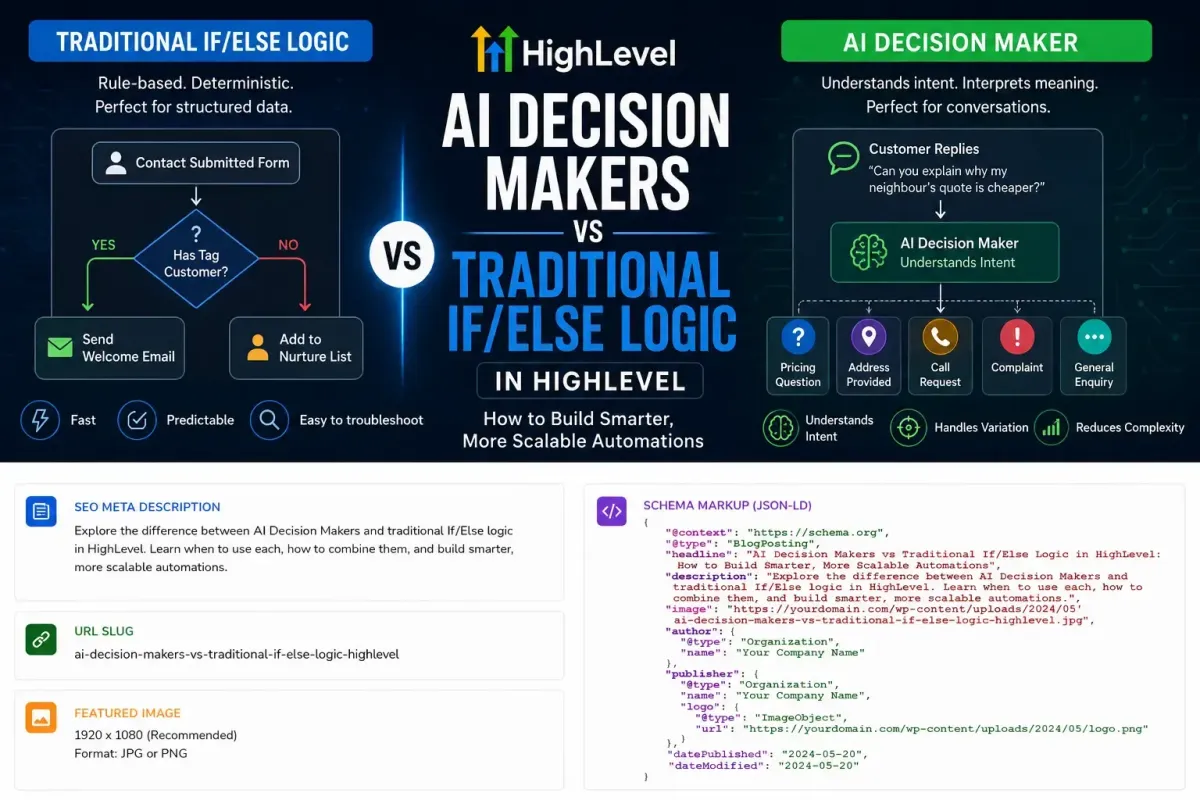
If/Else Conditional Logic in HighLevel Versus AI Decision Makers
Automation has always been built around rules. If a customer completes a form, send an email. If they reply, move them to the next stage. If they have a tag, assign them to a salesperson.
For years, this approach has worked exceptionally well. HighLevel's workflow builder is one of the most powerful no-code automation platforms available because it allows businesses to model these business rules visually using triggers, conditions and actions.
However, the introduction of AI Decision Makers changes what is possible and creates new boundaries. Rather than simply checking whether a condition is true or false, workflows can now understand context, intent and meaning. This allows automation to make decisions that previously required either extremely complex workflow logic or human intervention.
The question is no longer whether AI should replace traditional if/else logic. Instead, the question becomes: Which decisions should still use deterministic rules, and which should be delegated to AI? The answer is almost always a combination of both.
Traditional If/Else Logic
Every HighLevel user is familiar with If/Else branches. A workflow evaluates one or more conditions before choosing a path.
For example:
Contact has the tag "Customer"
Opportunity stage equals "Quote Sent"
Country equals United Kingdom
Lead source equals Facebook
Appointment status is Confirmed
Each condition has a clear answer. Yes / No. Nothing in between.
Because of this, traditional workflow logic is:
Fast
Predictable
Explainable
Easy to troubleshoot
Every outcome is completely deterministic. Given identical inputs, the workflow will always produce the same result. This is exactly what you want when automating business processes.

The Limitations of If/Else Logic
Problems begin when workflows need to understand language rather than data.
Imagine a customer replies:
"Can you tell me why my neighbour's quote is cheaper than mine?"
A traditional workflow has no understanding of this sentence. You could attempt to detect words such as:
neighbour
cheaper
price
quote
But customers may instead write:
Why is mine more expensive?
My friend paid less.
Can you explain your pricing?
I don't understand this quotation.
Surely this shouldn't cost that much.
Very quickly, the workflow becomes enormous. You end up maintaining hundreds of keyword checks trying to predict every possible variation. Eventually, someone asks the same question using wording you never considered.
The workflow fails. Not because the logic was wrong. Because language is unpredictable.
Where AI Changes Everything
AI Decision Makers don't look for exact matches. Instead, they analyse intent.
Rather than asking: "Does this sentence contain the word quote?"
they ask:"What is this customer actually trying to achieve?"
That is an entirely different type of decision. Instead of matching words, AI understands meaning.
Whether the customer writes:
Why is this price higher?
Can you explain my quotation?
My neighbour paid less.
This seems expensive.
AI recognises that all of these relate to pricing. The workflow can therefore take the same action every time without maintaining hundreds of keyword rules.
Deterministic Logic vs Intelligent Decisions
Think of automation as having two different brains. The first brain performs calculations.
It answers questions like:
Has the customer booked?
Has payment been received?
Is the opportunity in this pipeline?
Is the appointment confirmed?
Does the contact have this custom field?
These are factual questions.
The second brain interprets human communication. It answers questions like:
Is this customer asking a question?
Are they complaining?
Have they accepted the quotation?
Are they providing their address?
Are they asking to speak to someone?
Are they comparing prices?
These are judgment calls. Trying to solve judgment with deterministic logic quickly becomes difficult.

Why Replacing Every If/Else with AI Is a Bad Idea
Whenever new AI features appear, there is a temptation to use them everywhere. That would be a mistake. AI is excellent at understanding people. It is unnecessary to check structured data.
For example, asking AI whether:
Appointment Status equals Confirmed
Lead Source equals Google Ads
Quote Stage equals Address Required
would simply introduce unnecessary cost and complexity.
Traditional If/Else branches already solve these instantly.
In general:
Use traditional logic whenever the answer already exists inside your CRM.
Use AI whenever the workflow needs to interpret something that does not have a predefined structure.
The Best Architecture Combines Both
The most scalable HighLevel automations rarely choose one approach over the other. Instead, they combine deterministic automation with intelligent decision making.
A typical workflow might look like this:
Form submitted
Calculate quotation
Update custom fields
Check service area using If/Else
Generate quotation
Send WhatsApp message
Wait for customer reply
AI Decision Maker analyses the response
Workflow routes based on the customer's intent
Continue using traditional workflow logic
Notice that AI only appears where understanding language is required.
Everything else remains deterministic. This keeps workflows fast, predictable and easy to maintain.
A Practical Example
Imagine a customer receives a quotation for window cleaning. They reply with one of the following:
"I'll have the four weekly service."
"Can you explain the pricing?"
"Here's my address."
"Can someone call me?"
"I don't think this quote is correct."
A traditional workflow would need numerous keyword branches. Instead, an AI Decision Maker could classify each message into one of several categories:
Selected cleaning frequency
Pricing question
Address supplied
Human assistance requested
Complaint
General enquiry
The workflow immediately knows what should happen next. This keeps the workflow remarkably simple despite supporting thousands of possible customer responses.
Reducing Workflow Complexity
One of the highest hidden costs of workflow automation is maintenance.
Large If/else trees become difficult to understand.
Months later, nobody remembers why certain branches exist.
Duplicate logic begins appearing in multiple workflows.
Every change requires updating numerous branches.
AI often removes entire sections of workflow logic.
Instead of hundreds of keyword comparisons, one AI Decision Maker performs the classification.
The workflow becomes dramatically shorter while supporting many more scenarios.
AI as a Router Rather Than a Replacement
One of the most effective ways to use AI inside HighLevel is as a routing engine. Rather than performing every task itself, AI decides which deterministic workflow should run next.
For example, a customer asks a pricing question.
↓ AI classifies the intent.
↓ Workflow moves into the Pricing FAQ path.
Customer provides an address.
↓ AI detects a complete UK address.
↓ Workflow validates the postcode and books the appointment.
Customer asks to speak with someone.
↓ AI detects escalation.
↓ Workflow creates a task for the sales team.
In each case, AI makes the decision.
Traditional workflows execute the process. Each technology performs the job it is best suited to.
Combining AI with Conversations AI
This becomes even more powerful when AI Decision Makers are used alongside HighLevel's Conversations AI. Conversations AI is designed to hold natural conversations, answer frequently asked questions and collect information from customers. AI Decision Makers complement this by deciding what should happen operationally.
For example:
Has the customer accepted the quote?
Have they supplied their address?
Do they need escalation?
Should they be moved into another workflow?
Is this simply a frequently asked question?
Instead of building dozens of separate workflows for every possible conversation, the AI interprets the customer's intent while traditional automation continues managing the CRM, opportunities, appointments and notifications.
Where Traditional Logic Still Wins
There are many situations where AI adds little value.
Examples include:
Pipeline stage changes
Appointment reminders
Payment received
Sending invoices
Tag updates
Lead assignment
Time-based follow-ups
Internal notifications
SLA monitoring
Opportunity ageing
These processes depend on structured business data. AI offers little advantage because there is nothing to interpret.
Where AI Delivers the Greatest Value
AI becomes invaluable whenever automation must understand people rather than databases.
Typical examples include:
Customer intent
Sentiment analysis
Frequently asked questions
Quotation discussions
Complaint detection
Booking requests
Address extraction
Sales qualification
Objection handling
Escalation detection
Conversation summarisation
These tasks previously required either staff or extremely complicated workflows.
The Future of HighLevel Automation
As AI capabilities continue improving, workflows will gradually become less about programming every possible path and more about defining business outcomes.
Rather than asking: "What happens if the customer types this exact phrase?"
Businesses will increasingly ask: "What is the customer trying to achieve?"
That represents a significant shift in automation design. Traditional workflows remain the foundation of CRM automation because structured business processes still require deterministic logic.
However, AI now fills the gap that has always existed between rigid automation and genuine customer conversations. The result is automation that is both reliable and intelligent.
Final Thoughts
Traditional if/else logic is not becoming obsolete. It remains the fastest, most reliable and most predictable way to automate structured business processes.
AI Decision Makers solve an entirely different problem. They interpret language, understand intent and make contextual decisions that would otherwise require complex keyword matching or human intervention.
The most effective HighLevel implementations are unlikely to replace one with the other. Instead, they combine both approaches into a layered automation architecture.
Use If/Else logic wherever business rules are clear and structured. Use AI whenever workflows need to understand customers rather than simply evaluate data.
By allowing each technology to do what it does best, you can build workflows that are easier to maintain, more resilient to real-world customer behaviour and significantly more capable than traditional automation alone.