
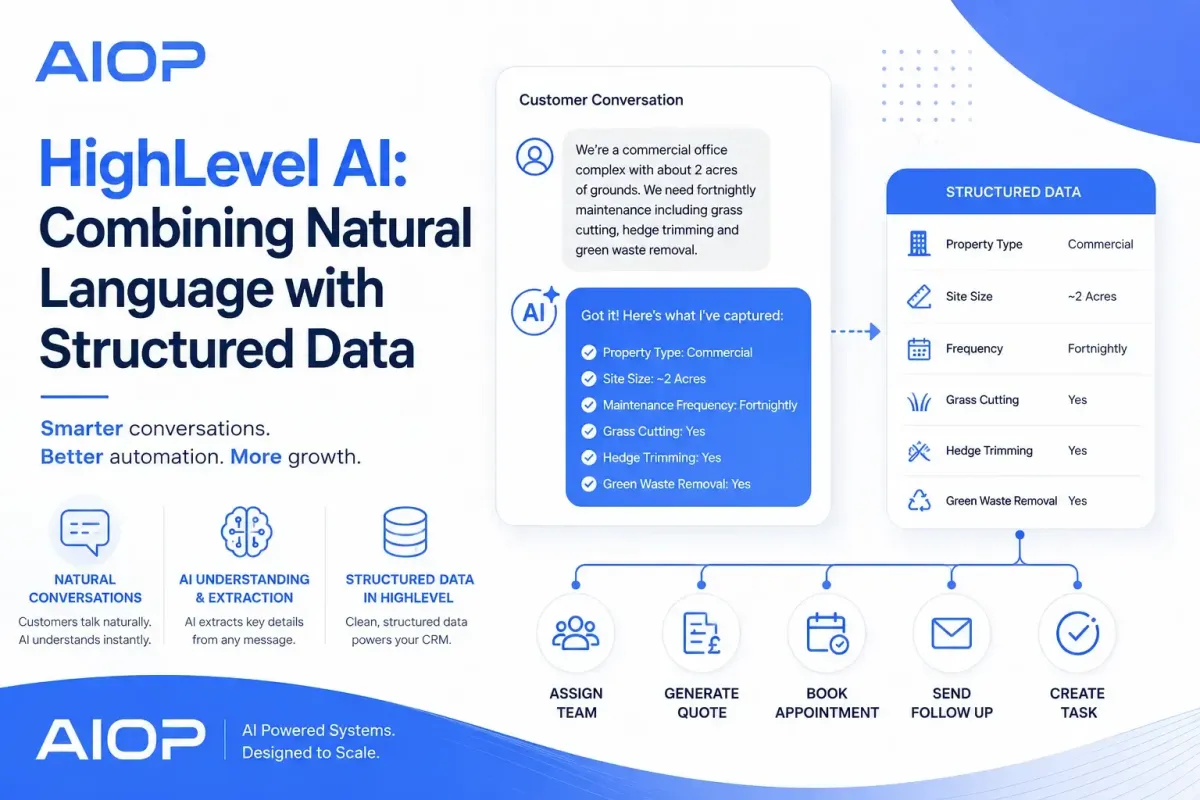
HighLevel AI: Combining Natural Language with Structured Data for Smarter CRM Automation
Artificial intelligence is changing how CRM systems operate, but one of the biggest misconceptions is that AI replaces traditional structured data.
In reality, the opposite is true.
The most effective HighLevel systems combine AI's ability to understand natural language with the reliability of structured CRM data. Together they create automations that are significantly more intelligent, more flexible and far easier for customers to interact with.
Rather than forcing customers into rigid forms and predefined workflows, AI allows businesses to communicate naturally while still producing clean, structured information that powers automation.
The Traditional CRM Approach
Historically, CRM systems have relied almost entirely on structured data.
Customers complete forms.
Dropdown menus provide predefined options.
Radio buttons limit available choices.
Checkboxes record yes or no answers.
Every workflow depends upon information being stored in specific fields.
Imagine a commercial landscaping company providing instant quotations.
Traditionally, their enquiry form might ask:
Property type
Site size
Grassed area
Frequency of maintenance
Hedge cutting required
Weed control required
Green waste removal
Preferred start date
Each answer is stored in its own CRM field.
Workflows then use those values to determine pricing, assign teams and schedule future work.
For example:
If
Property Type = Commercial
AND
Site Size = Medium
AND
Maintenance Frequency = Fortnightly
Then
Generate Commercial Maintenance Package B.
This approach is extremely reliable because every decision is based upon structured information.
The Problem with Structured Data Alone
Although structured data works well for software, customers rarely think in structured fields.
Instead, they describe what they need.
A facilities manager is much more likely to write:
"We're looking for someone to maintain the grounds around our office every two weeks. There are several lawns, some hedges around the car park and we'd like the green waste removed each visit."
To a person, this provides plenty of information.
To a traditional CRM, it is simply a block of text.
Someone must manually read it before creating structured records.
That slows down the sales process and introduces inconsistency.
AI Understands Natural Language
HighLevel's AI changes this completely.
Instead of forcing customers through lengthy forms, AI can understand natural conversations.
From the previous message it can identify:
Customer type = Commercial
Maintenance frequency = Fortnightly
Lawn maintenance = Yes
Hedge cutting = Yes
Green waste removal = Yes
Without asking the customer to complete multiple fields.
The enquiry feels like a conversation rather than an application form.
AI Should Populate CRM Fields
One of the biggest mistakes businesses make is storing AI conversations as unstructured notes.
Instead, AI should convert conversations into structured CRM data.
For example, a customer might say:
"We're a primary school with around 3,000 square metres of grounds. We'd like fortnightly grass cutting, monthly hedge trimming and weed control around the playground."
AI can automatically populate fields such as:
Business Type = School
Site Size = 3,000 m²
Grass Cutting = Yes
Hedge Trimming = Monthly
Weed Control = Yes
Visit Frequency = Fortnightly
The original conversation is still available, but the important information is now stored in a format the CRM understands.
Structured Data Still Powers Automation
Once AI has extracted the information, HighLevel continues using structured workflows.
For example:
Calculate estimated pricing
Assign the enquiry to the commercial sales team
Create maintenance schedules
Allocate the correct service region
Generate proposals
Send follow-up emails
Trigger appointment booking
Create internal tasks
Notify account managers
The automation hasn't changed.
Only the method of collecting the information has.
AI Makes Forms Optional
Many businesses still rely on long enquiry forms because their workflows require structured data.
AI removes that dependency.
Instead of asking customers to complete eight separate questions, the website can simply ask:
"Tell us about the grounds you'd like us to maintain."
Customers naturally describe:
Property type
Approximate size
Required services
Visit frequency
Special requirements
AI extracts the relevant information and updates the CRM automatically.
The experience feels far more natural while producing cleaner data.
AI Can Ask Intelligent Follow-Up Questions
Customers rarely provide every detail immediately.
Rather than rejecting incomplete enquiries, AI can continue the conversation.
Customer:
"I'd like a quote for maintaining our business park."
AI:
"Certainly. Approximately how large is the site?"
Customer:
"Around half an acre."
AI:
"Great. Which services do you require? For example, grass cutting, hedge trimming or weed control?"
Instead of presenting another form, the conversation continues naturally until enough information has been gathered.
Traditional Business Logic Still Matters
AI is excellent at interpreting language.
Business rules, however, should remain deterministic wherever possible.
For example:
If Site Size = Small
Use Pricing Matrix A.
If Site Size = Medium
Use Pricing Matrix B.
If Customer Type = School
Assign Education Sales Team.
If Customer Type = Commercial Estate
Assign Commercial Contracts Team.
These are fixed business decisions.
AI determines what the customer means.
Traditional workflows determine what the business should do next.
Each component performs the task it is best suited to.
Better Customer Experiences
Today's customers increasingly expect conversational experiences.
Instead of navigating complicated forms, they simply explain what they need.
For example:
"We've just taken over a retail park and need regular grounds maintenance."
"Our current contractor has retired."
"We're looking for weekly maintenance during the summer."
HighLevel AI can understand these requests, update the relevant CRM fields and trigger the correct automations without requiring manual data entry.
Customers receive faster responses, while businesses save considerable administrative time.
Better Data Quality
Combining AI with structured CRM fields often produces higher-quality data than traditional forms.
AI can:
Standardise property descriptions
Recognise service names
Correct spelling mistakes
Identify site sizes
Normalise maintenance frequencies
Extract addresses
Detect missing information
Validate postcodes
Rather than depending entirely on customers entering perfect information, AI helps maintain cleaner CRM records.
This improves reporting, automation and long-term data quality.
Designing CRM Systems for the AI Era
Modern CRM systems should not choose between AI and structured data.
The strongest systems combine both.
Natural language becomes the customer interface.
AI interprets conversations.
Structured CRM fields store the important information.
Traditional workflows automate the business processes.
This architecture gives businesses the flexibility of human conversation without sacrificing the reliability of structured automation.
HighLevel AI is not replacing structured data—it is making it easier to collect, more accurate to maintain and significantly more valuable throughout the customer journey.