
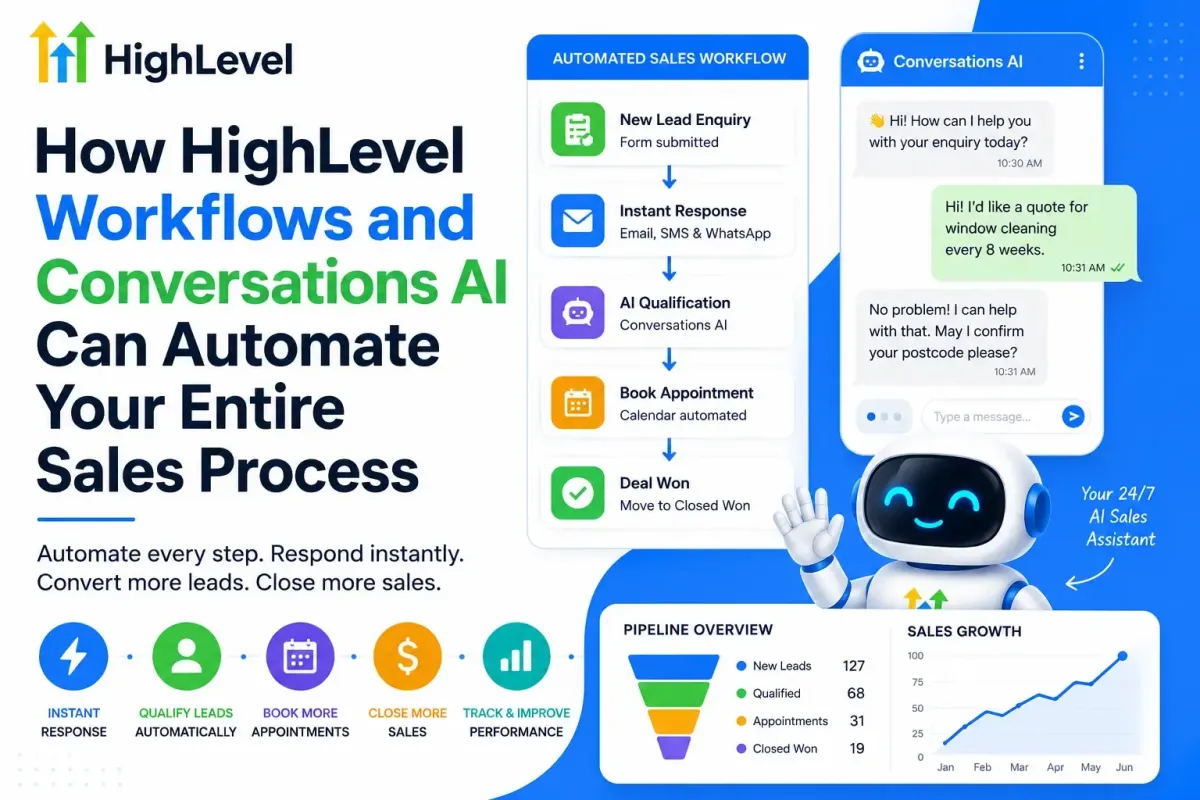
How HighLevel Workflows and Conversations AI Can Automate Your Entire Sales Process
For many businesses, the sales process is still surprisingly manual. New enquiries arrive through forms, Facebook Lead Ads, phone calls, emails and WhatsApp messages before someone has to manually respond, answer questions, qualify the lead, send a quotation, chase the customer, book an appointment and eventually close the sale.
Every manual step introduces delays. Those delays reduce conversion rates.
Modern customers expect immediate responses. Whether they're requesting a quotation for window cleaning, booking a consultation with a solicitor or enquiring about a marketing service, they increasingly expect businesses to reply within minutes rather than hours.
This is where HighLevel stands apart from many traditional CRM systems.
Rather than simply storing customer information, HighLevel combines CRM, workflow automation and AI into a single platform capable of automating much of the sales journey without removing the human element where it matters.
The result is a sales process that is faster, more consistent and considerably more scalable.
The Traditional Sales Process
Most businesses unknowingly follow a process that relies heavily on people remembering to complete the next task.
A typical enquiry might look like this:
Customer submits a form.
Staff receive an email notification.
Someone notices the notification.
The customer receives a response.
Staff answer questions.
Staff qualify the enquiry.
A quotation is prepared.
Follow-up reminders are created.
Someone manually checks whether the customer replied.
More reminders are sent.
The customer eventually books.
There is nothing technically wrong with this process. The problem is consistency.
People become busy.
Messages are overlooked.
Customers reply outside office hours.
Different staff members respond differently.
Follow-ups are forgotten.
Small delays quickly become lost opportunities.
Studies have repeatedly shown that responding to enquiries within the first few minutes dramatically increases the likelihood of conversion compared with waiting even an hour.

HighLevel Takes a Different Approach
HighLevel approaches sales automation from a completely different perspective. Instead of relying on staff to remember every step, the system can perform many of those tasks automatically.
Think of it as having two separate components working together.
The first component is Workflows. These control business logic.
The second component is Conversations AI. This handles natural conversations with customers.
Together, they create an automated sales process that can operate continuously, twenty-four hours a day.
Understanding HighLevel Workflows
A workflow is simply a sequence of actions that occur after a trigger.
For example:
A contact submits a form.
A Facebook Lead Ad is completed.
A quotation is requested.
A pipeline stage changes.
A customer replies.
A tag or custom field changes.
An appointment is booked.
A payment is received.
Once the trigger occurs, HighLevel can automatically perform dozens of actions.
Examples include:
Send an email.
Send an SMS.
Send a WhatsApp message.
Create or update an opportunity.
Move pipeline stages.
Assign a salesperson.
Wait for a period of time.
Check conditions.
Update custom fields.
Add notes.
Create tasks.
Start other workflows.
Stop workflows.
Trigger AI.
Instead of staff clicking through multiple screens, the workflow completes these actions within seconds.
Why This Is More Than Simple Automation
Many automation platforms simply execute actions one after another.
Modern HighLevel workflows behave much more like a decision engine. They continuously evaluate information before deciding what should happen next.
For example, a workflow might ask:
Has the customer replied?
Is this an existing customer?
Have they already booked?
Do they have a valid WhatsApp number?
Which service did they request?
What quotation value was calculated?
Has payment already been received?
Has an employee already responded?
Each answer can send the customer down a completely different path.
Rather than building dozens of separate automations, businesses can create intelligent workflows capable of adapting to each customer.
Conversations AI Becomes the Digital Salesperson
Traditional chatbots relied on predefined scripts. If a customer asked something unexpected, the conversation usually failed.
Conversations AI is considerably more flexible. Instead of matching exact keywords, it understands the customer's intent.
That allows it to answer natural questions such as:
"How much would it cost every eight weeks?"
"Do you clean conservatory roofs?"
"Can you come on Fridays?"
"Do I need to be home?"
"Can I change my appointment?"
Rather than forcing customers through rigid menus, the AI can hold a genuine conversation while still following the business rules defined by the company.
Workflows Decide. AI Communicates.
One of the most powerful concepts within HighLevel is understanding the different responsibilities of Workflows and Conversations AI.
Workflows are responsible for decision-making. Conversations AI is responsible for communication.
For example, imagine someone requests a quotation.
The workflow might:
Calculate the quotation.
Determine which services were selected.
Check whether the customer already exists.
Decide which follow-up sequence should be used.
The AI then takes over the customer interaction.
It can:
Explain the quotation.
Answer common questions.
Collect additional information.
Build confidence.
Guide the customer towards booking.
This separation keeps automation organised.
The workflow controls business logic.
The AI controls the conversation.

Responding Within Seconds
One of the biggest improvements automation provides is response speed. Rather than waiting for a member of staff to become available, HighLevel can respond almost instantly.
For example, A customer completes a quotation form.
Within seconds, HighLevel could:
Create the contact.
Calculate pricing.
Create an opportunity.
Send an email quotation.
Send a personalised WhatsApp message.
Send an SMS if WhatsApp isn't available.
Notify the sales team.
Begin monitoring for replies.
From the customer's perspective, the business appears highly organised and responsive. From the business owner's perspective, almost no manual work has been required.
Personalisation Without Manual Work
Customers respond better to messages that feel personal. HighLevel automatically merges CRM data into every communication. Instead of sending generic messages, workflows can personalise:
Customer name
Company name
Quotation amount
Selected service
Appointment date
Assigned salesperson
Location
Property information
Booking links
This allows businesses to communicate at scale without losing the personal touch customers expect.
Qualifying Leads Automatically
Not every enquiry deserves immediate attention. Some customers are ready to buy. Others are simply gathering information.
HighLevel workflows can automatically qualify leads using almost any available data.
Examples include:
Budget.
Service required.
Property type.
Number of bedrooms.
Geographic location.
Industry.
Company size.
Marketing source.
Existing customer status.
Instead of sales staff spending time identifying suitable prospects, qualified leads can be prioritised automatically. The CRM can even assign different salespeople depending on territory, service or enquiry type.
AI Handles Frequently Asked Questions
One of the biggest drains on sales teams is repeatedly answering the same questions. Businesses often receive identical enquiries every day.
Examples include:
How much does it cost?
What areas do you cover?
How long does it take?
Is there a contract?
Are you insured?
Can I change my booking?
What payment methods do you accept?
Instead of requiring staff intervention every time, Conversations AI can answer these questions instantly using the company's own Knowledge Base.
The answers remain consistent regardless of the time of day, helping customers move towards a buying decision much more quickly.
Conclusion: Building a Faster, Smarter and More Scalable Sales Process
HighLevel Workflows and Conversations AI do not simply automate individual sales tasks. When designed correctly, they create a connected sales system capable of managing the customer journey from the initial enquiry through to qualification, quotation, follow-up and booking.
The distinction between the two technologies is important. Workflows provide the deterministic structure behind the sales process. They calculate prices, evaluate CRM data, update opportunities, assign salespeople, control follow-up sequences and trigger operational actions. Conversations AI provides the flexible communication layer. It understands customer intent, answers questions, collects missing information and guides prospects towards the appropriate next step.
Together, they solve one of the biggest weaknesses in traditional sales processes: the gap between what the business knows and what the customer needs.
A workflow might know that a quotation has been calculated, the contact has a valid WhatsApp number and the opportunity has not yet reached the booking stage. Conversations AI can use that context to explain the quotation, answer an objection and help the customer choose the right service. Any new information collected during the conversation can then be written back to structured CRM fields, allowing the workflows to continue the process automatically.
This creates a continuous feedback loop:
Workflows evaluate structured CRM data.
Conversations AI communicates with the customer.
The AI collects and updates additional information.
Workflows respond to the updated business state.
The customer moves towards the next commercial milestone.
The objective is not to remove salespeople from the process. It is to remove the repetitive administrative work that prevents them from concentrating on the conversations where human judgement, negotiation and relationship-building add the greatest value.
Routine enquiries can receive immediate responses. Frequently asked questions can be answered consistently. Quotations can be delivered within seconds. Follow-ups can continue automatically. Qualified prospects can be prioritised, while complex enquiries and high-value opportunities can be escalated to the appropriate team member.
The result is not merely faster automation. It is a more reliable sales operating model.
Customers receive consistent communication regardless of when they enquire. Sales teams gain cleaner CRM records and clearer priorities. Managers gain greater visibility into where opportunities sit and why they are progressing or becoming stuck. Businesses can handle increasing lead volumes without requiring every additional enquiry to create more manual work.
However, the quality of the outcome depends heavily on the underlying architecture. Conversations AI requires an accurate Knowledge Base, clear objectives and a reliable CRM context. Workflows require structured fields, meaningful pipeline stages, carefully defined triggers and safeguards that prevent duplicated or conflicting actions. Human escalation must also be designed deliberately rather than treated as an afterthought.
When these foundations are in place, HighLevel becomes far more than a database or messaging platform. It becomes an integrated sales operating system that can respond, qualify, calculate, communicate, follow up and book customers continuously.
The most effective approach is therefore not to choose between automation, AI and human salespeople. It is to assign each one the responsibility it performs best.
Workflows manage the logic.. Conversations AI manages the dialogue. Salespeople manage the relationships and decisions that genuinely require human involvement.
By combining all three, businesses can build a sales process that is faster, more personal and considerably more scalable—without sacrificing control, consistency or the human element that ultimately builds customer trust.